

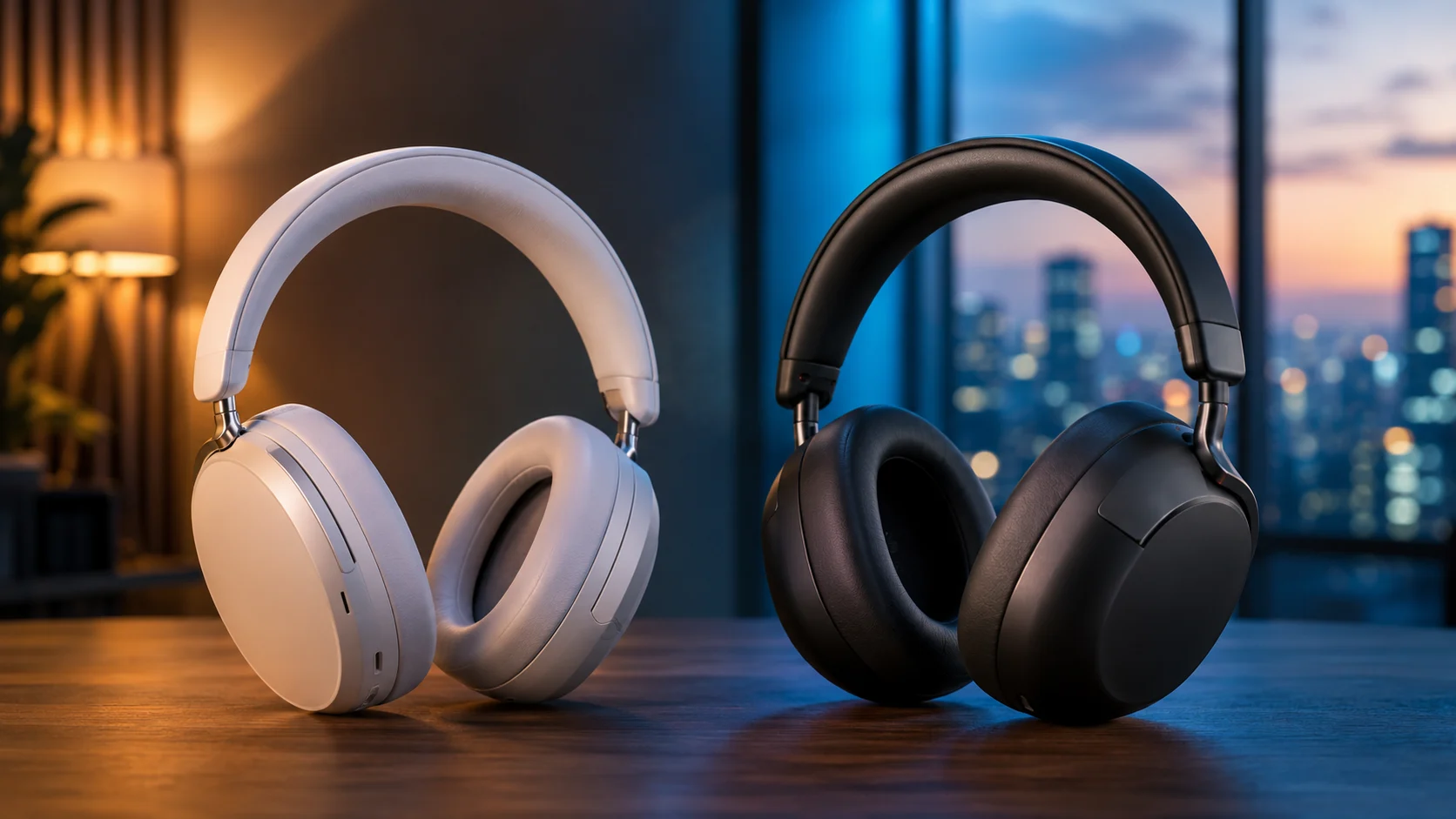
The fight for the best ANC headphones 2026 crown feels less like a normal gadget comparison and more like a clash between two very different ideas of modern listening. On one side, Sonos Ace walks in with a clean design, a home-theater-first personality, and the kind of comfort that makes long listening sessions feel less like a test and more like a lifestyle upgrade. On the other side, Sony WH-1000XM6 arrives with the confidence of a brand that has spent years shaping the noise-canceling conversation, refining every little detail from adaptive sound control to codec support. Both are premium over-ear headphones made for people who want silence on command, strong wireless audio, and smart features that actually matter in daily life. The real question is not just which one blocks more noise, but which one fits the way people listen in 2026, where music, movies, gaming, calls, commuting, and remote work all crash into the same pair of headphones.
That shift matters because headphones are no longer just accessories for music fans. They are tiny private rooms for people who work in noisy cafés, watch shows late at night, edit videos on laptops, take calls between errands, and chase better sound without building a full studio setup. The rise of premium ANC headphones shows how much people now value control over their sound environment, especially when daily life feels louder, faster, and more screen-heavy than ever. Sonos Ace and Sony XM6 both understand that reality, but they approach it from different angles. Sonos wants to make headphones feel like an extension of the living room and the home audio ecosystem, while Sony wants to make them feel like the smartest all-terrain sound tool you can carry anywhere.
Why This ANC Battle Feels Bigger in 2026
The premium headphone market in 2026 is crowded, but Sonos Ace vs Sony XM6 stands out because both products speak to listeners who care about more than just loud bass or flashy specs. These headphones are competing in a category where buyers expect active noise cancellation to be powerful, transparency mode to sound natural, microphones to handle chaotic calls, and comfort to stay solid after hours of wear. That is a difficult balance, because a headphone can be technically impressive but still annoying if the controls feel clumsy, the app is confusing, or the fit creates pressure after one album. This is why the best ANC headphones 2026 conversation has moved beyond one simple question about noise blocking. It is now about the whole experience, from how fast the headphones connect to how they behave when you jump from Spotify to a Zoom call to a late-night movie.
Sonos Ace enters this fight with a strong identity because Sonos already has cultural weight in home audio. The brand is associated with clean living-room sound, wireless speaker ecosystems, and a more polished approach to audio products that blend into modern spaces. That gives Sonos Ace an advantage with listeners who already own a Sonos soundbar or care about a seamless home entertainment setup. Instead of trying to beat Sony only on traditional headphone features, Sonos leans into private cinema, spatial listening, and physical controls that feel straightforward. It is a smart lane, because many people are not just asking for better music playback anymore; they want one pair of headphones that can make a movie at midnight feel immersive without waking the house.
Sony XM6, meanwhile, carries the pressure of legacy. The WH-1000X line has been treated for years as one of the safest recommendations for travelers, office workers, students, and anyone who wants dependable noise cancellation. That reputation creates high expectations because every new model has to feel familiar enough to satisfy loyal fans but advanced enough to justify the upgrade. The XM6 pushes that formula with refined noise control, strong app customization, high-resolution wireless audio support, and smarter performance across different environments. In short, Sony is not trying to reinvent what premium ANC headphones are; it is trying to make the category feel even more mature.
Sonos Ace: The Lifestyle Headphone With Cinema Energy
Sonos Ace is the kind of headphone that makes a first impression before the music even starts. The design feels minimal, polished, and intentionally less techy than many rivals, which helps it fit into the broader modern sound culture where gear is expected to look good on a desk, in a carry bag, or in a mirror selfie. Comfort is one of its biggest weapons, because the fit is designed for people who might wear headphones through a full work session, a long flight, or a movie marathon. The earcups feel spacious enough for extended use, and the overall build gives off a premium vibe without shouting for attention. That matters because in the high-end category, people are paying not only for sound but also for an object they will touch, wear, and notice every day.
The headline feature for Sonos Ace is its connection to the Sonos ecosystem, especially for users with compatible soundbars. The TV Audio Swap concept is simple but genuinely useful: move sound from a Sonos soundbar to the headphones and keep watching privately. For people who live with family, roommates, or neighbors separated by thin walls, this is not a gimmick. It turns the headphones into a late-night cinema tool, and that makes Sonos Ace feel different from most travel-focused ANC rivals. Instead of only asking how it performs on a plane, Sonos asks how it performs when your living room becomes your personal theater.
Sound-wise, Sonos Ace leans toward a balanced and spacious presentation that fits modern streaming habits well. It is not trying to overpower every track with heavy bass, which can be refreshing for listeners who move between pop, alternative, jazz, electronic, acoustic, podcasts, and film soundtracks. The tuning feels designed to be easy to live with, rather than aggressively shaped for instant drama. That approach may not satisfy bassheads who want every kick drum to hit like a club speaker, but it gives Sonos Ace a mature personality. For a site focused on gear reviews, that balance is important because it shows how premium headphones are being judged by long-term listenability, not just quick showroom excitement.
Sony WH-1000XM6: The Refined ANC Veteran
Sony WH-1000XM6 feels like the product of a company that knows exactly what people expect from its flagship noise-canceling line. The XM6 does not need to explain why Sony matters in this space, because the brand has already built trust through multiple generations of strong ANC performance. Instead, this model focuses on sharpening the experience with improved processing, adaptive features, and a sound profile that can be shaped through Sony’s app. It is a headphone made for people who travel, work, listen seriously, and want a feature set that feels deep without becoming impossible to use. That makes the XM6 one of the most obvious contenders for anyone searching for the best noise-canceling headphones in 2026.
The strongest thing about the XM6 is how complete it feels as an everyday tool. Noise cancellation is the star, but Sony also pays attention to ambient mode, call clarity, battery life, portability, and customization. The headphone is designed to adjust across situations, whether the listener is walking through traffic, sitting in an office, riding public transport, or trying to focus at home. Sony’s app ecosystem adds another layer by giving users more control over sound settings, adaptive behavior, and listening preferences. This makes the XM6 feel more flexible than many competitors, especially for people who like to fine-tune rather than accept one default mode forever.
Where Sony really flexes is audio technology. Support for LDAC and Sony’s own processing features gives the XM6 a strong position among listeners who care about higher-quality Bluetooth playback. Of course, codec support alone does not magically make every song sound better, because the source device, streaming service, and recording quality all matter. Still, Sony gives users more room to chase higher fidelity when their setup supports it. That makes the XM6 especially appealing for listeners who switch between casual playlists and more intentional listening sessions where details, dynamics, and clarity matter.
Best ANC Headphones 2026: Noise Canceling Face-Off
When people ask which model deserves the best ANC headphones 2026 title, noise cancellation is usually the first battlefield. Sonos Ace performs at a premium level and does a strong job reducing everyday noise like office chatter, fan hum, traffic rumble, and the messy background sound of public places. It creates a calm bubble without making the user feel completely disconnected from comfort, which is one reason it works well for long sessions. The transparency mode also feels important because modern users do not want to remove their headphones every time someone speaks. A good ANC headphone in 2026 must move between isolation and awareness smoothly, and Sonos clearly understands that.
Sony XM6, however, has the advantage of experience and a reputation built around excellent noise cancellation. The XM6 feels especially strong in unpredictable environments because Sony’s adaptive systems are designed to react to changing surroundings. Low-frequency noise, such as engine rumble or air-conditioning drone, has traditionally been a strength of top Sony models, and the XM6 continues that direction with confidence. It also feels built for people who spend more time outside the home, where a headphone has to manage trains, airports, sidewalks, gyms, offices, and cafés. That broader travel-and-commute identity gives Sony a slight edge for users who judge ANC by how well it survives the chaos of real life.
The difference is not so huge that Sonos Ace feels weak, because it absolutely belongs in the premium tier. Instead, the distinction comes down to priorities. Sonos Ace feels like a beautifully controlled private listening bubble, especially when paired with home entertainment features. Sony XM6 feels like a more tactical noise-canceling machine, built for people who want maximum adaptability across many environments. If the goal is pure ANC dominance in as many situations as possible, Sony still has the stronger argument. If the goal is premium silence plus lifestyle comfort and home-theater magic, Sonos Ace becomes much harder to ignore.
Transparency Mode and Real-World Awareness
Transparency mode has become one of the most underrated parts of modern headphone design. In the past, users mostly cared about blocking the world, but now they want control over how much of the world gets back in. Sonos Ace handles awareness mode in a way that feels natural enough for quick conversations, announcements, and moments when full isolation would be inconvenient. Sony XM6 also performs strongly here, especially because its broader software environment gives users ways to customize how ambient sound behaves. Neither model treats transparency as an afterthought, which shows how far premium ANC headphones have moved from simple noise blockers to smarter everyday companions.
Sound Quality: Clean Balance or Sony Detail?
Sound quality is where personal taste starts to matter more than spec sheets. Sonos Ace has a clean, wide, and controlled sound that fits listeners who want a refined experience without an overly hyped low end. It works nicely for people who stream a lot of different genres and do not want their headphones to make every song feel like the same bass-heavy remix. Vocals come through with enough presence, instruments have room to breathe, and the overall presentation feels polished. For music guides aimed at modern listeners, Sonos Ace is easy to recommend to people who want an elegant everyday sound rather than a technical playground.
Sony XM6 takes a more feature-rich approach, especially because users can shape the sound through app controls and EQ. Out of the box, it aims for a premium mainstream sound that many listeners will enjoy, but the real appeal is the ability to adjust it to personal taste. Someone who wants more low-end weight can push the bass, while someone who wants clearer vocals can tune around the mids and highs. Sony’s processing tools also help make compressed or lower-quality audio feel more polished, which is useful in a world where playlists jump between different eras and production styles. That flexibility makes the XM6 feel like a better choice for listeners who enjoy tweaking their sound profile.
The best way to describe the difference is that Sonos Ace feels curated, while Sony XM6 feels customizable. Sonos gives you a sound identity that is tasteful and easy to trust, especially for long listening and cinematic use. Sony gives you a deeper toolbox and more technical pathways, especially if you care about codec support and app-based control. Neither approach is wrong, but they serve different personalities. The listener who wants simplicity and polish may lean Sonos, while the listener who wants options and performance depth may lean Sony.
Comfort, Controls, and Daily Use
Comfort can decide a headphone battle faster than any spec sheet, because even the most advanced ANC becomes useless if the headphones feel annoying after an hour. Sonos Ace scores highly here because its fit feels intentionally relaxed and premium, with a design that avoids feeling bulky or overly aggressive. The physical controls also help because they give users a more predictable way to adjust volume, pause music, or switch modes without guessing where to swipe. In daily use, that kind of tactile confidence matters more than people expect. When someone is walking, cooking, working, or half-paying attention during a commute, reliable controls can make the whole product feel calmer.
Sony XM6 is comfortable too, but its experience leans more tech-forward. The controls and app features feel familiar to anyone who has used recent Sony headphones, and the overall design is built for portability and long listening. Sony has refined the shape and weight enough to keep the XM6 competitive, especially for travel and work routines. Still, some users may prefer physical buttons over touch controls because they are easier to use without thinking. This is one of those details that sounds small in a review but becomes very real after weeks of use.
Battery life is strong on both sides, with enough endurance for long days, flights, work sessions, and casual listening without constant charging anxiety. That means battery probably should not be the main reason to choose one over the other unless someone has a very specific routine. Fast charging, USB-C convenience, and reliable standby behavior matter more in the day-to-day experience. Both headphones understand that premium users expect their gear to disappear into the background until needed. The winner here depends less on raw hours and more on how naturally each model fits into a person’s rhythm.
Calls, Gaming, and the Hybrid Listening Era
Modern headphones live in a hybrid world, and that changes how Sonos Ace and Sony XM6 should be judged. A pair of premium headphones can no longer be excellent only for music and average everywhere else. People use the same headset for work calls, voice notes, gaming sessions, video streaming, short-form content, and late-night movies. That means microphone performance, latency, connection stability, and multipoint behavior all matter. In this wider lifestyle context, the best ANC headphones 2026 are the ones that handle mixed use without making the listener constantly switch devices.
Sony XM6 has a strong argument for versatility because Sony continues to improve voice pickup and software features around communication. The headphone is built for people who move between laptop calls and phone audio throughout the day. Recent low-latency improvements also make the XM6 more interesting for gaming and multimedia, especially as Bluetooth audio keeps evolving beyond basic music streaming. It still will not replace a dedicated gaming headset for every competitive player, but it is becoming more realistic as a one-headphone solution for casual gaming and video. That matters because younger users often expect premium headphones to be flexible, not single-purpose.
Sonos Ace has its own hybrid advantage through home entertainment. The TV Audio Swap feature gives it a use case that Sony cannot copy in the same ecosystem-specific way. For movie lovers, apartment dwellers, parents, or anyone who watches content late, that private cinema function can be the reason to choose Sonos even if Sony wins some technical categories. Spatial audio and head tracking also make sense when the content supports it and the user actually wants immersion. In other words, Sony may be the stronger all-around portable tech tool, but Sonos has a sharper identity for the living-room listener.
Modern Sound Culture Is Changing the Winner
The Sonos Ace vs Sony XM6 debate says a lot about where sound culture is heading in 2026. Listeners are not separating music, movies, work, and gaming as cleanly as they used to. One person might listen to a new indie album in the morning, join a client call at noon, watch a concert documentary at night, and scroll through short video edits before bed. That messy behavior forces headphone brands to build products that can survive multiple identities. It also explains why the premium ANC category feels more emotional than before, because headphones now shape how people create private space inside very public lives.
Sonos represents the lifestyle side of that change. It understands that sound is part of home design, personal comfort, and entertainment rituals. The Ace does not feel like a lab instrument, and that is part of its charm. It feels like something made for people who want technology to be useful without looking or behaving like a complicated gadget. That design language makes sense in an era where audio gear has to blend with fashion, furniture, remote work, and streaming culture.
Sony represents the performance heritage side. It knows that many listeners still want the smartest features, stronger customization, and proven noise-canceling muscle. The XM6 feels like a product for users who want confidence in airports, trains, open offices, and unpredictable environments. It is less about fitting into the home and more about mastering the outside world. That gives Sony a cultural role as the practical premium choice for people who want their headphones to do almost everything well.
Which One Should You Buy?
Choosing between Sonos Ace and Sony XM6 starts with being honest about where you listen most. If your headphones spend a lot of time at home and you already live inside the Sonos ecosystem, Sonos Ace makes a lot of sense. The combination of comfort, premium design, balanced sound, and private TV listening gives it a personality that feels different from the usual ANC race. It is especially strong for people who want headphones that handle music beautifully but also make movies and shows feel more immersive. For those users, Sonos Ace is not just a headphone; it is a lifestyle extension of the living room.
If your headphones need to survive commuting, flying, office noise, calls, playlists, app customization, and occasional gaming, Sony XM6 is probably the safer pick. It has the maturity of a flagship line that has been refined across years of user feedback. The ANC is highly competitive, the sound can be shaped more deeply, and the feature set feels ready for nearly every daily situation. Sony also makes more sense for users who care about high-resolution Bluetooth options and deeper control over listening settings. It may not have Sonos’s home-theater trick, but it feels more complete as a portable all-rounder.
There is also a personality difference that buyers should not ignore. Sonos Ace is for the listener who wants premium calm, clean design, and a more cinematic home experience. Sony XM6 is for the listener who wants stronger adaptability, smarter controls, and a proven travel-ready reputation. Both can be excellent, but they are not trying to win the same way. That is why the smartest choice depends less on which brand is louder online and more on which listening life matches yours.
Final Verdict: Who Is the New ANC King?
In the battle for the best ANC headphones 2026, Sony WH-1000XM6 still has the stronger claim to the overall crown. It offers the more complete package for most people, especially those who need premium noise cancellation across travel, work, commuting, calls, and everyday listening. Sony’s experience in this category shows through the XM6’s polish, flexibility, and performance depth. It is the headphone that feels ready for almost any situation, and that matters in a world where people expect one device to cover half their audio life. For pure all-around ANC leadership, Sony remains extremely hard to beat.
But Sonos Ace is not a loser in this story, and calling it one would miss what makes it interesting. It is arguably the more stylish and emotionally distinct headphone, especially for people who value comfort, design, and home entertainment. Its TV Audio Swap feature gives it a reason to exist beyond copying Sony, Bose, or Apple, and that is important in a category where many products feel similar from a distance. Sonos Ace may not dethrone Sony for every listener, but it absolutely changes the conversation. It proves that the future of ANC headphones is not only about blocking noise; it is about creating better personal sound spaces wherever people actually live, work, and relax.
So the final answer depends on how you define “king.” If the king is the headphone with the strongest all-around performance, smarter travel identity, and deeper customization, Sony XM6 wears the crown. If the king is the headphone that makes premium listening feel more cinematic, relaxed, and connected to the modern home, Sonos Ace has a serious case. For most buyers, Sony XM6 is the safer flagship recommendation, while Sonos Ace is the cooler lifestyle pick for the right setup. Either way, the Sonos Ace vs Sony XM6 battle shows that premium ANC in 2026 is no longer just about silence; it is about owning your sound world with style, control, and purpose.