

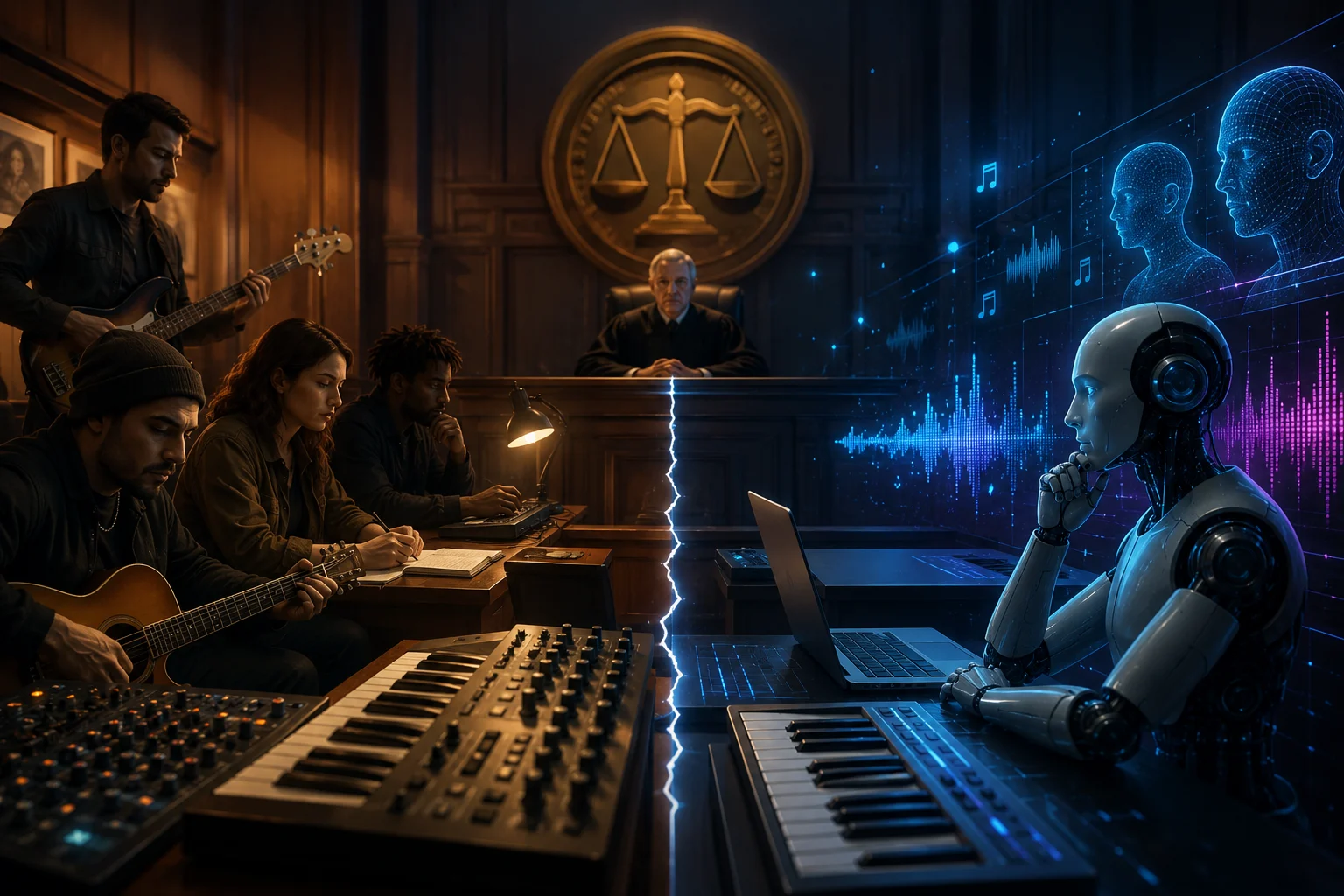
The fight around Suno is no longer just another tech-versus-art drama floating through the internet. It has become a defining test for AI music licensing, a phrase that used to sound like niche legal language and now sits right in the middle of modern music culture. What started as a wave of prompt-based song generators has turned into a bigger question about ownership, consent, training data, and the future value of recorded sound. For artists, producers, labels, publishers, and even casual listeners, the issue is not only whether AI can make convincing songs, because everyone can already hear that it can. The real question is whether the music industry can build a fair system before the technology rewires the market faster than the rules can catch up.
Suno sits at the center of that question because it represents both the dream and the panic of generative music. On one side, the platform makes music creation feel instant, playful, and weirdly addictive, letting users turn a short idea into a full song with vocals, arrangement, texture, and genre flavor. On the other side, its rise has triggered a massive licensing debate because the sound of AI music does not appear out of thin air. It is built from patterns, styles, structures, and sonic fingerprints learned from existing recordings, and that is where the cultural tension begins. The result is a courtroom-level battle that feels less like a single lawsuit and more like a stress test for the entire future of music rights.
Why Suno Became the Face of the AI Music Fight
Suno became a lightning rod because it arrived with the kind of product experience that turns legal theory into everyday behavior. Instead of asking people to understand complex audio models, it gave them a simple box, a prompt, and a song that sounded finished enough to share. That simplicity is exactly what made the platform exciting for beginners, meme creators, content makers, and people who always wanted to make music but never learned an instrument or digital audio workstation. Yet the same simplicity also made professional musicians uneasy, because it compressed years of practice, production taste, genre knowledge, and vocal performance into a few typed words. When a tool can generate songs at scale, the industry has to ask whether it is empowering new creators or quietly extracting value from the work of existing ones.
The conflict is deeper than whether AI music sounds “good” or “bad,” because taste is not the main legal issue. Plenty of AI-generated songs sound generic, but some can land close enough to recognizable musical territory that artists and labels start asking hard questions. If a model is trained on massive libraries of sound recordings, should those recordings be licensed first, just like samples, interpolations, and sync uses often require permission? If the output does not copy a song directly but clearly reflects the learned DNA of commercial recordings, is that inspiration, transformation, or exploitation? These questions are messy, and that mess is why Suno has become such an important case study for AI music licensing.
For Chordpunch readers, this matters because music technology has always moved through tension. The drum machine was once treated like a threat, Auto-Tune was mocked before becoming a vocal language, and bedroom production changed the power balance between studios and independent artists. But generative AI is different because it does not merely offer a new tool inside a human workflow. It can simulate the outcome of the workflow itself, from songwriting mood to vocal energy to genre arrangement. That shift makes the Suno fight feel bigger than a gear trend, because it asks whether modern music culture still knows how to separate assistance from replacement.
AI Music Licensing Is Now the Industry’s Main Stage
AI music licensing has become the phrase everyone is forced to deal with because the old music rights system was not built for machines that learn from catalogs at scale. Traditional licensing usually deals with defined uses, such as sampling a drum break, covering a song, placing a track in a commercial, or distributing a recording through a platform. AI training creates a more abstract problem because it may involve copying, analyzing, and learning from huge volumes of audio without producing a one-to-one replica. That makes it difficult to apply old rules cleanly, even when the moral argument feels obvious to many musicians. If human-created recordings help power a commercial AI system, artists and rightsholders want a say in how that value is used.
The industry is also worried about scale, because AI does not behave like a normal creator with limited time, budget, and energy. A human producer might spend a week building a track, while a prompt-based system can generate endless variations in minutes. That changes the economics of background music, playlist filler, social media audio, demo production, and low-budget sync work. If AI music floods platforms without clear labeling or licensing, listeners may not know what they are hearing, and human creators may find themselves competing against systems trained on the wider history of recorded music. This is why music rights in the AI era are not only about compensation, but also about transparency and market trust.
The biggest tension is that AI companies often frame training as a technical necessity, while musicians frame it as a creative debt. From the tech side, a model needs data to become useful, and large datasets are treated as the raw material of innovation. From the music side, those datasets are not neutral data piles; they are performances, mixes, master recordings, studio decisions, emotional labor, and cultural memory. The gap between those two views is massive, and courts are now being asked to translate that gap into legal language. Until that happens, AI music licensing will remain one of the loudest unresolved debates in music tech.
The Training Data Question Behind the Noise
The training data question is the core of the Suno battle because it decides whether AI music generation is built on permission or assumption. If copyrighted recordings were used to train a model without authorization, rightsholders argue that the model’s commercial value is connected to unauthorized use. AI companies may argue that training is transformative, that outputs are not direct copies, or that machine learning should be treated differently from traditional duplication. But musicians tend to hear the issue in a more personal way, because their recordings are not just files on a server. They are the final form of artistic choices made by people who expected those works to be heard, sold, streamed, licensed, or sampled under recognizable rules.
The problem becomes even more complicated when outputs sound familiar without being identical. A generated track might carry the mood of a 2000s pop-rock chorus, the bounce of a modern trap hi-hat pattern, the vocal texture of an indie ballad, or the glossy shape of a radio-ready country hook. None of those elements alone may be easy to protect, because style itself has always been shared, borrowed, and evolved across music history. Yet when an AI system can reproduce style at industrial speed, the line between influence and imitation starts to blur. This is where the law feels slow, because culture can recognize a vibe faster than a court can define it.
For producers and gearheads, the training question also changes how we think about tools. A guitar pedal does not know Jimi Hendrix; it only shapes your signal after you play it. A synth preset may reference a genre, but it still needs someone to sequence, perform, arrange, and mix with intention. A generative music platform, however, can absorb enough musical structure to produce a finished performance-like result from a prompt. That is why the debate belongs naturally in music tech culture, because it is not just about lawyers fighting over catalogs; it is about what we now consider a tool, a collaborator, a shortcut, or a competitor.
Why “It Sounds Like” Is Hard to Regulate
Music has always lived through resemblance, and that makes AI disputes uniquely difficult. Blues, punk, house, hip-hop, metal, reggaeton, and bedroom pop all grew through patterns that artists borrowed, flipped, distorted, and reimagined. If every shared groove or vocal mood were locked down, music would become impossible to make. At the same time, the music economy already recognizes that certain uses cross a line, especially when a recording, melody, lyric, or distinctive performance is copied too closely. AI puts pressure on that balance because it can generate familiar-sounding music without the obvious trail of a human producer dragging a sample into a timeline.
This is why the Suno fight feels so important for future rules. Courts and industry negotiators may need to distinguish between training inputs, generated outputs, user prompts, commercial use, and platform responsibility. A casual user making a joke song for friends is not the same as a company monetizing a model at scale. A track that vaguely resembles a genre is not the same as one that mimics an artist’s voice, song structure, or recognizable recording traits. The future of AI-generated music rights may depend on building a framework that can separate harmless experimentation from market-impacting imitation.
Why Artists Feel the Stakes First
Artists feel the stakes first because they already live in a music economy that can be brutal even without AI. Streaming payouts are thin for many musicians, touring costs keep rising, attention is fragmented, and social platforms demand constant content. In that environment, the arrival of AI-generated tracks can feel less like a fun new toy and more like another pressure point on a system that already undervalues creative work. If background playlists, ad jingles, demo vocals, mood tracks, and production music can be generated instantly, some income streams may shrink before new ones appear. That fear is not anti-technology; it is a realistic response from people who know how fragile music careers can be.
There is also an emotional layer that gets ignored when the debate becomes too technical. Musicians do not only care about money, even though payment matters. They care about identity, authorship, tone, imperfections, and the small human decisions that make a recording feel alive. When a model can generate music that resembles the language of human creativity without sharing the lived experience behind it, some artists feel copied even when no single song is directly duplicated. That feeling may not always map perfectly onto copyright law, but it is powerful enough to shape public opinion around AI music licensing.
At the same time, many artists are not rejecting AI entirely. Some producers already use AI for stem separation, mastering suggestions, lyric brainstorming, sound design, sample search, and workflow cleanup. The difference is that those uses tend to support a human-led process rather than replace the creative center. The backlash grows when AI platforms appear to skip the consent conversation while building products that compete with the people whose work may have helped train them. This is why a future licensing model cannot simply be a legal patch; it has to feel culturally legitimate to the people making the music.
What Labels Want From the Suno Battle
Major labels have their own motivations, and they are not identical to the motivations of every artist. Labels control valuable catalogs, and they understand that those catalogs are training gold for AI music systems. Their goal is likely not to stop all AI music forever, because the industry usually finds a way to monetize new technology once it becomes unavoidable. Instead, labels want leverage, licensing fees, control, attribution standards, and possibly a seat at the table when AI music products become mainstream. In other words, the fight is not only about whether AI music should exist; it is about who gets paid when it does.
This is where the business logic becomes clear. If AI platforms need licensed recordings to train better models, labels can turn catalogs into infrastructure for the next music economy. That could lead to licensing deals where AI companies pay for training access, output restrictions, artist opt-outs, revenue sharing, or branded AI creation tools. It could also create new divisions between artists whose catalogs are included in AI deals and artists who want nothing to do with them. The danger is that the industry could solve the label problem while leaving smaller musicians, session players, producers, and independent creators with less power in the negotiation.
A fair AI music licensing system would need to think beyond the major-label catalog level. It would need to consider independent recordings, sample libraries, vocal datasets, songwriting contributions, production credits, and performer rights. It would also need to answer whether creators can opt out of training, whether old contracts cover AI uses, and whether new contracts should include specific machine-learning clauses. These details may sound dry, but they will shape who benefits from AI music and who gets pushed aside. The Suno fight matters because it could set the tone for those negotiations before the market fully hardens.
The Listener Problem Nobody Can Ignore
Listeners are often treated like background characters in the AI music debate, but they may decide how fast the market changes. If people do not care whether a song is human-made or AI-generated, platforms may have less incentive to separate the two clearly. If listeners demand labels, credits, and transparency, the industry may move faster toward disclosure standards. The challenge is that many casual listeners judge songs by mood, convenience, and playlist fit, not by production ethics. That creates a strange future where AI music could become common in low-attention listening spaces before the average listener understands how it was made.
This does not mean listeners are careless. It means modern listening habits have been shaped by algorithmic feeds, passive playlists, short-form video, and background audio environments. Many people hear music while working, scrolling, studying, gaming, shopping, or watching clips, and they may never check the artist name. AI-generated music fits easily into that environment because it can be built for mood and volume rather than identity. But music culture has always needed more than frictionless sound, and the most meaningful fan relationships still come from story, personality, performance, and trust.
Transparency could become one of the most important parts of future music licensing for AI platforms. If a song is fully AI-generated, listeners should know. If a track uses licensed artist data, that relationship should be clear. If a human producer uses AI as one part of a larger creative process, the industry may need more nuanced credits rather than a simple AI-or-not label. The listener problem is not just about warning people; it is about preserving the connection between sound and authorship in a culture where machines can now imitate the surface of creativity.
How AI Music Could Change Gear Culture
Chordpunch lives in the space where music tools, taste, and culture overlap, and that makes the Suno fight especially relevant. Gear culture has always been about chasing a sound, whether through a specific amp, plugin, microphone, interface, synth, sampler, or pedal chain. AI music shifts the chase from “how do I create this tone?” to “can I prompt this result?” That is a massive change because the journey has always been part of the identity. Learning why a compressor breathes a certain way or why a fuzz pedal reacts differently to single-coils is part of how musicians develop taste.
Generative music tools may not destroy gear culture, but they could split it into two lanes. One lane will focus on fast outputs, where creators need background tracks, drafts, social audio, or concept demos with minimal friction. The other lane will become even more human-centered, where people value performance, process, physical instruments, studio craft, and the story behind the sound. In that second lane, gear may actually become more meaningful because it proves that a person made choices in real time. The more AI fills the internet with polished-but-empty music, the more listeners may crave tracks with fingerprints, mistakes, and risk.
This is why the best future is not necessarily anti-AI. A smart future would allow AI to help with boring tasks, rough sketches, accessibility, and experimentation while still protecting the rights and dignity of human creators. Producers could use AI to generate arrangement ideas, test genre directions, or create temporary placeholders without pretending the machine is a full substitute for authorship. But that future only works if the training and licensing side is handled responsibly. Without trust, even useful AI tools will be viewed through suspicion, and the whole category will carry the weight of unresolved exploitation.
The Streaming Flood and the Value of Human Taste
One of the biggest fears around AI music is not that every generated song will be amazing. The bigger fear is that millions of mediocre tracks can be uploaded, tagged, optimized, and pushed into the same attention economy as human music. Streaming platforms already struggle with fraud, fake artists, playlist manipulation, and low-effort catalog flooding. AI makes those problems cheaper and faster because it can generate endless mood tracks without a studio, band, vocalist, or meaningful creative process. If platforms cannot manage that flood, discovery may become even harder for real artists.
This is where human taste becomes more valuable, not less. When everyone can generate a song, the rare skill becomes knowing what should exist, what should be deleted, what has emotional weight, and what actually connects. Taste is not only about technical polish; it is about timing, restraint, cultural awareness, and the ability to make something feel necessary. AI can imitate patterns, but it does not care whether a chorus arrives like a confession or whether a guitar part leaves enough space for the lyric to breathe. That difference may become the new premium layer in music culture.
The Suno fight highlights this because licensing is ultimately connected to value. If recorded music has value as training material, then the people behind that music deserve recognition and compensation. If human taste is what makes certain recordings worth training on in the first place, the industry cannot treat those recordings as free fuel. A healthy AI music licensing system should not only prevent copying; it should acknowledge that today’s AI tools are standing on decades of human-made sound. Without that acknowledgment, the technology may grow quickly but lose the cultural trust it needs to last.
What a Fair Licensing Model Might Look Like
A fair licensing model for AI music will probably not be one simple contract. It may need several layers, because training, generation, distribution, and monetization are different activities. Training licenses could allow AI companies to use certain catalogs under clear terms, while output rules could prevent direct imitation of protected artists or recordings. Revenue-sharing systems could distribute money when AI products profit from licensed datasets, though the details would be difficult to design fairly. Opt-out or opt-in systems could give artists more control, especially when their voices, recordings, or styles are involved.
There is also a strong case for better metadata. If AI-generated songs enter streaming platforms, they should carry clear information about how they were made, what tools were used, and whether any licensed datasets or artist-approved models were involved. That metadata would help platforms label tracks, pay royalties correctly, filter spam, and give listeners more transparency. It would also help human creators prove the difference between original recordings, AI-assisted works, and fully generated outputs. In a world where audio can be produced instantly, metadata may become as important as the master file itself.
The hard part is making a system that does not only benefit the biggest companies. If AI licensing becomes a private deal between major labels and tech platforms, independent creators could be left outside the money flow while still competing against AI-generated content. A better model would include independent distributors, artist unions, publishers, producers, session musicians, and smaller rightsholders in the conversation. It would also need global thinking, because music does not stay inside one country’s legal system once it hits the internet. The Suno dispute may be centered in a specific legal context, but the consequences will travel across the entire music economy.
Why the Suno Case Is Bigger Than Suno
The Suno case is bigger than Suno because every generative music platform is watching the outcome. If courts decide that unlicensed training on copyrighted recordings creates serious liability, AI companies may rush toward licensing deals, cleaner datasets, or more limited models. If courts give broad protection to training practices, music companies may shift their strategy toward platform rules, legislation, public pressure, and private negotiations. Either way, the decision will shape how future AI music products are built, marketed, and monetized. This is why the case feels like a trial run for the next decade of music technology.
The fight also matters because it could influence how musicians think about releasing work online. If every public track can potentially become training material, creators may become more cautious, more protective, or more aggressive about rights management. Some may embrace licensed AI partnerships as a new revenue stream, while others may reject them completely. New artists might even negotiate AI restrictions into their contracts from the beginning, treating machine learning rights as a standard part of music business literacy. That would mark a major shift from the old days when artists mainly worried about masters, publishing, sync, and touring income.
There is a cultural lesson here too. Music technology moves fastest when people trust the tools, and trust comes from consent, credit, and clear rules. Sampling became a core part of modern music, but it also developed a licensing culture, even if that culture remains imperfect and expensive. Streaming became dominant, but it still faces criticism because many artists feel the payout model is unfair. AI music is now entering the same kind of legitimacy test, and AI music licensing is the center of that test.
The Future of AI Music Licensing and Creativity
The future of AI music licensing will likely be messy before it becomes stable. There will be lawsuits, settlements, platform policy changes, artist protests, experimental deals, and probably a few strange products that disappear as quickly as they arrive. Some AI music companies will try to build cleaner systems with licensed data, while others may push the boundaries until courts or regulators force a change. Musicians will keep experimenting, because creative people usually test new tools even when they distrust the companies behind them. The real question is whether the industry can build rules that reward experimentation without normalizing extraction.
For everyday creators, the smartest approach is to stay curious but cautious. AI can be useful for ideation, practice, arrangement references, and quick drafts, but releasing AI-generated music commercially without understanding rights can create problems. Artists should pay attention to platform terms, copyright claims, voice imitation risks, and whether their own work is being used in ways they never approved. Producers should also think about how much human authorship they bring to a track, because that may matter for ownership and long-term value. The more powerful the tools become, the more important it is to understand the rules around them.
Listeners, meanwhile, may need to become more intentional about what they support. If fans care about human-made music, they can follow artists directly, buy merch, attend shows, purchase music, and pay attention to credits. If they enjoy AI music, they can still ask whether it was made with consent and transparency. The future does not have to be a boring war between humans and machines, but it does need honesty. Without honesty, the market becomes a blur where nobody knows who made what, who got paid, or whose work quietly powered the system.
Conclusion: Suno Is the Warning Shot
Suno’s legal fight has become a warning shot for the entire music world because it forces everyone to confront the same uncomfortable truth. Generative AI music is not a distant concept anymore; it is already here, already usable, already controversial, and already changing how people think about creation. The technology can open doors for people who never had access to studios, instruments, or production skills, but it can also weaken the value of the artists whose work made modern music culture possible. That tension is why AI music licensing matters so much right now. It is the bridge between innovation and consent, and without that bridge, the future of music risks sounding impressive while feeling hollow.
The best outcome would not be a world where AI music disappears, because that is unlikely and probably unrealistic. The better outcome would be a world where AI tools are built on licensed material, artists have meaningful control, listeners get transparency, and human creativity remains the center of the culture. Suno may be the name in the spotlight today, but the real trial is much bigger than one company. It is a trial of whether the music industry can learn from past technology shifts before the damage becomes permanent. If the industry gets AI music licensing right, AI could become another tool in the creative ecosystem; if it gets it wrong, the next era of music may be louder, faster, and far less fair.