
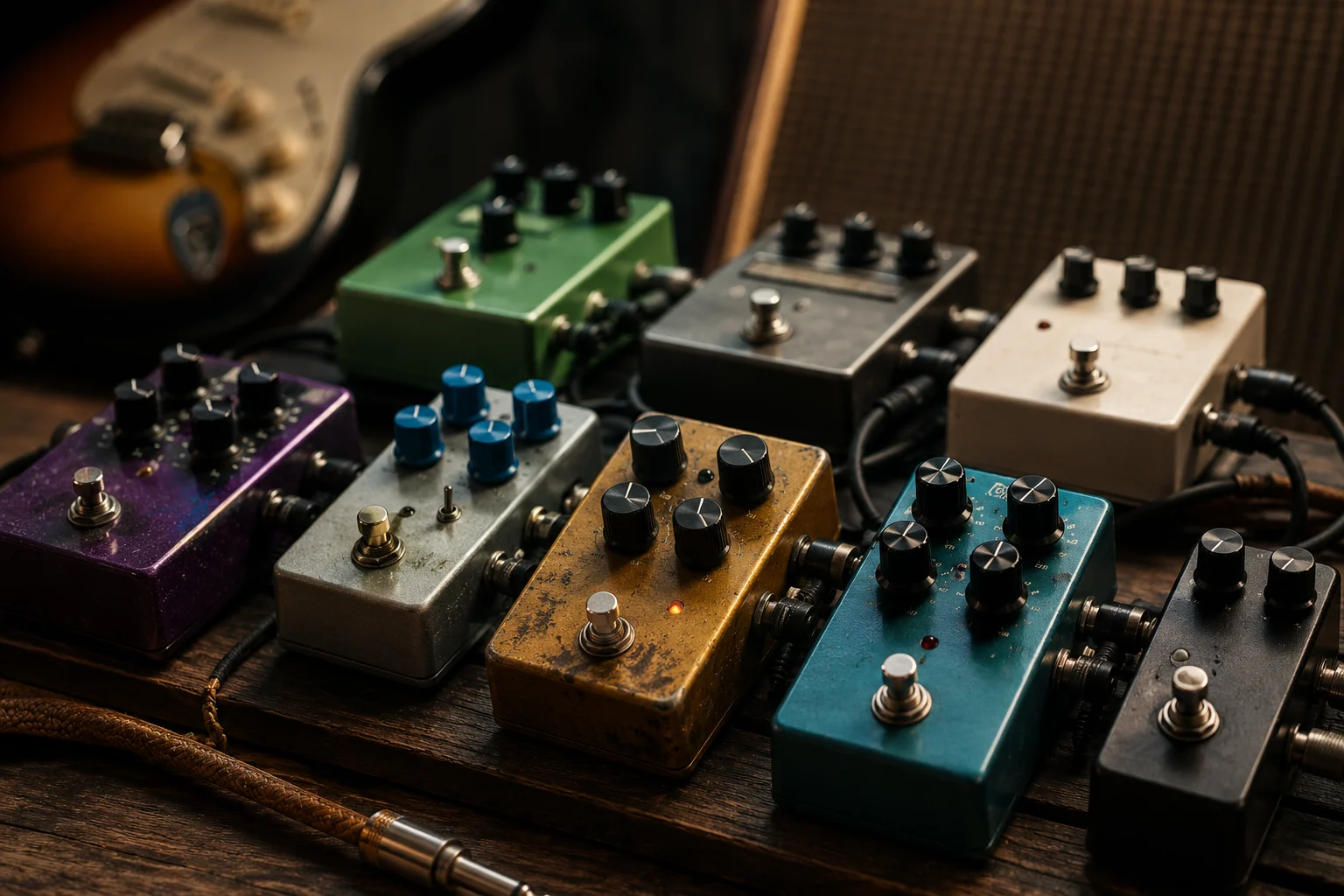
The strange thing about boutique guitar pedals is that they never really disappeared; they just waited for the rest of guitar culture to circle back around. For a while, the conversation seemed locked on amp modelers, plugins, compact multi-effects units, and rigs that could fit inside a backpack without sacrificing arena-ready tones. Yet in 2026, guitarists are once again staring at handmade overdrives, weird fuzz boxes, analog delays, and limited-run stompboxes like they are secret keys to a more personal sound. The comeback is not only about nostalgia, because modern players are not simply trying to rebuild the pedalboards of the past. It is about control, character, collectability, and the feeling that a small box on the floor can still change the way a riff behaves under your fingers.
That renewed hunger says a lot about where guitar culture is right now. Players have more digital power than ever, but abundance can make tone feel strangely weightless when every amp, cabinet, mic, and effect is one menu away. A boutique pedal does the opposite: it asks you to commit to a circuit, a knob sweep, a texture, and a physical relationship with sound. It makes you listen harder because there are limits, and those limits can turn into personality. For Chordpunch readers who care about modern guitar gear, this boutique pedal wave is one of the clearest signs that tactile music-making still matters in an increasingly virtual era.
Why Boutique Guitar Pedals Feel Fresh Again
The phrase boutique guitar pedals used to sound like a niche obsession, something reserved for forum veterans, session guitarists, and players who knew the difference between two nearly identical clipping diodes. Today, the phrase has moved into a wider conversation because guitarists are treating pedals as creative tools rather than simple accessories. A drive pedal is no longer just a way to make an amp louder; it can shape pick attack, change the emotional weight of a chord, or make a clean part feel expensive without sounding polished to death. The same thing is happening with fuzz, modulation, delay, and reverb, where players are searching for devices that react differently from the default presets everyone else is using. This desire for individuality is the emotional engine behind the comeback.
There is also a practical reason players keep coming back to stompboxes. Pedals are immediate, easy to understand, and surprisingly flexible when combined with amps, interfaces, modelers, and recording setups. A guitarist can use a boutique overdrive in front of a tube amp at rehearsal, then place the same pedal before an audio interface at home, then run it into a digital amp profile for a late-night demo. That kind of portability makes a pedal feel less like old gear and more like a creative anchor across different workflows. In a world where musicians constantly jump between bedrooms, studios, stages, and livestream setups, reliable physical tools become even more valuable.
The return of boutique pedals also connects to the way younger guitarists discover tone now. A player might hear a textured indie riff on TikTok, watch a pedalboard breakdown on YouTube, then scroll through used listings before they even learn the full discography behind that sound. This creates a faster, more visual, more community-driven tone culture where gear is not hidden behind studio doors anymore. Boutique builders benefit from that environment because their pedals often have bold artwork, strong identities, and stories that travel well online. A striking enclosure can catch attention, but the circuit has to deliver once the player plugs in, and that is where the best builders separate hype from lasting value.
The Human Factor Behind the Boutique Boom
One reason boutique guitar pedals keep winning is that they feel human in a way many modern tools do not. Players know there is a builder, designer, or tiny team behind the pedal, making choices that are sometimes irrational in the best possible way. A larger company might optimize for scale, consistency, and broad appeal, while a boutique builder might chase a very specific midrange bite, a strange decay trail, or a fuzz texture that seems almost broken until it sits perfectly in a mix. That sense of intention matters because musicians are often trying to make emotional decisions, not spreadsheet decisions. When a pedal feels like someone cared too much about a tiny sonic detail, guitarists tend to notice.
This human factor also helps explain why boutique gear creates loyalty. A guitarist might buy a pedal because of one demo, but they keep it because it becomes part of their playing language. The way a transparent overdrive cleans up with the volume knob, the way a compressor holds a country lick together, or the way a chaotic fuzz punishes lazy picking can subtly train a player over time. The pedal becomes less of an object and more of a collaborator. That relationship is difficult for purely digital systems to replace, even when digital systems sound excellent.
There is a cultural layer here too. In an era when so much music is created through screens, boutique pedals offer a little resistance against frictionless production. They bring back knobs, switches, patch cables, Velcro, power supplies, and the mild chaos of building a board that reflects your taste. That does not mean analog is automatically better, because plenty of digital pedals and modelers are brilliant. It simply means that physical interaction can spark ideas differently. Sometimes turning one knob with your hand is faster, more inspiring, and more memorable than scrolling through a hundred technically perfect presets.
How Classic Circuits Became Modern Status Symbols
The boutique pedal story cannot be separated from classic circuits. Many of the most desired pedals are inspired by older designs: transparent overdrives, Bluesbreaker-style drives, Tube Screamer variations, vintage fuzz circuits, tape-flavored delays, optical compressors, and modulation effects with roots in the 1960s and 1970s. On paper, that might sound repetitive, but guitar culture has always been about small differences that feel huge under the fingers. A slight change in headroom, EQ curve, clipping response, or output level can make one pedal feel alive while another feels stiff. That microscopic obsession is exactly where boutique builders thrive.
What makes the current moment interesting is that these old ideas are being reinterpreted for modern rigs. Guitarists are not always plugging into loud tube amps anymore, so pedals need to work with clean pedal-platform amps, compact hybrid rigs, interfaces, and modelers. A boutique overdrive that sounded perfect into a cranked combo in 2005 may need a different voicing to feel useful through a studio monitor or in-ear system today. Builders understand this shift and often design pedals with more headroom, wider EQ control, lower noise, or switchable modes that fit multiple environments. The result is a new generation of pedals that respects history without being trapped by it.
The status-symbol side of the market is real, but it is not the whole story. Yes, certain pedals become expensive because they are rare, discontinued, hyped, or connected to iconic players. However, the deeper reason they hold attention is that guitarists love gear with mythology. A pedal with a waitlist, a weird origin story, a famous studio rumor, or a legendary live rig connection becomes more than a tool. It becomes part of a shared language among players, and that language keeps boutique culture alive even when prices get uncomfortable.
Overdrive Is Still the Main Character
If there is one category that defines the boutique pedal boom, it is overdrive. Guitarists can argue forever about fuzz, delay, chorus, or reverb, but overdrive remains the pedalboard foundation because it interacts directly with touch. A great overdrive can make a clean amp feel more responsive, push a dirty amp into sustain, or create the illusion that the guitar is fighting back in a satisfying way. Boutique builders have turned this simple idea into a whole universe of transparent drives, mid-forward drives, amp-like drives, low-gain boosts, and dual-channel gain machines. That variety keeps the category exciting even though the basic concept has been around for decades.
The renewed demand for boutique overdrives also reflects how guitarists record now. Many players build songs at home before they ever step into a studio, so they need gain sounds that sit well without hours of engineering. A good boutique drive can add harmonic density, smooth out rough edges, or create a mix-ready rhythm tone before any plugin touches the track. It can also make direct recording feel less sterile, especially when placed before an amp sim or capture device. In that sense, overdrive pedals are not old-school leftovers; they are modern production tools with metal boxes.
Boutique Guitar Pedals vs Amp Modelers
The comeback of boutique guitar pedals does not mean amp modelers are losing relevance. In fact, the relationship between pedals and modelers has become more interesting because players are mixing both worlds instead of choosing one side. A guitarist might use a modeler for amp sounds, cabinet simulation, and routing, while still relying on a boutique fuzz or delay for the part of the chain that feels most personal. This hybrid setup makes sense because modelers offer convenience, consistency, and deep control, while pedals offer immediacy and physical personality. The modern rig is less about purity and more about what helps the player create faster.
There is also a psychological difference between selecting a digital effect and stepping on a physical pedal. A modeler can give you hundreds of sounds, but that abundance can sometimes slow the creative process because every choice creates another possible choice. A single boutique pedal narrows the field, which can be creatively liberating. You learn what it does well, where it breaks, how it responds to different guitars, and how to push it beyond the obvious settings. That familiarity can become a signature, especially for players trying to develop a recognizable voice rather than a collection of impressive presets.
Still, it would be lazy to frame this as analog soul versus digital convenience. Many boutique pedals are digital, many modelers feel expressive, and many players use whatever works without caring about the ideological debate. The more accurate story is that guitarists are now curating their rigs with greater intention. They may use a compact processor for live consistency, a boutique compressor for feel, a weird reverb for atmosphere, and a plugin chain for final polish. The boundaries have blurred, and that blur is exactly why pedals continue to matter.
The Collecting Culture Around Modern Stompboxes
Part of the boutique pedal revival is driven by collecting, and pretending otherwise would miss a huge piece of the culture. Limited colors, anniversary runs, artist editions, discontinued models, and tiny-batch releases create urgency in a way that feels closer to sneaker drops than traditional instrument shopping. Guitarists may tell themselves they are buying tools, but many are also buying stories, artwork, rarity, and the thrill of owning something that not everyone can easily grab. This can make the market exciting, but it can also make it exhausting when hype outruns usefulness. The healthiest players learn to enjoy the chase without letting the chase replace the music.
Used marketplaces have amplified this dynamic because pedals are relatively easy to ship, trade, and resell. Unlike a heavy amp or a fragile vintage guitar, a stompbox can move quickly from one board to another, and that liquidity gives buyers confidence. If a pedal does not fit, it can often be sold or traded without destroying the budget. That makes experimentation feel safer, especially for players who are still learning what they actually like. It also helps boutique pedals hold value when the builder has a strong reputation or the circuit earns long-term respect.
The downside is that hype can distort expectations. A rare pedal will not automatically make a riff better, and a long waitlist does not guarantee a sound that fits every player. Some affordable mass-produced pedals remain classics because they are reliable, musical, and easy to replace. The smartest approach is not boutique snobbery, but careful listening. If a pedal inspires better playing, solves a real problem, or opens a new creative lane, then it has earned its spot regardless of the logo on the enclosure.
What Guitarists Should Look For Before Buying
Buying boutique guitar pedals can be exciting, but the best purchase starts with a clear purpose. A player should ask what the pedal needs to do inside a real rig, not just what it sounds like in an isolated demo. Does the overdrive need to push an already dirty amp, or should it create gain into a clean platform? Does the delay need tap tempo and presets for stage use, or is one beautiful slapback enough? These questions matter because boutique pedals often have strong personalities, and the wrong personality can become frustrating even if the tone is objectively good.
Power requirements are another detail that players should not ignore. Some pedals need higher current, isolated outputs, or specific voltage to perform correctly. A noisy board can make even an expensive pedal feel disappointing, especially when fuzz, modulation, and digital time-based effects share a messy power setup. The same goes for pedal order, because a fuzz placed after the wrong buffer may behave differently than expected. These details are not glamorous, but they often determine whether a boutique pedal feels magical or confusing.
It also helps to listen to demos with skepticism. Many online demos are recorded through great amps, expensive interfaces, careful mic placement, and post-production that flatters the sound. That does not make the demo dishonest, but it means your results may vary depending on your guitar, pickups, amp, room, and playing style. Whenever possible, compare multiple demos and focus on how the pedal responds across settings rather than one perfect tone. A good pedal should have a usable range, not just one sweet spot captured under ideal conditions.
The Best Pedal Is the One You Actually Use
The most overlooked truth in pedal culture is that a smaller, more intentional board often beats a crowded one. It is easy to keep adding pedals because each one promises a new color, but too many options can turn playing into troubleshooting. A boutique pedal should earn its space by making songs better, not just by looking cool under stage lights. If a drive pedal makes every chorus hit harder, if a compressor makes fingerstyle parts feel alive, or if a reverb turns a simple melody into a world, then it is doing real work. That kind of usefulness matters more than rarity, resale value, or internet approval.
Why This Trend Matters for Modern Guitar Culture
The renewed love for boutique pedals says something bigger about music culture in 2026. Listeners are surrounded by algorithmic playlists, AI-assisted production, ultra-clean mixes, and an endless stream of songs competing for a few seconds of attention. In that environment, imperfections and tactile choices can feel refreshing. A slightly unstable fuzz, a noisy analog delay, or a drive pedal that reacts differently depending on the player can create fingerprints that software perfection sometimes smooths away. Guitarists are not just buying pedals; they are buying ways to sound less generic.
This matters for bands, solo artists, producers, and bedroom musicians alike. A distinctive pedal can influence songwriting by suggesting parts that would not happen on a dry signal. A glitchy modulation pedal might inspire a bridge, a heavy fuzz might change the entire mood of a demo, and a transparent boost might make a chorus feel more urgent without adding obvious distortion. Gear does not write songs by itself, but it can create the conditions where better ideas appear. That is why the boutique pedal comeback feels less like a collector fad and more like a creative response to sameness.
There is also a community impact. Pedal culture brings together builders, reviewers, touring musicians, bedroom players, repair techs, collectors, and curious beginners. People share settings, compare boards, trade stories, and debate tiny details that would seem ridiculous outside guitar circles. That shared obsession keeps guitar culture alive in a time when instruments compete with countless other forms of digital creativity. The boutique scene gives players something to talk about, experiment with, and build identity around, which is valuable even before the first note is played.
Where Boutique Pedals Go Next
The next phase of boutique guitar pedals will likely be more hybrid, more experimental, and more connected to real-world workflows. Builders are already blending analog gain stages with digital control, compact enclosures with stereo routing, classic circuits with MIDI, and vintage-inspired tones with studio-grade flexibility. This does not mean every pedal needs a screen or a software editor. It means the best builders will understand that modern guitarists want character without giving up practical features. A pedal can be soulful and still support presets, expression control, quiet switching, and reliable live performance.
At the same time, there will always be room for simple boxes that do one thing beautifully. Not every player wants a deep menu, and not every sound benefits from endless tweakability. A two-knob fuzz, a one-knob boost, or a straightforward analog chorus can still feel radical when it responds perfectly to the guitar. In fact, simplicity may become even more attractive as digital tools grow more complex. The future of boutique pedals will not be one lane; it will be a split road where minimalism and advanced control both have loyal audiences.
The builders who last will be the ones who offer more than hype. They will need strong quality control, clear communication, repair support, realistic pricing, and circuits that keep inspiring players after the launch buzz fades. Guitarists are more informed than ever, and they can quickly tell when a product is mostly aesthetic. That pressure is good for the scene because it rewards originality and reliability. A beautiful enclosure might sell the first batch, but a great sound is what keeps a pedal on boards for years.
Conclusion: The Stompbox Still Has a Future
The comeback of boutique guitar pedals is not a rejection of technology, and it is not just a sentimental return to older gear habits. It is a reminder that musicians still crave tools with character, limits, and physical presence. In a world where sounds can be copied, stored, downloaded, and recalled instantly, a small pedal with a stubborn personality can feel surprisingly powerful. It gives guitarists something to react to, something to fight, and something to shape in real time. That interaction is why stompboxes still matter even when the rest of the rig becomes smarter.
For modern players, the smartest move is not to chase every limited drop or treat boutique gear as automatically superior. The better path is to understand what kind of response, texture, and workflow actually supports the music you want to make. A boutique pedal should serve the song, sharpen your identity, and make the act of playing feel more alive. When it does that, it becomes more than a purchase; it becomes part of your sound’s memory. That is why the boutique pedal boom keeps coming back, and why guitarists are once again looking down at the floor to find the next spark.