
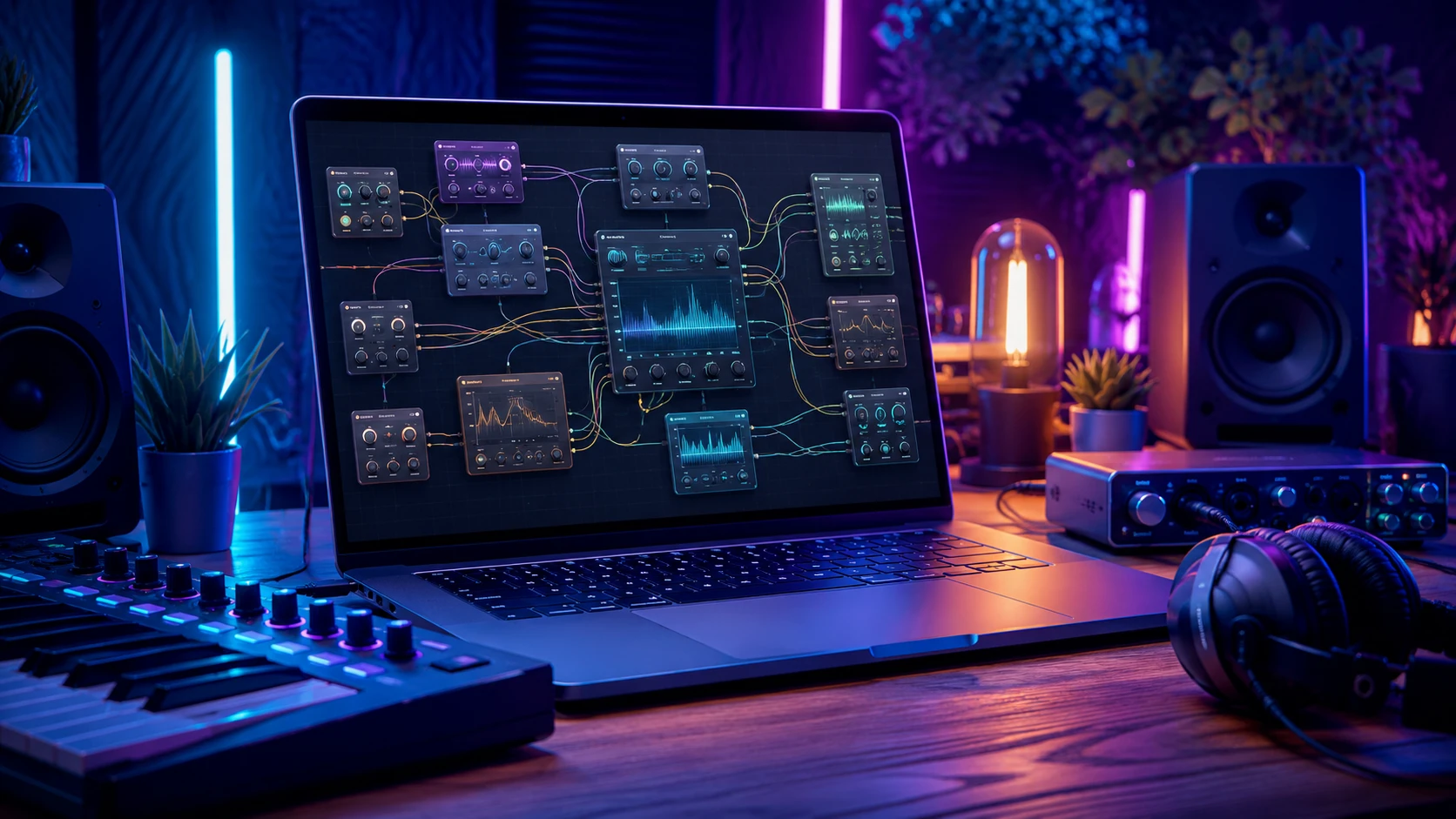
The new wave of laptop music production is not just about faster computers, cleaner interfaces, or another shiny preset pack landing in a producer’s downloads folder. It is about how sound design itself is being rebuilt around movement, routing, and controlled chaos, which is why modular effects plugin culture feels so alive right now. Nodes steps into that conversation as a modular effects environment for Mac and Windows, giving producers a way to treat the laptop less like a closed studio box and more like a patchable playground. Instead of locking a sound into one fixed effect chain, the idea is to let creators connect, reshape, distort, filter, and redirect audio in ways that feel closer to modular hardware thinking. For ChordPunch readers who care about gear, workflow, and modern sound culture, this is exactly the kind of release that shows where bedroom studios are heading next.
Why Nodes Feels Bigger Than Another Plugin Drop
Every week, the music tech world gets flooded with plugins promising warmer tone, wider mixes, cleaner masters, or instant creative inspiration. Most of them can be useful, but many still follow the same basic structure: insert the plugin, turn a few knobs, browse presets, and move on. Nodes feels interesting because it sits inside a different mindset, one that treats effects as pieces of a living system rather than a simple row of processors. That shift matters because modern producers are no longer only asking how to polish a vocal or fatten a synth line; they are asking how to make sound behave, mutate, and surprise them during the writing process. In that sense, a modular effects plugin is not just a tool for mixing but a creative instrument that can change the way a track is born.
The timing also makes sense because laptop studios have become the default creative space for a huge part of today’s music scene. A producer can start a beat on a train, finish sound design at a café, send stems from a bedroom, and still land a mix that competes with professional studio output. That mobility has created a hunger for tools that feel deep without demanding a room full of hardware, cables, power supplies, and patch notes. Nodes fits into this modern workflow by bringing modular-style effects into software, where experimentation can happen inside a DAW without turning the session into a technical obstacle course. It gives the laptop producer a version of modular freedom that feels more accessible, more portable, and more aligned with how music is actually made in 2026.
Modular Effects Plugin Culture Is Going Mainstream
For years, modular sound design carried a certain mystique because it lived heavily in hardware culture. Eurorack rigs looked beautiful and intimidating at the same time, with colorful cables, blinking modules, and a learning curve that could scare off anyone who just wanted to finish a song. But that same visual complexity also represented something powerful: the ability to build a sound path from scratch instead of accepting a fixed signal chain. Software tools like Nodes translate that energy into a format that more producers can actually use every day. The result is a new middle ground where the creative spirit of modular synthesis meets the practical speed of laptop production.
This does not mean software is replacing hardware culture, and honestly, that argument has always felt too simple. Hardware still brings touch, friction, limitation, and a physical relationship with sound that many musicians deeply love. What software does better is lower the barrier, reduce the cost of experimentation, and make complex routing easier to save, recall, duplicate, and automate. A modular effects plugin like Nodes can give producers a modular-style workflow without asking them to become cable-management experts before they can make something usable. That is why this type of tool speaks to beatmakers, electronic artists, film composers, sound designers, and even guitar producers looking for stranger textures inside a familiar DAW setup.
How Nodes Changes the Laptop Studio Mindset
The biggest mental shift with Nodes is that effects stop being a straight line. In a classic DAW session, a producer might place EQ first, then compression, then saturation, then delay, then reverb, and the signal flows through that chain in a predictable order. That approach works, but it can also create habits where every track starts to get treated the same way. A node-based environment invites the producer to think in shapes, branches, feedback paths, and combinations that would be awkward or time-consuming in a normal insert chain. Suddenly, a boring loop can become a system where distortion feeds movement, filtering reacts to texture, and ambience feels like part of the instrument rather than decoration after the fact.
This matters because modern sound culture rewards identity more than perfection. Listeners are surrounded by clean mixes, polished vocals, and technically impressive production, so a track often stands out because of its fingerprint rather than its loudness. A strange transition, a warped drum bus, a vocal texture that sounds half-human and half-machine, or a synth pad that seems to breathe can become the thing people remember. Nodes gives creators another way to build those fingerprints without leaving the laptop environment. It turns the DAW into a more flexible space where effects are not just corrective tools but part of the storytelling language of a song.
From Fixed Chains to Living Systems
The phrase “living system” may sound dramatic, but it describes the appeal of modular effects better than most technical terms. When audio is routed through a flexible environment, the result can feel less like pressing a button and more like setting up a small machine that reacts to itself. Producers can build chains that evolve over time, create movement that feels organic, and design transitions that are more exciting than a basic filter sweep. Even when the final result is subtle, the process encourages listening in a different way because every connection can change the personality of the sound. That is why tools like Nodes are not only about features; they are about changing the producer’s relationship with decision-making.
There is also a psychological benefit to this kind of workflow. Many producers get stuck because modern DAWs are too efficient, and efficiency can make every session feel like a checklist. Load drums, add bass, find chords, arrange, mix, export, repeat until the excitement fades. A modular effects plugin interrupts that loop by making the sound itself more playful and less predictable. That tiny bit of uncertainty can be valuable because it pushes the producer to respond emotionally instead of only making safe technical choices.
Why Mac and Windows Support Matters
Cross-platform support is not the flashiest headline, but it matters more than people sometimes admit. Music scenes are no longer divided neatly between one operating system, one DAW, or one kind of studio setup. A producer might use a Windows desktop for heavy sessions, a MacBook for travel, and collaborate with someone running a completely different environment across the world. When a new tool supports both Mac and Windows, it has a better chance of becoming part of real collaborative workflows instead of staying trapped inside a niche corner. For a platform like ChordPunch, where gear reviews are not just about specs but about how tools fit into creative life, that kind of accessibility is a key part of the story.
The modern producer does not want inspiration locked behind compatibility drama. Nobody wants to discover an amazing patching environment and then realize half the team cannot open the session or recreate the idea. Cross-platform availability makes it easier for musicians to share presets, exchange project files, and build a common sound language around the same tool. It also helps smaller software concepts travel faster because creators on different systems can post demos, tutorials, and experiments without splitting the audience too much. Nodes arriving as a Mac and Windows environment gives it a stronger shot at becoming part of the broader modular software conversation rather than a cool but isolated release.
The Sound Design Appeal for Electronic Producers
Electronic producers are probably the most obvious audience for Nodes, especially those working in genres where texture carries as much weight as melody. Ambient, techno, experimental pop, IDM, future garage, industrial, and left-field club music all benefit from tools that can turn simple sounds into evolving scenes. A dry synth stab can become a metallic pulse, a field recording can turn into a rhythmic bed, and a basic drum loop can become something that feels alive instead of looped. That kind of transformation is exactly where a modular effects environment can become more inspiring than a standard multi-effect plugin. It gives producers permission to treat raw audio like clay rather than a finished object waiting for polish.
At the same time, the appeal is not limited to experimental artists who want everything to sound strange. Pop producers can use modular effects for ear candy, transitions, vocal throws, and moments that make a chorus feel more expensive without overcrowding the arrangement. Hip-hop producers can use it to build darker sample treatments, moving textures under drums, or gritty background layers that create mood without stealing attention. Even singer-songwriters can benefit if they want one guitar line or vocal harmony to feel more cinematic. The important thing is that Nodes is part of a wider shift where effects are no longer separated by genre; they are becoming part of a shared language across modern music production.
A New Playground for Resampling
One of the most exciting uses for any modular effects plugin is resampling, because modular-style processing can generate results that deserve to become new audio files. A producer might run a synth loop through a wild routing setup, record several minutes of output, then chop the best moments into a fresh sampler instrument. This workflow has become central to modern production because it blends design and discovery in a way that feels fast but personal. Instead of relying only on preset packs, the producer creates a private sample universe from their own experiments. Nodes could fit neatly into that culture by giving users a flexible environment for generating unique source material inside the same laptop session.
Resampling also helps solve one of the biggest problems in music software: endless tweaking. When everything stays live forever, a producer can spend hours making tiny changes and never commit to a direction. Recording the output of a modular effects chain forces a decision while still preserving the creative energy of the experiment. That is why many modern producers bounce weird effect passes, reverse them, stretch them, slice them, and build hooks from accidents. A node-based effects workflow is perfect for that because it can create sounds that feel too detailed to program note by note but too musical to dismiss as random noise.
What Nodes Says About Modern Sound Culture
Modern sound culture is moving away from the idea that a track must be built from clean categories. Drums are not just drums anymore, vocals are not just vocals, and synths do not have to stay inside traditional roles. Producers blur everything: a voice becomes a pad, a kick becomes a texture, a guitar becomes a granular wash, and a field recording becomes percussion. A modular effects plugin fits that culture because it gives creators a way to break sound out of its original identity. Nodes arrives at a time when the most exciting records often sound like they were made by people who are not afraid to misuse their tools.
This is also connected to how younger musicians learn. A lot of today’s producers did not begin with formal studio training, large consoles, or traditional engineering rules. They learned through videos, Discord communities, cracked-open project files, livestreams, short clips, and endless trial and error inside a DAW. That learning style rewards tools that are visual, flexible, and immediate because the user can understand the result by experimenting rather than reading a huge manual first. Node-based environments match that mindset because they make signal flow feel more visible and more playful. Instead of hiding the process behind menus, they turn routing into something producers can see, test, and remix.
Why Guitarists Should Pay Attention Too
Even though Nodes sits in the software effects world, guitarists should not ignore it. Guitar culture has always loved signal chains, from classic pedalboards to studio rack effects to modern amp modelers. A modular software environment simply expands that tradition into a space where the routing can become more flexible than most physical pedalboards. A guitarist could use this kind of tool to build evolving ambience, glitchy rhythmic layers, distorted parallel paths, or cinematic textures that would be difficult to recreate with a normal chain of pedals. For players already recording direct into a laptop, Nodes represents another bridge between performance and sound design.
This is especially relevant because the border between guitarist and producer keeps getting thinner. Many modern players are not just tracking riffs; they are arranging, mixing, programming drums, designing tones, and building full sonic worlds from a bedroom or small project studio. That kind of musician needs tools that go beyond amp tone and into atmosphere, movement, and identity. A modular effects plugin can help a guitar part become less predictable while still keeping the emotional feel of the performance. Instead of replacing the player, it expands what the recorded instrument can become after the strings are played.
The Producer Workflow: Fast Ideas, Deep Results
The best modern music tools usually balance two things that seem opposite: speed and depth. A tool that is deep but slow can become intimidating, while a tool that is fast but shallow gets boring after the first few sessions. Nodes has attention because the modular effects concept promises a workflow where simple starting points can lead to complex results. A producer can begin with one sound, add a few connected processes, and quickly hear how the system changes the original material. That makes the creative process feel less like solving a technical puzzle and more like following a sound until it becomes interesting.
This balance matters because production sessions are emotional as much as technical. When inspiration is fresh, every extra menu, routing problem, or compatibility issue can kill momentum. A well-designed modular environment should make exploration feel immediate while still leaving enough depth for advanced users to build unusual chains. That is the sweet spot producers are looking for in 2026, especially as plugin folders become crowded and attention spans get shorter. The tool that wins is not always the one with the longest feature list; it is the one that helps an idea become a finished moment before the vibe disappears.
Nodes and the Rise of Visual Music Tools
There is a larger design trend happening across music software: creators want visual systems that show relationships, not just panels full of knobs. This is why clip launchers, modulation lanes, spectral displays, routing matrices, and node-based interfaces continue to attract attention. Visual tools can make complex processes feel less abstract because the user can see how one element connects to another. A modular effects plugin benefits from this because signal flow is not only heard but understood as a map. That visual feedback can help producers learn faster, experiment more confidently, and create effects chains that would feel confusing if hidden inside traditional menus.
This shift also reflects how music production now overlaps with design culture. Producers care about sound, but they also care about how tools feel, how interfaces guide behavior, and how quickly a screen can invite creativity. A plugin that looks like a creative environment can influence the way a user thinks before a single note is played. That may sound subtle, but interface design shapes music more than people admit. When the screen encourages patching, branching, and experimentation, the track is more likely to carry that same spirit in its final sound.
Potential Challenges for Modular Software Effects
Of course, modular software is not automatically perfect just because the concept is exciting. The same freedom that makes a tool inspiring can also make it overwhelming if the interface is unclear or the workflow becomes too technical. Producers need to understand what is happening quickly enough to stay creative, especially when they are working inside a larger song arrangement. If a modular effects environment demands too much attention, it risks becoming a separate project instead of a useful part of the session. The real test for Nodes will be whether it can make modular thinking feel powerful without making everyday production feel slower.
Another challenge is musical restraint. When a tool can destroy, reshape, and mutate audio in dramatic ways, it becomes tempting to overuse it on everything. That can lead to tracks that sound impressive for ten seconds but exhausting over three minutes. The strongest producers will probably use Nodes as a source of contrast, movement, and surprise rather than a permanent layer of chaos. Like any powerful effect system, its value will depend on taste, intention, and the ability to know when the sound has already said enough.
Why This Release Matters for ChordPunch Readers
ChordPunch lives in the space where gear, music guides, and culture overlap, and Nodes is a clean example of why that overlap matters. It is not enough to say that a plugin exists, list its platform support, and move on. The bigger story is how tools like this reflect the changing identity of the modern musician. Today’s creator might be a guitarist, beatmaker, mix engineer, sound designer, content creator, and label manager all at once. A flexible modern production workflow is no longer a luxury; it is part of how independent music actually survives.
Nodes also points toward a future where music technology becomes more modular in spirit even when it is not literally modular hardware. Producers want systems they can bend, not just products they can operate. They want tools that can be simple on day one but weird on day fifty. They want software that respects both quick results and deep exploration, because real music careers often require both. For readers building a home studio, upgrading a laptop setup, or searching for new sound design inspiration, this is the kind of release that deserves attention beyond the usual plugin-news cycle.
The Bigger Trend: Laptops Are Becoming Modular Studios
The phrase “laptop studio” used to sound like a compromise, as if serious production had to happen somewhere larger, more expensive, and filled with hardware. That attitude has faded because some of the most interesting music now comes from compact setups built around strong software, smart monitoring, and a producer who knows how to make fast decisions. Nodes fits this reality because it brings a modular effects mindset into the exact space where many creators already live. The laptop is not just a recorder, arranger, or mixer anymore; it is becoming a modular studio in its own right. That change is reshaping what musicians expect from their tools and what they believe is possible outside traditional studio spaces.
This trend also changes the economics of experimentation. In hardware modular culture, every new possibility can require another module, another cable, another case, or another financial decision. In software, the cost of trying wild routing ideas is often lower, and the session can be saved before everything falls apart. That makes experimentation less precious and more frequent, which is healthy for creativity. A modular effects plugin like Nodes belongs to this new economy of sound, where the goal is not to own the biggest setup but to build the most personal sonic identity from the tools within reach.
Conclusion: Nodes Brings Modular Energy Home
Nodes matters because it captures a clear direction in modern music production: creators want tools that make sound feel alive, flexible, and personal. The rise of the modular effects plugin is not only about copying hardware ideas inside software, but about giving laptop producers new ways to think through sound. It lets effects become part of composition, arrangement, performance, and identity instead of staying locked in the final mixing stage. That is why this release feels relevant for electronic artists, guitarists, beatmakers, composers, and anyone trying to make a small studio feel bigger than its physical space. In a music culture where originality often comes from how a sound moves, breaks, bends, and transforms, Nodes feels like another sign that the future of production is modular, portable, and deeply creative.