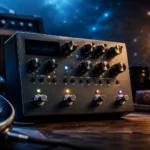


The first thing that makes the MXR Textures feel interesting is not that it is another pedal promising wild ambient sounds, because guitar players have heard that pitch before. What makes it land differently is how directly it brings granular guitar pedal thinking into a compact stompbox format that still feels familiar enough for a regular pedalboard. Instead of asking players to leave the guitar world and enter a laptop, modular rig, or plugin maze, it takes the signal they already know and breaks it into tiny pieces that can be stretched, reversed, frozen, stacked, and reshaped. That idea sounds technical on paper, but the real appeal is emotional: one note can stop acting like a note and start acting like a cloud, a film cue, a glitch loop, or a memory fading in slow motion. In a music culture where guitarists are no longer just chasing louder distortion or cleaner delay, MXR Textures feels like a sign that tone design is becoming part of everyday playing.
Why MXR Textures Feels Like a 2026 Guitar Pedal
For decades, the electric guitar pedalboard had a pretty clear language, even when players used it in creative ways. Overdrive pushed the front of the amp, delay repeated a phrase, chorus widened the sound, reverb gave it space, and fuzz turned it into a cracked wall of electricity. The MXR Textures enters from a different lane because it does not simply color the signal or repeat it in a predictable rhythm. It listens to the incoming guitar, captures small fragments of that sound, and then replays those fragments as grains that can overlap, drift, reverse, detune, shimmer, or build into something that barely resembles the original pick attack. That makes it feel less like a traditional effect and more like a small instrument that responds to the way the guitarist feeds it.
This is why the timing matters so much for modern guitar culture. Guitarists today are not only trying to sound like classic records; many are trying to score reels, build cinematic intros, create textures for indie games, layer ambient loops, or make a bedroom recording feel bigger than the room it was tracked in. In that setting, a pedal like this is not just a toy for experimental players. It becomes a shortcut into sound design for anyone who wants to turn a simple chord into a moving background, a single harmonic into a frozen pad, or a picked melody into something that feels like it came from a synth rack. The phrase granular synthesis might still sound intimidating, but the creative result is easy to understand once a guitar note starts dissolving into motion.
The most Gen Z-coded part of this whole trend is that the line between guitarist, producer, and sound designer keeps getting thinner. A player might record a riff, post a short performance clip, produce an ambient intro, and design their own sample pack without ever leaving the same desk. Gear that used to belong to separate categories now needs to live together, because modern creators do not separate “playing” from “producing” as much as older workflows did. A granular guitar pedal like this fits that mindset because it lets the guitar become raw material instead of just a finished performance. The instrument is still under the fingers, but the final tone feels shaped by editing, sampling, synthesis, and performance at the same time.
What Granular Sound Actually Means for Guitarists
Granular sound can feel like a complicated concept until it is explained through a guitarist’s ear. Imagine playing a chord into a delay pedal, but instead of hearing the chord return as one clean repeat, the pedal chops that sound into tiny fragments. Those fragments can be stretched longer, layered closer together, scattered in time, shifted in pitch, or sent backward until the original attack disappears. The result is not just an echo, because the repeated material becomes a new texture that has its own movement and shape. That is the core reason MXR Textures feels different from a normal delay, even if its DNA still has a delay-like idea at the center.
For guitar players, this matters because pick attack is usually one of the strongest parts of the instrument’s identity. You hear the hand, the string, the fret buzz, the pressure, and the tiny imperfections that make a performance human. When granular processing starts breaking that sound into grains, it can soften the attack until the guitar feels like a pad, or exaggerate the fragments until the performance becomes rhythmic and glitchy. A clean major seventh chord can turn into a floating cinematic bed, while a distorted note can become a collapsing swarm of tiny reversed echoes. Instead of replacing the guitar with a synth, the pedal bends the guitar toward synth-like territory while keeping the player’s touch inside the result.
This is especially useful for players who feel stuck between traditional guitar tones and electronic production aesthetics. A guitarist who loves shoegaze might use granular textures to create a wash that does not simply drown the signal in reverb. A post-rock player might freeze a chord underneath a melody and make a live trio sound wider than expected. A producer might run guitar through the pedal, sample the output, and turn it into a loop that no longer screams “guitar” at all. That is why experimental guitar effects are gaining more attention: they give players a way to sound current without abandoning the physical relationship they have with strings, pedals, and amps.
MXR Textures and the Rise of Pedalboard Sound Design
The bigger story behind MXR Textures is that pedalboards are becoming sound design stations. For a long time, the most popular guitar pedals were built around solving straightforward problems. Players wanted more gain, more sustain, more space, more modulation, or a stronger solo boost. Now, many players are asking a different question: how can one performance become a whole atmosphere? That shift has opened the door for pedals that behave less like simple tone enhancers and more like creative engines for composition, layering, and sonic world-building.
This change is easy to see in the way modern guitar content is consumed. Short performance videos reward sounds that grab attention quickly, and ambient textures often do that better than another blues lick through a familiar overdrive. Film composers and sync-focused creators want tones that can sit under dialogue, transition between scenes, or suggest emotion without sounding too obvious. Bedroom producers want hardware that feels inspiring before the DAW screen even opens. A pedal such as MXR Textures fits these habits because it turns the act of playing into the start of a design process rather than the final step.
There is also something important about having this kind of effect from MXR specifically. The brand is historically associated with pedals that feel direct, sturdy, and easy to place in a real rig, not just boutique devices aimed at players who already speak deep modular language. That gives the Textures a different cultural weight, because it suggests that granular processing is moving from the edges toward the center of guitar gear conversation. When a mainstream pedal name puts granular synthesis into a stompbox with presets, familiar controls, and practical routing options, it tells players that this sound is no longer only for experimental specialists. It becomes part of the modern vocabulary of guitar gear reviews, pedalboard planning, and creative production talk.
The Difference Between Texture and Atmosphere
One reason guitarists get excited about pedals like this is that texture and atmosphere are not exactly the same thing. Atmosphere is the space around a sound, like reverb tails, delay trails, stereo width, and the feeling of a room or landscape. Texture is more about what the sound is made of, whether it feels smooth, grainy, broken, glassy, metallic, soft, unstable, or alive. Traditional ambient pedals can create atmosphere beautifully, but they sometimes leave the guitar signal too recognizable underneath. A granular guitar pedal can go deeper by changing the internal fabric of the note itself, which is why one simple chord can suddenly feel like a moving surface rather than a chord with reverb on top.
That distinction matters in practical playing. A worship guitarist, soundtrack composer, or indie ambient artist may want a sound that supports a song without becoming a busy lead part. A noise-rock guitarist may want the opposite, using broken grains and unstable repeats to make a section feel like it is tearing apart. A loop-based performer may want a pad that can evolve underneath several layers without sounding like a static keyboard patch. With MXR Textures, the same basic concept can move between those moods depending on how the player shapes grain size, overlap, pitch, reverse behavior, regeneration, and mix level.
Inside the MXR Textures Workflow
The smartest thing about MXR Textures is that it seems built around two different kinds of players. Some guitarists want fast inspiration, and for them the onboard presets are the obvious entry point. Instead of opening a blank canvas and wondering what every granular parameter does, they can start from sounds that already point toward shimmering pads, glitch pulses, octave movement, reverse trails, or layered ambience. Other guitarists want to dig into the machine and treat every knob like part of a living patch. For them, the pedal’s deeper controls make it possible to shape the behavior of the grains rather than just selecting a vibe and moving on.
The main controls are important because they map abstract sound design ideas onto movements guitarists can understand. Size influences how long each grain feels, which changes whether the texture comes across as tiny flickers or broader slices of sound. Overlap affects how densely those grains stack, and that can make a patch feel sparse, rhythmic, smeared, or almost pad-like. Pitch changes the playback character, bringing in octave shifts, harmonized motion, or strange detuned movement depending on the setting. Reverse, regeneration, time or delay behavior, and mix then decide how much the original guitar remains visible inside the final sound.
The modes also shape how a player approaches the pedal in a real musical situation. A delay-style mode gives the most familiar starting point because the pedal continues responding as the guitarist plays, turning notes and chords into granular echoes and trails. An auto-freeze approach can capture input and hold it into a sustained wash, which is perfect for players who want to build a bed underneath a section without manually looping a phrase. A layers-style workflow can stack notes or chords into separate buffers, which opens the door to small orchestral pads, evolving harmony, and performance-based composition. That range makes MXR Textures feel less like one effect and more like a toolkit for several modern guitar roles.
Why Presets Matter More Than Purists Admit
Some players hear the word preset and immediately think of shortcuts, but in a deep pedal like this, presets can be a creative advantage rather than a limitation. Granular processing can become confusing fast because small parameter changes may create dramatic shifts in behavior. A preset gives the player a musical starting point, which matters when inspiration disappears the moment a pedal feels like homework. With MXR Textures, the preset idea is especially useful because the player can start with a ready-made texture and then adjust it into something personal. That workflow feels more like remixing a sound than reading a manual from page one, and that is exactly how many modern musicians prefer to work.
Presets also make a pedal more realistic for live performance. In the studio, a player can spend an hour sculpting a granular wash until it sits perfectly behind a vocal. Onstage, that same player needs something that can be recalled quickly, controlled confidently, and trusted under pressure. If a pedal can move between a reverse ambient patch, a subtle pad, and a glitchy rhythmic texture without a complicated setup, it becomes more than a studio curiosity. That is why MXR Textures has a better chance of reaching players who love experimental sound but still need gear that behaves like gear, not like a science project.
How MXR Textures Fits Modern Ambient Guitar
Ambient guitar has changed a lot from the old stereotype of endlessly swelling volume-pedal chords into giant reverb. That sound still has its place, but modern ambient players often want motion, instability, pitch movement, glitch detail, and small imperfections that make a loop feel alive. The MXR Textures speaks directly to that because granular processing naturally creates movement inside sustained sound. Rather than relying only on a long reverb tail, the pedal can make the body of the sound shimmer, fold, fragment, and regenerate. This gives ambient players a way to build depth without always turning everything into a huge blurred cloud.
For clean guitar, the pedal can make simple harmony feel much larger. A slow chord progression played with restraint can become the foundation for a whole track if the grains are smooth, overlapped, and mixed carefully. Harmonics can become glassy particles, single notes can turn into floating lines, and gentle arpeggios can dissolve into a moving background. This is the kind of sound that works well for intros, interludes, cinematic bridges, and solo performances where the player needs to fill space without overplaying. In that context, MXR Textures is not just adding an effect; it is changing how a guitarist thinks about arrangement.
For dirty guitar, things can get more chaotic in a good way. Distortion already adds harmonic density, and granular processing can pull that density apart into broken pieces. A heavy chord can become a reverse cloud, a lead line can turn into a fractured echo trail, and feedback can be reshaped into something between noise music and synth ambience. This is where the pedal could appeal to shoegaze, post-hardcore, doom, experimental metal, and noise-rock players who want atmosphere without losing danger. The best use may not be leaving it on all the time, but bringing it in at moments where a song needs to stop sounding normal.
The Pedalboard Question: Where Should It Go?
Placement will be one of the most interesting debates around MXR Textures because granular pedals react dramatically to what enters them. Put it after clean modulation and the grains may capture a polished, chorus-widened signal that turns into smooth ambient movement. Place it after distortion and it may chew on a denser signal, creating more aggressive fragments and dramatic reverse textures. Run it before reverb and the rest of the board can make the granular output feel huge and cinematic. Put it after reverb and the pedal may chop up the space itself, creating stranger, more unstable clouds that can sound beautiful or completely unhinged depending on the settings.
There is no single correct placement because the pedal’s personality changes with the surrounding rig. A guitarist building a subtle ambient board may want compression, volume, and drive before it, then delay and reverb after it for extra polish. A producer using it as a sound design tool may put it almost anywhere, including after pedals that would normally sit late in the chain. A live player may prefer a predictable setup where the original dry signal still cuts through, especially if the mix control is kept balanced. That flexibility is part of why modern guitar effects are so interesting right now: the pedalboard is no longer a fixed rulebook, but a modular arrangement of creative decisions.
Stereo and wet-dry possibilities also matter here. A texture pedal becomes much more immersive when the processed signal can spread across a stereo field or sit beside the dry guitar instead of replacing it completely. For home recording, that means a guitarist can print wide atmospheric layers without needing a full plugin chain. For live rigs, it can create dramatic movement if the venue or monitoring setup supports it. Even for players who usually run mono, knowing that the pedal can grow with a larger rig makes MXR Textures feel more future-proof than a simple one-lane effect.
MXR Textures Granular Guitar Pedal as a Creative Tool
The best way to understand the MXR Textures granular guitar pedal is to stop thinking about it only as something that improves tone. A classic overdrive can make a guitar sound better in a familiar way, and a classic delay can make a part feel wider or more rhythmic. This pedal is more about making a part become something else. That difference changes how a player writes, because the guitar can generate material that later becomes a pad, a transition, a hook, or a background layer. Instead of recording a guitar part and then adding production around it, the guitarist can generate production from the part itself.
That has real value for solo creators. Many modern musicians are building tracks alone, which means one person may need to write guitar, bass, synth parts, textures, and production details without a full band in the room. A pedal that turns guitar into ambient grains can help fill that gap in a more organic way than dragging in a generic pad preset. The result still carries the player’s timing, chord choices, pick dynamics, and sense of touch. That makes MXR Textures useful not because it hides the guitar, but because it transforms the guitar into a more flexible source of musical material.
It could also become a strong tool for writers who feel trapped by muscle memory. Every guitarist knows the feeling of reaching for the same shapes, the same voicings, and the same rhythmic habits. A granular pedal can break that loop because it responds in ways that are harder to predict. One chord might bloom longer than expected, one harmonic might become the center of a whole section, and one reversed fragment might suggest a melody the player would never have written directly. This is where the pedal’s “sandbox” energy becomes more than marketing language, because the most useful creative tools often give musicians a little bit of resistance and surprise.
The Film Score and Sync Angle
One of the most practical audiences for MXR Textures may be guitarists who work around visual media. Film score, trailer music, YouTube intros, game ambience, and brand videos all need sounds that create mood quickly without demanding too much space. A guitar through granular processing can provide that because it feels emotional and human, but it can also become abstract enough to avoid sounding like a normal band performance. A clean chord can become a cold city-night pad, while a muted note can become a tense pulse under a scene. This makes the pedal appealing not only for players chasing tone, but also for creators building atmospheres that need to support images.
The advantage over a basic synth pad is the physical performance. A guitarist can lean into a note, let a chord ring unevenly, brush a harmonic, or use volume swells to feed the processor in a more expressive way. Those small gestures can become part of the grain behavior, which keeps the final texture from feeling too perfect or sterile. In modern scoring, imperfection often matters because it gives digital productions a human fingerprint. That is why a granular guitar pedal can be more than a strange effect for introverts with huge pedalboards; it can be a practical composing tool for anyone who needs emotion, movement, and originality fast.
Why This Pedal Says a Lot About Modern Sound Culture
The arrival of a pedal like MXR Textures says something bigger about where guitar culture is heading. For years, gear conversations were dominated by authenticity: which overdrive sounds closest to a famous amp, which delay recreates a vintage unit, which pickup gives the most accurate old-school voice, and which fuzz captures a certain era. Those conversations still matter, but younger players often seem just as interested in transformation as replication. They want sounds that feel personal, cinematic, weird, and usable across different forms of content. That shift makes granular processing feel timely because it is built around turning one thing into another.
Modern sound culture is also shaped by the way people listen now. A guitar tone does not only live on a record anymore; it might be heard through phone speakers, headphones, social clips, live streams, short-form edits, indie games, or small-room performances. In those spaces, texture often cuts through faster than technical playing. A strange reversed shimmer can make someone stop scrolling before a perfect alternate-picked run does. This does not mean musicianship matters less, but it does mean tone identity has become part of storytelling. A pedal like MXR Textures gives guitarists another way to create that identity without abandoning the instrument.
There is also a quiet reaction against overly polished digital production happening in many corners of music. People still use plugins, loops, and AI-assisted tools, but many artists want hardware interactions that feel immediate and a little unpredictable. Turning a knob while a note blooms, freezing a chord by foot, or letting a granular patch wander slightly differently each time creates a kind of performance energy that a mouse click does not always deliver. That is why modern sound culture keeps making room for tactile gear even as software gets more powerful. Hardware pedals survive because they make decisions feel physical, and MXR Textures leans directly into that feeling.
Who Will Actually Use MXR Textures?
The obvious audience is ambient guitar players, but the pedal should not be boxed into that category too quickly. Ambient players will likely love the ability to create pads, reverse washes, and evolving sound beds, yet the same features can serve many other styles. Indie guitarists can use it for transitions and breakdowns, metal players can use it to create unsettling intros, and pop producers can use it to turn guitar lines into ear candy. Even a traditional player might find value in using one subtle preset for a bridge, outro, or live loop moment. The key is not whether someone identifies as experimental, but whether they are curious about making the guitar behave in less predictable ways.
There is also a real beginner-to-intermediate angle here, even though granular synthesis sounds advanced. Many newer players are comfortable with unusual sounds because they grew up hearing genre-blended music, sample-based production, and heavily processed guitars. They may not care whether a tone follows classic pedalboard rules as long as it feels inspiring and fits the track. A pedal with presets can help them access deeper textures without needing to understand every technical layer immediately. In that sense, MXR Textures could introduce granular ideas to players who would never open a modular synth tutorial but would absolutely step on a pedal and start exploring.
Advanced players may approach it differently. They will likely care more about expression control, stereo routing, secondary parameters, and how the pedal reacts to dynamics. They may use it with loopers, MIDI-capable rigs, split signals, volume pedals, or complex wet-dry setups. For them, the appeal is less about instant atmosphere and more about how far the pedal can be pushed. If it can handle subtle textures as well as obvious chaos, it becomes a serious part of a professional sound design rig rather than a novelty that only appears once on a record.
The Learning Curve Is Part of the Point
A pedal like MXR Textures will probably not reveal everything in five minutes, and that is not necessarily a problem. Some effects are designed to be understood immediately, while others reward time and repetition. Granular processing belongs in the second category because the best sounds often come from learning how the pedal reacts to different input styles. A softly played chord may produce a smooth bed, while a sharp staccato phrase may create rhythmic fragments. The player has to learn not only the knobs, but also how to perform into the effect.
That performance relationship is what separates a deep pedal from a complicated one. Complicated gear simply creates friction, while deep gear gives back more as the player develops a sense of timing, dynamics, and control. With MXR Textures, the learning curve could become part of the creative process because the pedal encourages players to listen differently. Instead of asking whether a tone is good or bad, the player starts asking what kind of material the pedal wants. That shift can change writing habits in a healthy way, especially for guitarists who feel like they already know what every standard effect will do before they even turn it on.
The trick is to use restraint. Granular effects can become too much very quickly, especially in a full mix where every instrument needs space. A massive reverse pad might sound amazing alone but swallow a vocal, bass line, or drum groove if left unchecked. The most musical use may come from balancing the mix control, choosing moments carefully, and letting the dry guitar remain part of the story when needed. In other words, MXR Textures can be wild, but the player still needs taste, arrangement sense, and a reason for the texture to exist.
A New Kind of Guitar Identity
One of the most exciting things about MXR Textures is that it reflects a broader move away from guitar identity being defined only by amp tone. For many classic players, the dream sound was a certain guitar into a certain amp with the right drive and maybe a little delay. That still works, but modern guitar identity can also come from processing, routing, resampling, and the way a player builds atmosphere around the part. A guitarist can now be recognized not only by their phrasing, but also by the way their sound blooms, fractures, loops, glitches, or disappears. That creates room for a new kind of signature tone that is less about copying a famous rig and more about designing a personal sound world.
This matters for Chordpunch-style music culture because gear reviews are no longer just about whether a product is “good” in a basic sense. The better question is what kind of creative behavior a piece of gear encourages. A transparent overdrive encourages touch sensitivity and amp interaction. A classic chorus encourages width and nostalgia. A granular pedal encourages players to think in layers, fragments, movement, and transformation. That is why the MXR Textures granular guitar pedal feels like more than a fresh release; it feels like a snapshot of where modern guitar creativity is moving.
It also shows that guitar is still adapting instead of fading into the background of electronic production. Every few years, someone declares that guitar has run out of ideas, and every few years, players find new ways to make strings feel current again. Sometimes that comes from genre shifts, sometimes from new players, and sometimes from gear that changes what the instrument can become inside a track. MXR Textures belongs to that last category because it does not ask the guitar to compete with synths, samplers, or plugins on their terms. It lets the guitar enter that world while keeping the human source intact.
Final Take: MXR Textures Turns Notes Into Worlds
The reason MXR Textures is worth paying attention to is not simply that it can create strange sounds. Strange sounds are easy to find now, and any laptop can bury a guitar track under effects in seconds. What makes this pedal compelling is the way it brings granular thinking into the physical rhythm of guitar playing. You play, the pedal captures, the grains move, and suddenly the performance becomes a landscape instead of a line. That process feels modern because it matches how many musicians now create: fast, tactile, hybrid, emotional, and open to accidents.
As a granular guitar pedal, it gives players access to shimmering pads, reverse motion, frozen harmony, glitch detail, layered ambience, and evolving sound design from a format that still belongs on the floor. As a piece of modern gear, it speaks to a culture where guitarists want to be producers, composers, performers, and sonic architects at the same time. As a creative tool, it may help players escape familiar shapes by making every note feel like the beginning of something larger. That is the real promise of MXR Textures: it does not just make the guitar sound different, it invites the guitarist to write differently. In a year where pedalboards keep getting smarter, stranger, and more cinematic, this is exactly the kind of box that makes the future of guitar feel alive.