

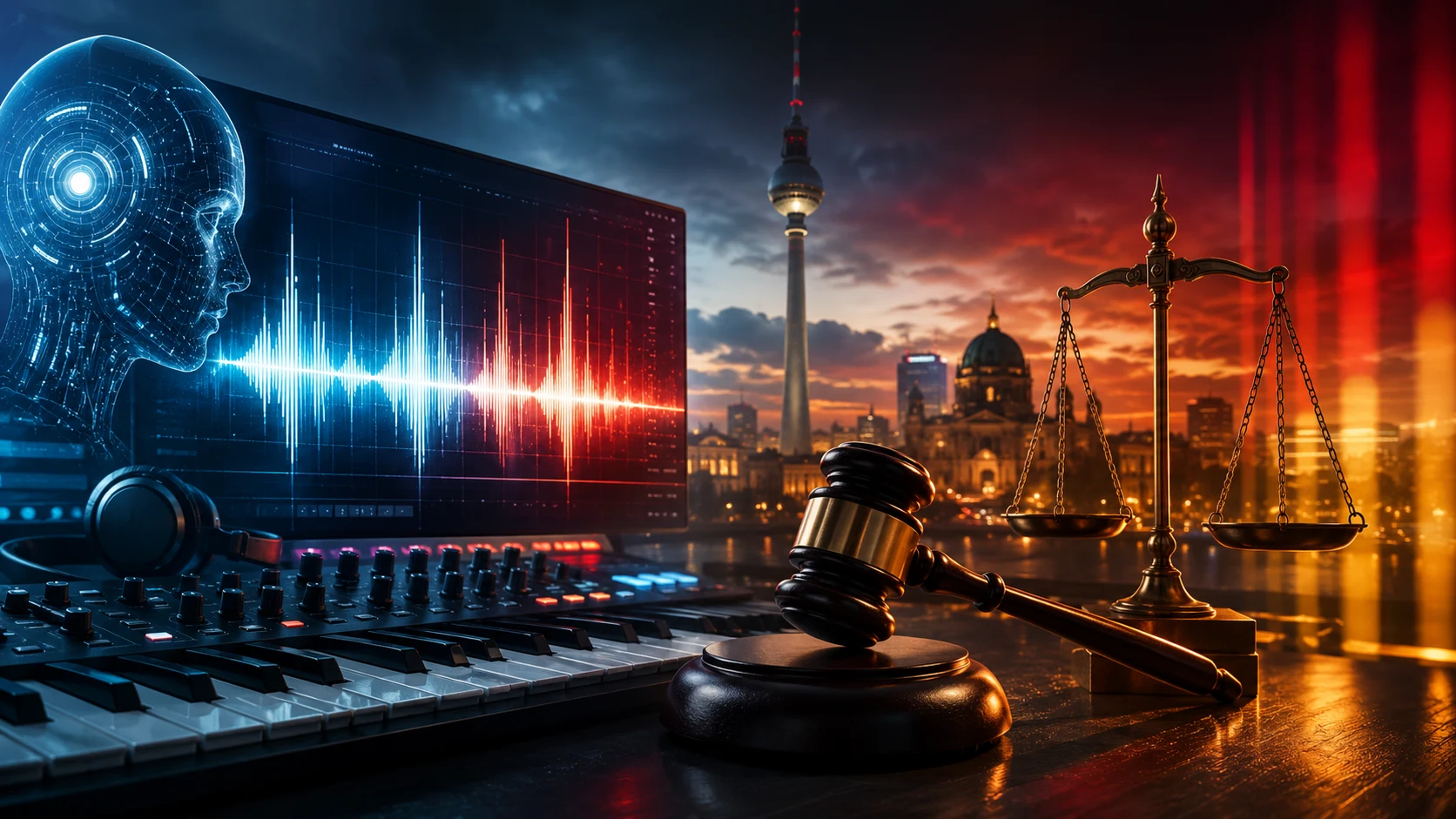
The party around instant song generation suddenly feels less like a wild studio jam and more like a room where the lights have just snapped on. After Suno lost a major copyright fight in Germany, the conversation around AI music copyright no longer sounds like a distant legal debate for lawyers, labels, and policy people. It now feels like the next big pressure point for every producer, songwriter, indie artist, startup founder, and casual creator who has been watching AI music explode at internet speed. For a while, generative music tools carried the energy of a new toy that could turn a sentence into a polished track in seconds, but this ruling adds a harder question: what happens when the machine’s magic depends on human-made music that was never clearly licensed? That tension is now moving from forum arguments and comment sections into courtrooms, business models, and the future shape of digital music culture.
The case matters because Suno is not some tiny experimental app hiding in a niche corner of the web. It represents the new wave of AI music platforms that made music creation feel as easy as typing a mood, a genre, and a few emotional cues. That simplicity is exactly what made the platform exciting, but it is also what made it controversial. Artists and rights organizations have argued that these systems cannot simply absorb years of copyrighted songs, learn their patterns, and then compete with the same creators whose work helped train the machine. Suno’s loss in Germany does not instantly settle every question around generative music, but it sends a loud signal that the industry’s “move fast and generate everything” era may be facing its first serious speed limit.
Why This Suno Ruling Feels Bigger Than One Company
The easy way to read this story is to say that one AI music company lost one legal battle in one country. That reading misses the bigger cultural shift happening underneath the headline. Germany has long treated music rights, collecting societies, and creator compensation as serious parts of the creative economy, so a court decision there carries more symbolic weight than a random dispute between two tech brands. When a platform like Suno is told that it crossed copyright boundaries, it puts pressure on every similar company to explain where its training data came from, how it was used, and whether creators were given any choice. In other words, the ruling does not just ask whether one AI track sounds too close to one original song; it asks whether the entire foundation of AI music generation can keep running without cleaner licensing rules.
This is why musicians are watching closely, even if they have never used Suno and never plan to. The modern music economy is already full of pressure, from streaming payouts that feel painfully small to social platforms that demand constant content just to stay visible. AI music adds a new layer because it can produce endless tracks at a scale no human creator can match. If those tracks are built on the back of human-made catalogs without permission, the issue becomes more than technical. It becomes a question of fairness, value, and whether original work is being treated as culture or as raw material for someone else’s product.
For listeners, the case may sound abstract at first, but it touches the music they will hear every day. Playlists, background tracks, advertising jingles, gaming soundbeds, lo-fi streams, short-form video hooks, and even demo vocals could all be shaped by the outcome of these battles. If AI music platforms have to license catalogs properly, their pricing, output, and commercial rules may change. If courts side more often with platforms, the market may get flooded with cheaper synthetic music that competes directly with human creators. Either way, AI music copyright is not just a legal category anymore; it is becoming one of the defining questions of modern sound culture.
AI Music Copyright Moves From Theory to Reality
For the last few years, the debate around AI and music often felt stuck between hype and panic. On one side, AI companies framed their tools as creative assistants that open the door for people who cannot sing, produce, mix, or afford studio time. On the other side, artists warned that the same tools could clone styles, imitate voices, and undercut paid work at massive scale. The Germany ruling pushes the issue into a more concrete space because it focuses on rights, usage, and compensation rather than vibes. Once a court begins treating training and output as copyright issues with real financial consequences, the conversation becomes harder for platforms to dodge with broad talk about innovation.
The key issue is not whether AI can help people make music, because that answer is already obvious. It can help with arrangement ideas, lyric drafts, mood boards, production references, demo sketches, and sound design experiments. The deeper question is whether an AI system should be allowed to study protected songs at scale without permission, then produce music that may compete in the same market. Traditional musicians learn by listening, copying, practicing, failing, and developing taste over time, but AI training happens at industrial speed and can involve huge datasets. That difference is why the legal system is being asked to decide where inspiration ends and extraction begins.
For many people inside the creative world, this case feels like a long-awaited reality check. AI music tools became powerful before the rules around them became clear, creating a messy gap between what technology can do and what copyright law can comfortably handle. The gap was always going to close eventually, either through regulation, licensing deals, lawsuits, or all three at once. Germany’s ruling suggests that courts may not accept the idea that copyrighted music can be treated as free training fuel just because the final output is generated by a model. That does not kill AI music, but it does force the business side to grow up fast.
The Training Data Question Gets Louder
The training data question is the part of the debate that keeps returning because it sits at the center of the entire AI music economy. When users type a prompt and receive a polished track, they rarely see the invisible history behind that result. They do not see which songs shaped the model, which recordings were analyzed, which patterns were absorbed, or which rights holders were never contacted. That invisibility is useful for platforms because it keeps the product feeling clean and frictionless. Yet the more realistic AI-generated music becomes, the harder it is for the industry to ignore the catalogs that may have helped make that realism possible.
This matters especially in music because style is not just decoration. A guitar tone, vocal phrasing, drum swing, synth texture, bass movement, or production signature can carry years of personal craft and cultural context. When AI recreates those signals convincingly, it may not copy a song note for note, but it can still feel like it is borrowing from a living creative ecosystem. That makes music licensing more complicated than simply checking whether two melodies match. The real battle is about whether the sound of an era, a scene, or an artist’s identity can be mined, packaged, and sold back to the public through a prompt box.
Artists are not asking technology to stop existing. Most working musicians already use digital tools, sample libraries, plugins, MIDI packs, virtual instruments, and AI-adjacent features in some part of their workflow. The frustration comes from feeling that tech companies may be taking from creative workers without giving them credit, control, or payment. That is why a ruling like this can energize creators who have felt ignored during the AI gold rush. It suggests that courts may be willing to look beyond the shiny interface and examine the material that made the tool valuable in the first place.
What This Means for AI Music Platforms
For AI music companies, the Germany loss is a warning shot about risk. Until now, many platforms have grown by emphasizing speed, scale, and user excitement, while the legal questions followed behind like storm clouds on the horizon. A court defeat changes the mood because investors, partners, labels, and enterprise customers start asking sharper questions. Can the company prove its datasets are clean? Can it license music at a scale that still makes the business profitable? Can it avoid generating outputs that trigger claims from artists, publishers, or collecting societies? These are not side issues anymore; they are survival questions for the next phase of the AI music market.
The most likely result is not that AI music disappears overnight. Instead, platforms may move toward more licensed datasets, opt-in creator programs, rights-management tools, revenue-sharing systems, and stricter output filters. Some companies may build partnerships with labels and publishers, while others may focus on royalty-free training material or user-owned content. This could make AI music less chaotic but also less frictionless, because licensing adds cost and complexity. The platforms that survive may be the ones that can prove they respect rights without making the creative experience feel slow, expensive, or overly restricted.
That shift could divide the market into two clear lanes. One lane will be the professional, licensed, commercially safer side of AI music, built for brands, studios, creators, game developers, and agencies that need legal clarity. The other lane may remain more experimental, chaotic, and risky, where hobbyists generate tracks for personal fun without thinking much about rights. Over time, the professional lane will probably matter more because money always attracts legal scrutiny. If a song is just sitting on someone’s private hard drive, nobody cares much, but when AI music starts earning revenue, replacing commissions, or filling commercial spaces, copyright questions become impossible to avoid.
Licensing Could Become the New Feature
In the early AI music boom, the main selling point was output quality. Users wanted to know whether a platform could create realistic vocals, catchy hooks, clean arrangements, and convincing genre textures. After this ruling, legal confidence may become just as important as sound quality. A platform that can say its system is trained on properly licensed music, transparent creator agreements, and commercially safe assets may become more attractive than a platform with slightly flashier output but unclear rights. In that sense, AI music copyright could become a product feature, not just a legal headache.
This would mirror what happened in other parts of the creative tech world. Stock photo platforms, sample marketplaces, font libraries, and production music services all became valuable because they reduced legal uncertainty for creators and companies. AI music may need a similar layer of trust before it can fully enter professional workflows. A marketing team does not want a viral campaign ruined by a copyright claim. A game studio does not want a soundtrack asset to become a legal liability. A YouTuber does not want a generated track to trigger takedowns after a video starts gaining traction.
For Chordpunch readers who follow gear reviews and music tech, this shift is worth tracking because the next generation of music tools will not be judged only by tone, workflow, or interface design. They will also be judged by how responsibly they handle rights. The coolest AI generator in the world becomes less useful if users cannot confidently publish what it creates. That changes the way creators compare platforms, the way reviewers test tools, and the way producers decide what belongs in a serious workflow. The question will move from “Can it make a good track?” to “Can I safely use this track in the real world?”
Why Human Musicians Are Not Just Being Defensive
One of the laziest takes in the AI debate is the idea that musicians are simply afraid of progress. That framing ignores how much musicians have always adapted to new tools, from electric guitars and drum machines to samplers, DAWs, Auto-Tune, bedroom production, and streaming distribution. Music history is full of artists turning disruptive tools into new language. The difference with generative AI is that it does not merely give creators a new instrument; it can generate complete songs by learning from existing music at a scale that no previous tool could match. That makes the anxiety less about nostalgia and more about whether the value chain is being rewritten without the people who built the culture.
Human creators are also dealing with a brutal attention economy. A musician today often has to be a songwriter, producer, editor, designer, marketer, data analyst, community manager, and content machine at the same time. When AI platforms promise unlimited songs in seconds, they do not enter a calm marketplace with plenty of room for everyone. They enter a crowded economy where creators are already fighting to be heard. If AI-generated tracks flood playlists, sync libraries, social platforms, and background music markets, the impact will land hardest on working musicians who depend on those smaller income streams.
That is why the Germany ruling feels emotionally significant. It tells musicians that their catalogs, recordings, and compositions are not invisible just because a machine can process them. It also gives rights organizations stronger ground to demand licensing conversations rather than chasing platforms after the fact. This does not mean every artist opposes AI music, and it does not mean every AI user is doing something wrong. It means the creative economy needs a better deal than “upload the world, generate forever, and apologize later.”
Modern Sound Culture Is Entering Its Accountability Era
The most interesting part of this moment is not only legal; it is cultural. AI music arrived during a time when online culture already moves fast, recycles sounds quickly, and rewards instant aesthetics. A song can become a meme, a sped-up edit, a remix, a dance challenge, and a background trend before the original artist even catches their breath. Generative AI fits perfectly into that environment because it can produce endless variations for every vibe. But the Germany ruling suggests that modern sound culture may need to slow down long enough to ask who gets paid, who gets credited, and who gets erased.
This accountability era will probably feel uncomfortable because it challenges the internet’s favorite fantasy: that everything can be remixed forever without consequences. Remix culture has created brilliant art, but it has also blurred lines between homage, theft, transformation, and exploitation. AI intensifies those blurred lines because the remixing happens inside a system that most users cannot inspect. A person can explain their influences, cite references, or show their process, while a model often appears as a black box. That opacity makes trust harder, especially when the outputs are polished enough to compete with human-made music.
At the same time, accountability does not have to kill experimentation. The best version of AI music culture would give creators new ways to collaborate with technology while protecting the people whose work shaped the tools. Imagine AI platforms where artists can opt in, license their catalogs, set style boundaries, earn revenue when their influence is used, and decide how their voice or sound identity can be modeled. That kind of future is more complicated than the current prompt-and-generate fantasy, but it is also more sustainable. It treats music as a living culture rather than an unlimited resource to scrape.
Fans May Start Asking Better Questions
Listeners are going to play a bigger role in this shift than many people expect. For years, fans have become more aware of how streaming royalties work, how labels structure deals, and how platforms shape what gets heard. AI music will push that awareness further because listeners will increasingly ask whether a track is human-made, machine-made, or somewhere in between. Some people will not care, especially when the music is used as background audio or disposable content. But in scenes built on identity, craft, performance, and emotional connection, the origin of a track still matters.
This does not mean AI-generated music cannot be meaningful. A person can use AI as part of a personal creative process and still attach real emotion to the result. The issue is transparency. Fans deserve to know when they are hearing an artist, an AI-assisted production, a synthetic vocal, or a fully generated track created from a prompt. As the legal pressure grows, platforms and creators may need clearer labels, disclosures, and rights information. That could make the listening experience more honest, even if it also makes the music ecosystem more complicated.
The Impact on Producers, Songwriters, and Indie Artists
For producers and songwriters, the ruling lands in a very practical way. AI tools can be useful for sketching ideas, testing arrangements, generating placeholder vocals, or breaking creative blocks. Many musicians are not anti-tool; they are anti-extraction. The challenge now is figuring out how to use AI without building a workflow on uncertain rights. A producer who wants to stay safe may begin favoring tools with clearer licensing, original sample sources, transparent terms, and better output controls.
Indie artists may feel the tension more sharply because they often live closest to both sides of the AI music debate. On one hand, AI can help a small creator mock up demos, generate visual ideas, test song structures, or create quick promotional assets without hiring a full team. On the other hand, those same artists are vulnerable if AI-generated content floods the spaces where they earn attention or money. A bedroom producer competing for playlist placement may not be competing only with other people anymore. They may be competing with endless synthetic tracks optimized for mood, length, platform behavior, and background listening.
This is where creator rights become more than a slogan. If licensing becomes standard, musicians may gain new income streams from AI platforms that want legal access to catalogs. If opt-out systems improve, artists may gain more control over whether their work becomes training material. If transparency rules develop, fans and clients may better understand what they are paying for. None of this solves every problem, but it creates a more balanced path than letting AI companies define the rules alone.
AI Music Copyright and the Future of Creative Tools
The next phase of AI music copyright will likely be shaped by a mix of lawsuits, settlements, licensing experiments, and platform design choices. Companies will keep trying to build tools that feel powerful and easy, but they will also need to prove that their systems are legally durable. That may lead to more closed datasets, artist-approved models, rights dashboards, and commercial-use tiers. Some users may complain that the tools become less free or less flexible. Still, if the goal is a music ecosystem where AI can coexist with human creators, the cost of clarity may be worth paying.
This shift could also inspire better tools. Instead of generic generators that imitate everything at once, we may see more focused systems designed around licensed sound worlds, specific production tasks, or artist-approved collaborations. A producer might use AI to generate drum variations from their own sample library. A composer might train a private model on their own sketches. A label might create tools that help fans remix catalog material within controlled boundaries. These use cases are less wild than the early AI boom, but they may be more useful for serious creative work.
There is also a chance that the legal pressure improves the quality of AI music by forcing platforms to move away from volume obsession. When the goal is simply to generate as much as possible, the internet gets flooded with disposable tracks that sound polished but empty. When tools are built around rights, collaboration, and intentional use, creators may use them more thoughtfully. That could turn AI from a replacement fantasy into something closer to a new studio instrument. The difference depends on whether companies treat musicians as partners or as data sources.
A Brake, Not a Full Stop
The phrase “AI music is getting slowed down” does not mean the technology is going away. It means the industry is entering a more serious chapter where legal shortcuts may become expensive. Suno’s loss in Germany is a brake, not a wall. It slows the momentum enough for courts, creators, companies, and listeners to ask better questions before the next wave arrives. That pause matters because music is not only content; it is memory, labor, identity, community, and a business that millions of people depend on in different ways.
For AI optimists, the ruling should not be seen only as bad news. Clearer rules can create a healthier market where users know what they can publish, artists know how their work is used, and companies can build without waiting for legal disasters. For AI critics, the ruling is not the final victory either, because platforms will adapt, appeal, negotiate, and keep developing. The real story is that the blank-check phase of AI music is starting to fade. The next era will be defined by who can combine innovation with respect for rights.
That is why AI music copyright is now one of the most important topics in modern sound culture. It sits at the crossroads of technology, creativity, labor, fandom, and the economics of listening. The Germany ruling against Suno gives the music world a rare moment to reset the conversation before synthetic sound becomes even more deeply woven into everyday media. If the industry gets this right, AI could become a useful creative layer that expands possibility without flattening human artistry. If it gets this wrong, the future of music may become louder, faster, and cheaper, but far less fair to the people who taught the machines how music feels.