
A guitar note usually begins with a familiar promise: the pick hits the string, the amplifier responds, and the sound travels forward in a clean line. The MXR Textures granular synth pedal breaks that line into tiny pieces, rearranges them, stretches them, reverses them, and sends them drifting through an entirely different sonic universe. Instead of treating the guitar as a fixed instrument with six strings and a recognizable voice, Textures turns every chord, scrape, harmonic, and accidental noise into raw material for synthesis. It arrives at a moment when guitarists are increasingly interested in sound design rather than simply collecting another variation of overdrive, delay, or reverb. For players who have ever wondered what would happen if a pedalboard behaved more like an experimental software instrument, MXR has created one of its boldest answers yet.
That answer is especially surprising because it comes from MXR, a company associated with some of the most direct and dependable stompboxes in guitar history. The brand built its reputation through pedals that could often be understood within seconds, from the single-knob movement of the Phase 90 to the practical compression of the Dyna Comp. Textures moves in another direction without abandoning the compact format that made those classics so easy to place on a board. It is a granular synthesis engine housed inside a pedal that looks manageable, even though the sounds emerging from it can feel enormous, unstable, and strangely alive. The result is not merely another ambient effect but a tool capable of changing how players think about the relationship between performance and production.
Why Granular Sound Feels Like a New Guitar Language
Granular synthesis sounds intimidating when described in technical language, but its core idea is easier to understand than the name suggests. The process takes a recorded sound and divides it into extremely short fragments commonly called grains. Those fragments can then be replayed at different speeds, pitches, positions, densities, and directions, creating textures that may no longer resemble the original signal. A normal delay repeats a recognizable version of what the guitarist played, while a granular processor treats the performance as a collection of microscopic samples waiting to be reorganized. That difference allows a single guitar chord to become a shimmering cloud, a broken digital rhythm, a frozen drone, or a sound that seems to breathe long after the strings have stopped moving.
For years, this type of manipulation was most commonly associated with computer software, modular synthesizers, and studio environments where producers could spend hours adjusting detailed parameters. Guitarists could access related ideas through boutique pedals, complex multi-effects units, and experimental looping systems, but the learning curve often remained steep. The MXR Textures granular synth pedal brings this process into a more familiar physical workflow, where a musician can turn knobs, press a footswitch, and respond immediately to the sound coming back. It does not remove the complexity of granular synthesis, because that complexity is part of its creative power. Instead, it gives the player a tactile entry point, making an advanced production technique feel like something that can be performed rather than merely programmed.
This matters because guitar culture has been quietly changing. A growing number of players are less interested in recreating one famous tone and more interested in building personal environments around their instrument. They use pedalboards as composition systems, amplifiers as texture generators, and recording software as an extension of the instrument itself. Ambient music, post-rock, shoegaze, experimental pop, cinematic scoring, and noise-based genres have all helped push this shift forward. Textures enters that landscape as a pedal designed not only to decorate a guitar tone but to challenge the idea of what a guitar tone is supposed to be.
Inside the MXR Textures Granular Synth Pedal
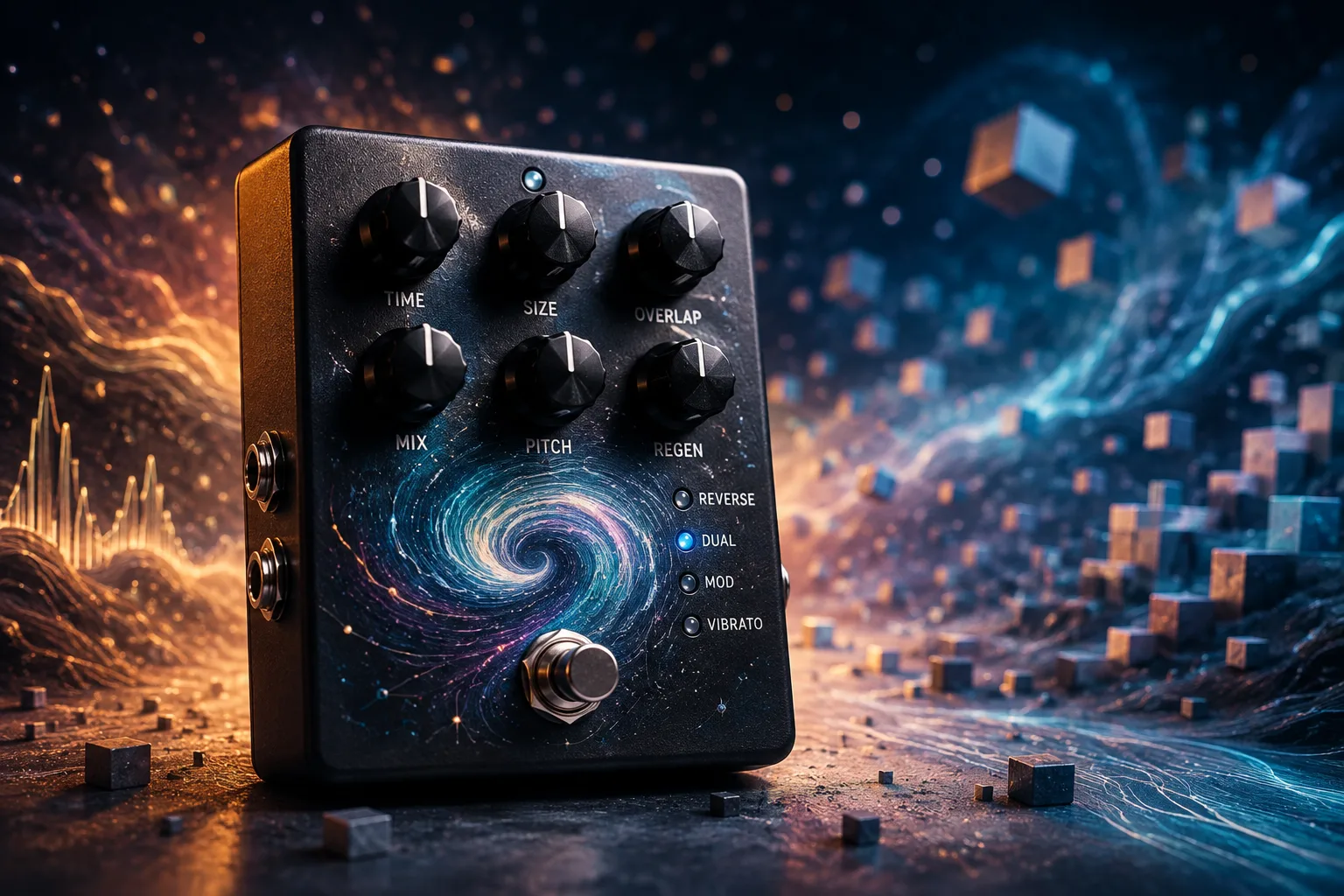
The front panel gives players six central controls labeled Time, Size, Overlap, Mix, Pitch, and Regen. Each one affects the way incoming audio is captured, divided, layered, and transformed, although their relationship becomes more important than any isolated setting. Time helps define the temporal behavior of the captured material, while Size influences the length and character of the individual grains. Overlap determines how closely those pieces interact, allowing the result to move from separated fragments toward dense, continuous clouds. Pitch changes the tonal position of the generated material, Mix balances the processed sound against the dry instrument, and Regen sends transformed audio back into the system to create evolving layers.
Those controls make Textures feel less like a pedal with one signature sound and more like a miniature instrument. A low-density setting may produce scattered digital sparks around a clean guitar line, leaving plenty of space between the original notes. Increasing the overlap can blur those sparks into a smooth pad that sits beneath the performance like an invisible synthesizer. Moving the pitch upward may generate crystalline harmonies, while lower settings can turn the same material into a shadowy sub-octave bed. Adding regeneration allows the fragments to keep feeding themselves, which can create beautiful evolving motion but can also send the sound toward controlled chaos when pushed aggressively.
Dedicated Mode and Reverse controls expand that range without forcing the player to navigate a screen. Reverse processing changes the direction of the captured grains, producing swells and backward motion that can feel disconnected from the physical attack of the guitar. Depending on the surrounding settings, the effect may resemble a reversed tape, an inhaling reverb, or a cluster of sounds moving against time. Other processing options introduce elements such as filtering, reverb, and vibrato, helping the grains develop a distinct shape instead of remaining as raw fragments. The pedal can therefore move from soft atmospheric support to rhythmic glitching without requiring an entirely different signal chain.
Eight Presets Lower the First Barrier
A pedal with this many interacting ideas could easily become overwhelming, particularly for guitarists who have never worked with granular synthesis. MXR addresses that issue by including eight factory presets that demonstrate different directions the engine can take. The available examples cover sounds such as regenerative octave loops, unstable polyphonic synth tones, glitch-like fragments, and sub-octave pads shaped by stuttering vibrato. These presets are not merely convenience settings for players who do not want to experiment. They function as practical lessons, allowing someone to hear a complete result first and then discover how individual controls change its behavior.
That approach is important because experimental gear often fails when it gives users unlimited possibilities without providing a meaningful starting point. A blank canvas can feel inspiring, but it can also make every knob movement seem random. By offering carefully designed examples, Textures creates a bridge between instant gratification and deeper exploration. A guitarist can load a preset, play a simple chord progression, and immediately hear the instrument transformed into something cinematic. From there, changing one parameter at a time helps reveal the internal logic of the sound, turning confusion into curiosity.
It Is More Than an Unusual Delay Pedal
Textures has a clear connection to delay because both effects involve recording audio and playing it back after the original event. That shared foundation may make the pedal feel somewhat familiar during the first few minutes, especially when the grains remain long enough to preserve the identity of the original notes. However, the similarity quickly disappears once the fragments are shortened, reversed, pitch-shifted, overlapped, or regenerated. A conventional delay asks how many times a note should return and how far apart those repetitions should be. A granular processor asks what the note can become after its internal structure has been taken apart.
This is why Textures should not be judged by the same standards used for a traditional echo pedal. Players looking for a clean slapback or a straightforward quarter-note repeat may find its potential excessive for that job. The pedal becomes more meaningful when the guitarist stops expecting every processed sound to remain neatly connected to the original phrase. It rewards sustained notes, unusual chord voicings, volume swells, pick scrapes, harmonics, muted attacks, and even the noise created while moving a hand across the strings. Anything that reaches the input can become part of the granular field, including details that would normally be treated as mistakes.
That relationship with imperfection gives the pedal a distinctly modern personality. Digital audio tools were once designed mainly to remove noise, correct timing, and preserve clarity, but contemporary music often celebrates damaged, unstable, and incomplete sounds. Producers intentionally stretch samples until they reveal artifacts, while artists use clipping, bit reduction, and digital distortion as emotional colors. Textures places the guitar inside that culture without requiring the musician to stop playing and edit a waveform. The transformation happens in real time, so the player can interact with the instability instead of applying it after the performance is finished.
How Textures Changes the Way Guitarists Perform
One of the most exciting qualities of granular processing is that it changes the feedback loop between the player and the instrument. With a familiar distortion pedal, the guitarist generally knows how a note will respond before it is played. Textures introduces a degree of unpredictability because previous fragments may continue evolving underneath each new phrase. The musician begins listening not only to the note being performed but also to the environment created by everything that came before it. This can lead to slower, more intentional playing, because leaving space becomes just as important as adding another chord.
In ambient settings, the pedal can function almost like an additional band member. A player may introduce a chord, allow it to dissolve into a shifting pad, and then improvise over the resulting harmony. The granular layer can hold emotional tension while the dry guitar moves elsewhere, creating the impression of multiple instruments interacting. Because the processed material comes from the guitarist’s own performance, the background texture remains connected to the composition even when it becomes difficult to recognize. This creates an organic quality that fixed backing tracks and conventional synthesizer pads may not provide.
The same engine can behave very differently in heavier music. Placed around distortion or fuzz, Textures can turn aggressive riffs into fractured pulses, metallic swarms, and collapsing walls of sound. A noise-rock guitarist might use high regeneration and reverse processing to make transitions feel as though the entire signal chain is breaking apart. Shoegaze players can blend the pedal with reverb and distortion to create layers that move beyond the familiar wash of traditional modulation. Experimental metal musicians may use short grains and unpredictable pitch movement to add mechanical tension around sustained chords and feedback.
Film Scoring Without Leaving the Pedalboard
Textures also makes sense as a compact scoring device because cinematic sound often depends on transformation rather than virtuosity. A single note can become unsettling when stretched, reversed, and surrounded by unstable overtones. A simple chord can feel enormous when its fragments continue shifting underneath the scene. For independent composers who work quickly, the pedal offers a way to record expressive sound design directly from the guitar without constructing every layer inside a computer. It can generate drones, transitions, pulses, atmospheric beds, and abstract effects while preserving the physical expression of a live performance.
This workflow may appeal to creators who feel disconnected from music when every decision is made with a mouse. Turning a physical knob while hearing a texture change can produce faster and more intuitive choices than editing automation lanes after recording. The performer can respond to the visual rhythm of a scene, increase density during a moment of tension, or lower the pitch as an image becomes darker. Small imperfections remain part of the result, giving the score a sense of movement that can be difficult to design through static samples. In that context, Textures becomes less of a special effect and more of a performance interface for shaping atmosphere.
Stereo Operation Makes the Grains Feel Larger
Granular effects become especially immersive when their fragments are allowed to move across a wide stereo field. Textures supports mono, wet-and-dry, and true stereo configurations, giving it flexibility for pedalboards, amplifiers, recording interfaces, and more elaborate live systems. A mono setup keeps the experience direct and practical, which may be ideal for players using a single amplifier onstage. A wet-and-dry arrangement can preserve the definition of the original guitar through one path while allowing the processed layer to expand through another. True stereo operation provides the broadest canvas, allowing the granular movement to feel less like an effect sitting on top of the guitar and more like a space surrounding it.
That flexibility matters because highly processed guitar sounds can lose impact when every layer competes in the same narrow frequency and spatial position. Separating dry and wet signals helps keep the player’s attack clear while the granular material develops behind it. In a studio, engineers can process each side differently, adding compression to the dry guitar while leaving the generated textures more dynamic. Live performers can send the direct signal toward a traditional amplifier and route the effected output into a full-range system. These possibilities make the pedal useful beyond the bedroom experiment, although they also encourage users to think carefully about routing and gain structure.
Where Textures Fits on a Modern Pedalboard
There is no single correct position for Textures because its response changes dramatically depending on what comes before and after it. Placing overdrive or fuzz before the pedal gives the granular engine a harmonically rich signal to capture, which can produce dense and aggressive fragments. Running distortion after Textures can make the generated grains feel more unified, as though the entire synthetic cloud is passing through one amplifier. Modulation before the pedal adds movement to the source material, while modulation afterward reshapes the completed granular layer. Reverb can be used on either side, but each placement creates a different sense of depth and distance.
Players exploring experimental guitar gear may initially get the clearest results by placing Textures after drive pedals but before a final reverb. This arrangement allows the granular engine to capture a developed guitar tone while the reverb places the completed result inside a larger acoustic space. However, moving Textures after the reverb can be equally interesting because the pedal will begin cutting the reverb tail itself into grains. That can produce soft clouds with fewer obvious pick attacks, making the guitar feel almost entirely detached from the strings. The best position will depend less on traditional signal-chain rules and more on the emotional role the pedal is expected to play.
Expression and external tempo control can add another level of performance, especially for players who want movement without bending down between songs. Tempo synchronization can help the fragmented rhythms interact with a drummer, sequencer, or electronic backing track. Gradual parameter changes can turn a stable pad into a rising shimmer or push a subtle texture toward complete disintegration. These transitions are valuable because they allow the effect to participate in the structure of a song rather than remaining at one static setting. A performer can use Textures for an entire arrangement, beginning with barely audible movement and ending in a dense granular collapse.
The Learning Curve Is Part of the Experience
Textures is unlikely to reveal everything it can do during a quick test in a crowded music shop. Its controls interact in ways that may initially produce results that feel unpredictable, especially when regeneration, grain size, pitch, and overlap are all changed at once. Players accustomed to pedals with one obvious sweet spot may need to adjust their expectations. The goal is not always to find a perfect setting and preserve it forever. Much of the value comes from learning how the processor reacts and developing techniques that guide its unpredictability.
A useful approach is to begin with one of the factory presets and play fewer notes than usual. Sustained chords, harmonics, and volume swells give the processor enough material to reveal its movement clearly. From there, changing a single control helps the ear understand what that parameter contributes to the texture. Reducing the wet mix can also make experimentation easier because the dry guitar remains available as a stable reference. Once the relationship between the controls becomes familiar, more extreme combinations start to feel intentional rather than accidental.
This learning process reflects a broader change in music technology. Modern gear increasingly sits between instrument, effect, and production environment, asking musicians to develop skills that were once associated with studio engineers or synthesizer programmers. That can seem demanding, but it also gives individual players more control over their identity. A guitarist no longer needs a large collection of separate devices to create pads, glitches, drones, pitch-shifted layers, and evolving ambience. One compact engine can cover those roles, provided the musician is willing to spend time building a personal language around it.
Why MXR Entering Granular Synthesis Matters
Granular pedals are not entirely new, but MXR entering this space carries symbolic weight. The company is one of the most recognizable names in mainstream pedal culture, and its products appear on boards used by beginners, touring professionals, and studio musicians. When a brand with that reach releases a dedicated granular engine, the technology moves closer to the center of the guitar market. What once felt like a niche technique for electronic composers and experimental specialists becomes something a much larger group of players may encounter. Textures therefore represents more than a single product launch; it suggests that advanced sound manipulation is becoming part of the normal vocabulary of guitar equipment.
The pedal also shows how traditional manufacturers are responding to a generation raised around digital production. Younger musicians often move between guitar, synthesizers, sampling apps, DAWs, and short-form video platforms without treating those worlds as separate cultures. They may want the physical immediacy of a stompbox but expect the sonic flexibility of software. Textures meets that expectation by placing a deep digital process behind a recognizable set of controls and footswitches. It respects the physical ritual of playing guitar while refusing to limit the instrument to sounds inherited from previous decades.
This does not mean classic pedals are becoming irrelevant. Straightforward compression, overdrive, modulation, and delay remain essential because they perform clear musical jobs with minimal effort. The significance of Textures is that it sits beside those traditional tools rather than attempting to replace them. A player can move from a familiar clean tone into a strange synthetic atmosphere using the same foot-based workflow that has defined pedalboards for generations. The old and new languages can coexist, and the contrast between them may produce some of the pedal’s most powerful moments.
Who Will Get the Most From MXR Textures?
The most obvious audience includes ambient guitarists, experimental composers, post-rock players, film scorers, and musicians who already treat effects as part of the writing process. These users will immediately recognize the value of transforming a short performance into a long, evolving layer. Producers who record guitar mainly as a source for sampling may also appreciate the ability to create unusual material before the signal reaches the computer. Noise artists can push the regeneration and pitch controls toward instability, while pop musicians may use subtler settings to add movement underneath a vocal. The pedal is flexible enough to support all of those roles, but it rewards people who enjoy discovery more than predictability.
Traditional guitarists may still find useful sounds inside Textures, provided they approach it selectively. A low mix setting can add a soft synthetic halo around clean chords without taking over the performance. Pitch-shifted fragments can create unusual harmonies behind a solo, while reverse grains may help connect sections of a song with atmospheric swells. The presets make it possible to find a musical starting point without understanding every technical detail. Even so, players who need every sound to remain consistent and easily repeatable may prefer a simpler effect designed around a narrower purpose.
The price also positions Textures as a serious creative investment rather than a casual novelty. Its launch price sits around the level expected for premium digital processing, reflecting the number of functions packed into the compact enclosure. Whether that cost feels reasonable will depend on how many roles the pedal replaces in a specific setup. For a guitarist who only wants occasional shimmer, a simpler reverb or pitch-delay pedal may be more practical. For someone who would otherwise combine several devices or rely heavily on granular software, Textures could become the central sound-design tool on the board.
MXR Textures Points Toward Guitar’s Next Era
The electric guitar has survived repeated predictions of its decline because musicians continue finding new ways to make it communicate. Every major shift in effects technology has expanded that conversation, from fuzz turning clean amplification into controlled destruction to delay transforming a single line into rhythmic architecture. Granular synthesis offers another step by treating the recorded identity of the note as something fluid. The guitar no longer has to remain recognizable after it enters the pedal. It can dissolve into particles, rebuild itself as harmony, and occupy a space somewhere between stringed instrument and synthesizer.
That transformation is the real appeal of the MXR Textures granular synth pedal. Its value is not measured only by the number of presets, controls, routing options, or unusual effects it contains. The pedal creates situations in which the guitarist must listen differently, leave more space, and react to sounds that continue changing after the original gesture has ended. It turns performance into a conversation between intention and surprise. In an era when digital tools can make almost any sound possible, Textures proves that the most exciting technology is often the one that makes a musician play in a new way.
MXR could have created another safe variation on a familiar effect, but Textures takes a more ambitious route. It brings granular processing into a compact format without pretending that the experience should be completely predictable or instantly mastered. The presets offer an accessible doorway, while the deeper controls leave enough uncertainty for years of experimentation. For guitarists who want their instrument to become a pad, a glitch machine, a cinematic generator, or an evolving source of digital atmosphere, this pedal opens an unusually wide path. The guitar enters the granular world not by abandoning its history, but by allowing every note from that history to be broken apart and imagined again.