
The guitar world moves fast, but new guitar gear July 2026 feels different because the latest wave is not just about louder amps, flashier finishes, or another boutique pedal with mysterious knobs. This month’s gear story is about players chasing more control, more texture, and more personality in a time when music culture is split between bedroom creators, touring pros, tone nerds, and casual players who still want their rig to feel inspiring every time they plug in. The interesting part is that July 2026 is not being defined by one single breakthrough product, but by a wider mood across guitars, pedals, pickups, bridges, acoustics, and digital tone tools. Instead of asking whether old-school gear or futuristic tech is winning, players are starting to build hybrid rigs where vintage feel and modern workflow sit on the same board. That is why this month’s most exciting releases are not only worth watching, but also worth understanding as clues about where guitar culture is heading next.
Why July 2026 Feels Like a Big Gear Month
Every year has a few gear moments that get players talking, but July 2026 has landed with a strangely balanced mix of premium effects, practical hardware, updated signature models, experimental acoustics, and digital ideas that feel closer to real-world use than hype. A few years ago, the guitar conversation often felt stuck between two extremes: either vintage purists defending tubes, wood, and analog circuits, or tech-forward players arguing that modelers and plugins could replace almost everything. Now the mood is more relaxed, and that makes the gear scene more interesting. Guitarists are not choosing one camp as much as they are choosing what helps them sound like themselves with less friction. This matters because modern players need rigs that work in a studio apartment, on a fly date, in a rehearsal space, on social video, and sometimes on a full stage with zero time for troubleshooting.
The latest July releases show that brands understand this shift. Delay pedals are becoming deeper without giving up tactile controls, bridge hardware is being treated like a tone-shaping upgrade instead of a boring replacement part, and acoustic guitars are leaning into storytelling as much as specification sheets. At the same time, signature guitars and pickups are no longer just celebrity merch for collectors. They are becoming snapshots of how certain tones, genres, and player identities keep evolving. For a site like Chordpunch, this is the perfect moment to look at new guitar gear July 2026 not as a shopping list, but as a map of what guitarists actually care about right now.
The Delay Pedal Is Still the Main Character
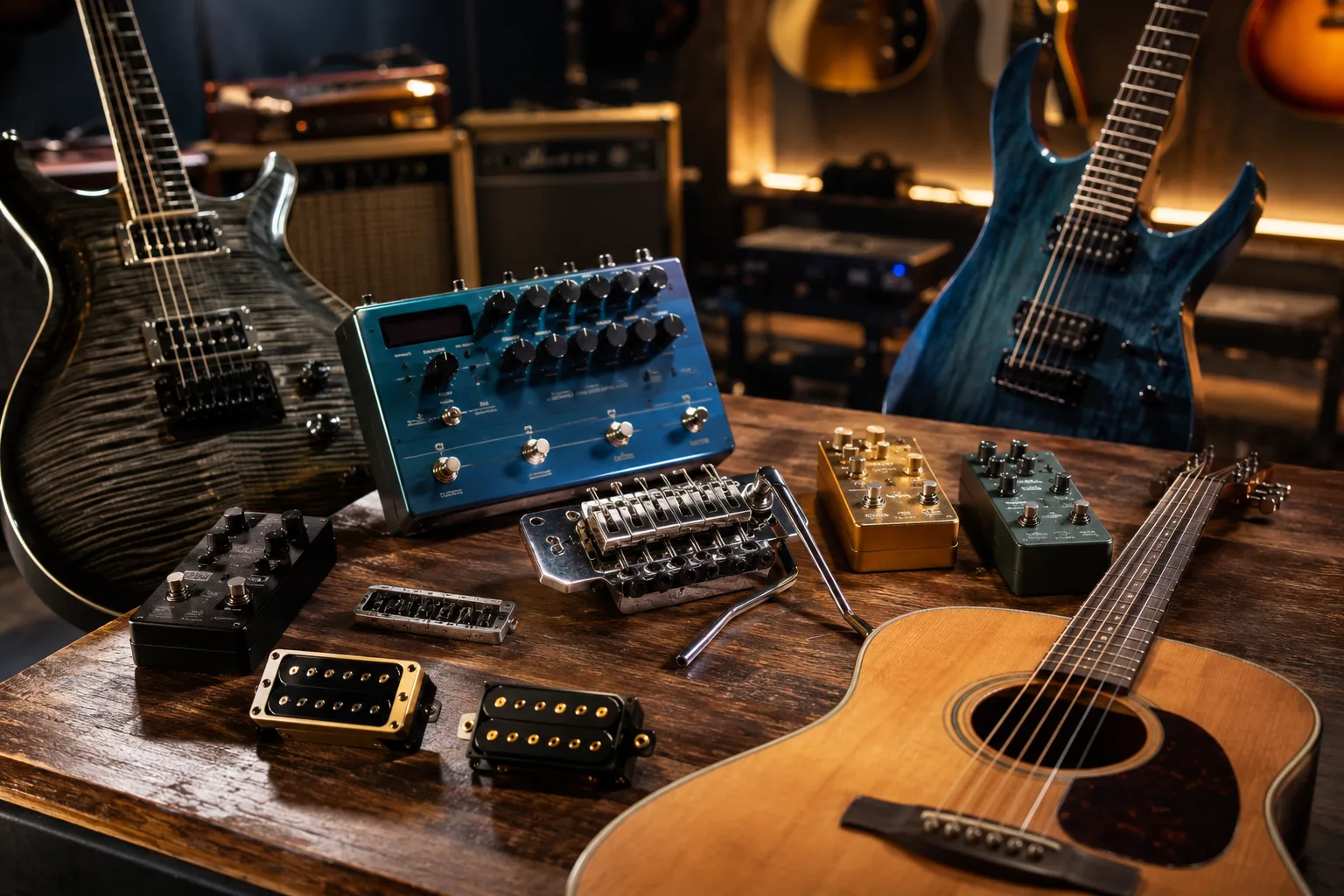
If one category is stealing the spotlight this month, it is delay. The Strymon TimeLine MX has become the kind of release that instantly divides the room, partly because it sits in the premium zone and partly because guitarists have very strong opinions about how much delay power they actually need. Some players only use slapback or a dotted eighth setting and still find themselves curious because high-end delay pedals have a way of turning simple ideas into cinematic spaces. The appeal is not just that a pedal can repeat notes, because even cheap delay pedals can do that beautifully. The real attraction is how a modern multi-delay unit lets a guitarist sculpt rhythm, atmosphere, stereo movement, looping, and performance transitions from one compact command center.
That is why the TimeLine MX conversation matters beyond its price tag. A pedal like this signals that there is still a strong market for serious hardware among players who could easily use plugins or modelers instead. The draw is immediacy, reliability, and the feeling of interacting with sound through knobs and footswitches rather than screens alone. For ambient players, worship guitarists, film-score-style composers, post-rock bands, and session musicians, advanced delay is not a luxury effect; it is part of the arrangement. When a delay pedal offers layered engines, stereo routing, looper functionality, MIDI control, and experimental textures, it becomes less like a single effect and more like an instrument inside the rig.
Why Expensive Pedals Still Get Attention
The obvious question is whether a guitarist really needs a premium delay when there are already excellent affordable options. The honest answer is that many players do not, and that is exactly why the debate is useful. Expensive pedals are rarely about need in the basic sense; they are about workflow, feel, depth, and how quickly a player can turn an idea into a finished sound. A budget delay can be perfect for a punk band, a garage setup, or a guitarist who wants one reliable echo setting. A flagship delay, however, makes more sense for players who treat time-based effects as part of their songwriting language and need presets, routing, expression control, and complex layers that survive live performance pressure.
This is also where guitar culture in 2026 gets more nuanced. Players are more informed than ever, so a big price tag does not automatically create hype. People compare specs, listen to demos, watch long-form reviews, read comments, and question whether a pedal is actually improving the creative process. That pressure is good for the industry because it forces brands to justify premium products with real usefulness, not just shiny packaging. In the case of high-end delay, the value depends on whether the pedal can inspire new parts, simplify a complex rig, and sound good enough that the player keeps reaching for it after the launch buzz fades.
New Guitar Gear July 2026 Shows Hardware Still Matters
Pedals often get the most attention because they are easy to demo and fun to argue about, but new guitar gear July 2026 also proves that guitar hardware is having a serious moment. The Gotoh and Babicz tremolo bridge collaboration is a good example of a category that casual players sometimes overlook until tuning stability, sustain, or feel becomes a daily frustration. A bridge is not glamorous in the same way as a fuzz pedal or signature guitar, but it can completely change how connected a guitar feels under the picking hand. When hardware makers focus on smoother operation, stronger contact points, and better energy transfer, the result can make an average instrument feel more alive. That kind of upgrade speaks to players who already love their guitar but want it to perform like a more refined version of itself.
This hardware trend also reflects a broader change in how players think about value. Instead of buying a new guitar every time they want a fresh tone or feel, many guitarists are upgrading specific parts of instruments they already trust. A better bridge, a smarter nut, locking tuners, improved electronics, or a more suitable pickup set can extend the life of a guitar and make it feel custom without requiring a full replacement. That is especially important in 2026, when many players are balancing gear curiosity with tighter budgets and more careful spending. For readers following gear reviews, the practical upgrades may end up being more useful than the flashy launches because they solve problems players actually notice every day.
Pickups Are Becoming Identity Pieces Again
Pickups have always been one of the fastest ways to change a guitar’s personality, but the current wave of updated signature models shows how much identity still matters in modern tone. Seymour Duncan’s Dave Mustaine Thrash Factor updates, for example, do not exist in a vacuum. They belong to a larger appetite for high-output, aggressive, articulate pickups that can handle modern gain while still nodding to classic metal DNA. Players want saturation, but they also want note separation, because heavy music in 2026 is not only about raw distortion. It is about riffs that stay tight on recordings, live mixes that do not collapse into mud, and guitars that can move between old-school attack and polished production.
The renewed focus on pickup finishes and visual presentation also says something about guitar culture. A pickup is no longer just a hidden electronic part that happens to sit under the strings. It is part of the guitar’s visual language, especially for players filming performances, creating gear content, or building instruments that need to look as intentional as they sound. This does not mean tone has become secondary, because serious players still care deeply about response, output, dynamics, and clarity. It simply means modern gear exists in both sonic and visual spaces, and brands that understand that connection are more likely to stand out.
Signature Guitars Are Getting More Specific
Signature guitars used to feel simple: take a famous player, copy their specs, add a name to the headstock story, and hope fans buy in. The July 2026 landscape is more layered than that. Fender’s Shoreline Gold version of Jim Root’s heavy-metal Telecaster shows how signature models can evolve without losing the original identity that made them appealing. The Telecaster shape has always carried a certain cultural weight, but in a stripped-down, high-gain format, it becomes something sharper and more modern. A finish update may sound minor, yet for a signature instrument, aesthetics can refresh the whole conversation and bring a familiar guitar back into the spotlight.
Epiphone’s Eric Church Dark Hummingbird acoustic moves in a different direction, leaning into character, mood, and storytelling rather than pure technical aggression. That kind of guitar is not trying to win a spec war. It is built around vibe, songwriting, and the emotional connection that acoustic players often value more than extreme versatility. Martin’s Shawn Mendes-inspired models also fit into this trend, especially because artist-linked acoustics often sell a feeling as much as a feature set. In a culture where young musicians discover instruments through clips, live sessions, intimate performances, and artist stories, signature acoustics can become entry points into a deeper relationship with guitar.
Why Artist Models Still Work in 2026
Artist models still work because guitarists do not only buy tools; they buy context. A guitar associated with a player can suggest a sound, a genre, a stage presence, or a creative attitude before anyone even plays the first chord. That does not mean every signature guitar is automatically great, and smart buyers should always judge playability, build quality, and value on their own terms. Still, the best artist models offer a shortcut into a world that players already admire. When the specs are useful and the story feels authentic, a signature guitar can become more than a collectible and turn into a serious everyday instrument.
Ambient Texture Is Becoming a Core Sound
One of the clearest trends in new guitar gear July 2026 is the rise of texture as a central part of guitar tone. Walrus Audio making the Lüm Texture Engine a permanent Core Series fixture is a strong signal that ambient, cinematic, and sound-design-friendly effects are not just niche experiments anymore. Guitarists increasingly want tools that blur the line between reverb, modulation, pad-like sustain, and atmospheric movement. This is partly because modern music production has changed what guitar is expected to do. A guitar does not always need to sit in the front of the mix with a riff; sometimes it needs to create width, mood, tension, or emotional color behind a vocal.
This texture-first mindset has been growing across indie, worship, ambient, pop, alternative, and even heavier experimental music. Players who once built boards around drive, delay, and reverb as separate boxes are now looking for pedals that behave more like creative environments. That does not replace traditional guitar playing, but it expands what a guitarist can contribute. A single chord can become a wash, a swell can become a transition, and a simple melodic fragment can become the emotional center of a track. For creators producing at home, these tools are especially powerful because they can make a small setup feel cinematic without requiring a huge studio chain.
Acoustic Guitars Are Selling Stories, Not Just Specs
The acoustic side of July 2026 is just as interesting because it is less obsessed with raw innovation and more focused on feel, heritage, and personality. Bourgeois making premium acoustic models more accessible to North American players points toward a growing appetite for high-end craftsmanship that still feels grounded in tradition. Meanwhile, artist-driven acoustics from brands like Epiphone and Martin show that players are still drawn to guitars with a narrative. Unlike electric gear, where specs can dominate the conversation, acoustic guitars often win people over through resonance, touch response, body shape, and the feeling of sitting with an instrument that encourages a song to happen. That emotional factor is hard to measure, but it is central to why acoustic guitar remains culturally strong.
There is also a quiet reaction happening against over-complicated music tech. After years of screens, plugins, updates, presets, and AI-assisted workflows, many players want at least one instrument that feels direct and human. A great acoustic guitar does not need a firmware update, and that simplicity has become part of its appeal. At the same time, modern acoustic buyers are not stuck in the past. They still care about pickup systems, stage reliability, sustainable materials, comfortable necks, and designs that work for recording as well as live performance. The result is a market where tradition and modern usability are not enemies, but partners.
Bold Electric Designs Are Back in the Chat
Kiesel’s Antares double-cut guitars reflect another July 2026 theme: bold electric design is finding a fresh audience. For years, the guitar market often leaned heavily on familiar shapes because players love tradition and brands know nostalgia sells. But a new generation of guitarists is more comfortable with instruments that look custom, futuristic, and slightly outside the usual vintage template. This does not mean classic shapes are fading, because Strat-style, Tele-style, Les Paul-style, and offset guitars are still everywhere for good reasons. It means there is more room for instruments that feel like they were designed for modern technique, visual impact, and online-first music culture.
Bold guitars serve a different purpose than vintage-inspired models. They can make a player feel less like they are borrowing someone else’s history and more like they are building their own lane. Extended-range options, ergonomic contours, aggressive horns, unusual finishes, and high-performance necks all speak to players who grew up with metal, fusion, prog, anime soundtracks, game music, and internet-native guitar heroes in the same ecosystem. These players do not see technical performance and visual identity as separate things. They want a guitar that looks ready for the music they are making now, not only the music their heroes made decades ago.
Budget Awareness Is Shaping the Gear Conversation
Even with premium gear making headlines, July 2026 is also heavily shaped by budget awareness. Sales on guitars, amps, and pedals matter because many players are not casually dropping huge money on every exciting release. A discounted shred-ready electric, a classic clean amp with a rare price cut, or a reliable affordable seven-string can be more relevant to everyday musicians than a flagship pedal. This is especially true for younger players, gigging musicians, and home producers who need gear that can survive multiple roles. The best budget gear is not cheap in spirit; it is practical, inspiring, and good enough to keep up with serious creative work.
This makes the current market more interesting because the gap between affordable and premium gear is not as simple as it used to be. Entry-level guitars are better built, budget pedals are more usable, and affordable amps often deliver tones that would have shocked players twenty years ago. Premium gear still has a place, especially when it saves time, offers deeper control, or brings a unique response. But players are more willing to mix price tiers now, pairing an expensive delay with a budget guitar, or a boutique pickup set with a midrange instrument. That mixed-rig mentality is one of the healthiest trends in modern guitar culture because it focuses on results instead of status.
Digital Tone Is Getting Closer to the Player
While this article focuses on physical gear, the digital side cannot be ignored because it is changing what guitarists expect from every product category. Neural amp modeling, mobile processing, compact modelers, and smarter plugins are pushing high-quality tone into smaller and more flexible environments. The important shift is not simply that digital sounds better, although it does continue to improve. The bigger shift is that digital tone is becoming more immediate, portable, and performance-friendly. When guitarists can practice silently, record convincing parts, switch amp characters instantly, and still use real pedals around the setup, the old line between hardware and software becomes less useful.
This puts pressure on traditional gear brands, but it also creates opportunity. A great pedal must feel great, a great amp must justify its physical presence, and a great guitar must offer something that cannot be replaced by a preset. That might sound intimidating, yet it actually brings the focus back to experience. Physical gear that inspires touch, movement, dynamics, and emotional commitment still has a powerful role. Digital tools are not killing guitar gear; they are forcing every product to be more intentional. For more practical context, players can explore music guides that connect tone choices with real playing situations instead of treating every release like isolated hype.
What This Means for Modern Guitarists
The most useful way to read the July 2026 gear wave is not to ask which product is objectively the best. A touring guitarist, a bedroom producer, a blues player, a metal rhythm player, an acoustic songwriter, and an ambient soundscaper all need different things. The smarter question is what problem a piece of gear solves or what creative door it opens. A premium delay might be transformative for someone building layered arrangements, but unnecessary for a player who mainly needs a tight slapback. A bridge upgrade might be invisible in a social media demo, yet it could make a favorite guitar finally stay in tune through a full set.
This is why gear buying in 2026 should be more personal than trend-driven. The best purchase is often the one that removes friction from your actual playing life. If you record often, then noise, routing, and recall matter more than stage looks. If you gig, then reliability, fast controls, and durability matter more than deep menu options. If you write songs, then the instrument that makes you play longer may be more valuable than the one with the most impressive spec sheet. Modern guitar culture gives players more options than ever, but the real win is learning which options support your own musical habits.
How to Choose from the New July 2026 Gear Wave
Choosing from the current gear wave starts with being honest about your rig, not your fantasy rig. It is easy to watch demos and imagine a completely new version of your sound, but the better move is to identify what currently slows you down. Maybe your delays sound flat, your guitar will not hold tuning, your acoustic does not record well, or your pickups get blurry under gain. Once the problem is clear, the right category becomes easier to choose. That mindset protects you from hype while still leaving room for excitement, because gear should be fun as well as functional.
- Choose advanced delay or texture pedals if your music depends on atmosphere, transitions, stereo movement, or preset-based live control.
- Choose hardware upgrades if you already love a guitar but struggle with tuning, sustain, tremolo feel, or performance stability.
- Choose pickup upgrades if your amp and playing style are solid, but your guitar lacks clarity, aggression, warmth, or dynamic response.
- Choose a new acoustic if songwriting feel, recording response, and physical comfort matter more than adding another electric tone.
- Choose discounted guitars or amps if you need dependable tools now and want maximum value without chasing every premium release.
The main point is that each category serves a different creative purpose. A pedal can reshape the space around your notes, but it will not fix a guitar that fights your hands. A new pickup can add power and focus, but it will not teach a bad arrangement how to breathe. A boutique acoustic can inspire new songs, but only if its body shape and voice match the way you actually play. Gear becomes meaningful when it connects directly to a musical need, and the July 2026 releases offer enough variety for almost every kind of guitarist to find something relevant.
The Bigger Trend: Guitar Is Not Stuck
The deeper story behind new guitar gear July 2026 is that guitar is not stuck, even if people keep trying to frame the instrument as a nostalgia machine. The latest products show a scene that is still arguing, experimenting, remixing old ideas, and chasing new sounds. Some players want premium delay engines, some want better tremolo stability, some want signature metal machines, and others want acoustic instruments that feel like companions rather than products. That variety is a sign of health. A stagnant guitar culture would produce the same safe releases forever, but this month’s gear spread shows that brands and players are still pushing in multiple directions at once.
It also proves that guitar’s future is not one single lane. The future is analog and digital, expensive and affordable, vintage-inspired and futuristic, stage-ready and bedroom-friendly. A guitarist in 2026 might write a song on a heritage-style acoustic, record it through a neural amp app, add texture from a high-end delay pedal, and perform it live on a modified midrange electric. That kind of workflow would have sounded messy in the past, but now it feels completely normal. The instrument keeps surviving because it adapts to whatever musicians need from it, and July 2026 is another reminder that adaptation can sound exciting.
Conclusion: The Gear Worth Watching Now
At the end of the day, new guitar gear July 2026 is worth watching because it captures the current guitarist mindset better than any single product launch could. Players want depth, but they also want practicality. They want premium sounds, but they are more careful about value. They want modern workflows, but they still care about touch, wood, metal, magnets, switches, and the physical thrill of plugging in. The best gear this month is not just shiny; it is gear that reflects how musicians actually create in 2026.
For some players, the headline item will be a serious delay pedal that turns a small board into a cinematic machine. For others, the smartest move will be a bridge upgrade, a pickup swap, a discounted guitar, or an acoustic that makes writing feel natural again. The bigger lesson is that guitar gear is no longer about choosing between tradition and technology. It is about building a setup that lets your ideas move faster from your hands to the listener. That is why this July’s releases deserve attention, not because every guitarist needs every item, but because they show a scene that is still alive, still opinionated, and still full of sound waiting to be discovered.