

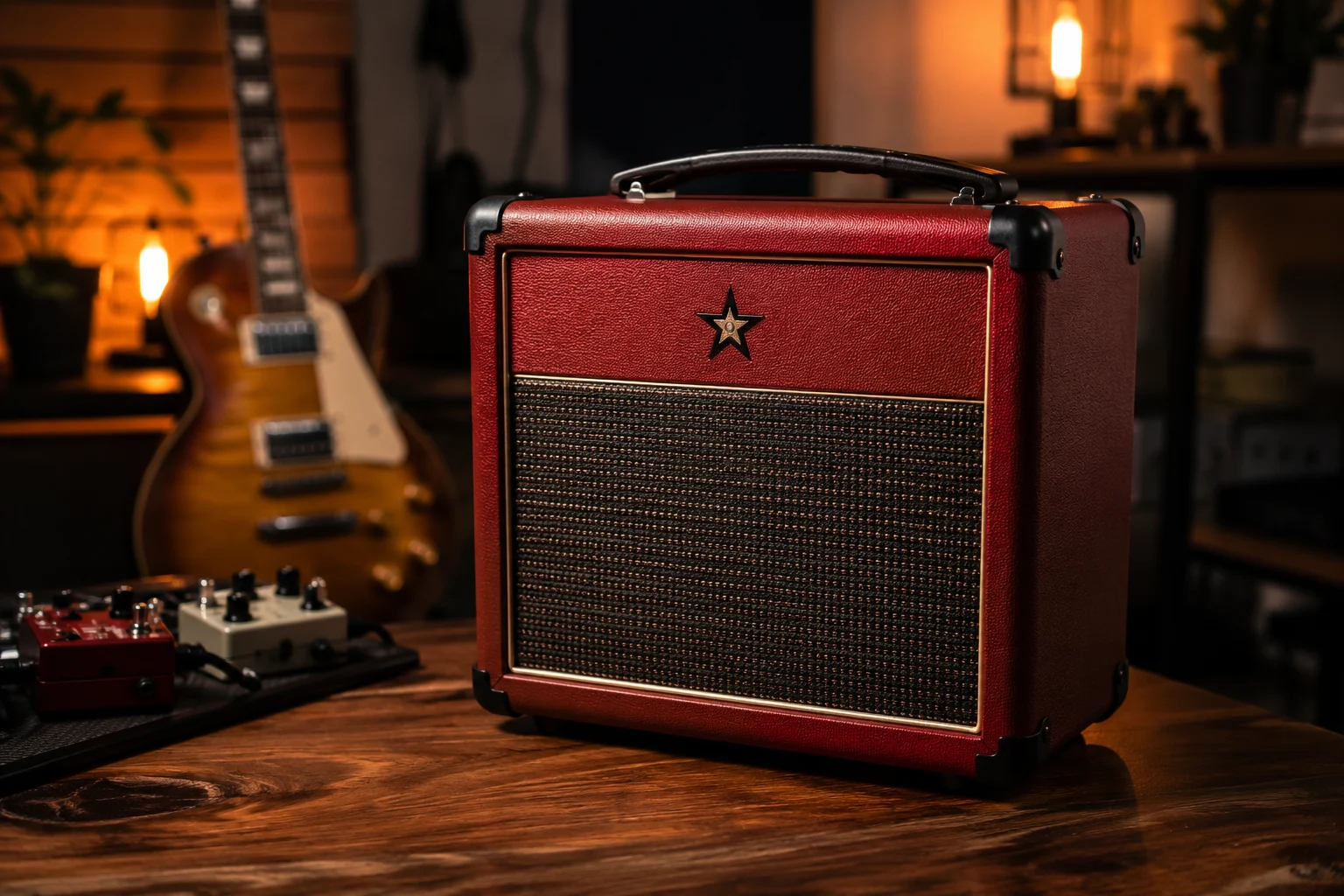
The first thing that makes the Blackstar DA5 Ruby feel interesting is not just its size, but the promise behind it. Guitar players have spent years chasing huge tube-amp energy while living in smaller rooms, recording in tighter spaces, and trying not to start a volume war with neighbors. That tension is exactly where this compact signature combo starts to make sense, because it takes the attitude of a stage-focused rock amp and pulls it into a format that feels realistic for modern players. The Blackstar DA5 Ruby is not trying to be another cute practice amp that looks good in a bedroom but disappears when the tone gets serious. It is aiming for something more specific: a small all-valve combo with enough punch, character, and recording flexibility to make guitarists rethink what a mini amp can actually do.
Why the Blackstar DA5 Ruby Feels Like a Big Deal
Mini amps used to sit in a very predictable corner of guitar culture, mostly seen as beginner gear, travel gear, or something you grabbed when the “real amp” was too loud to use. That perception has changed because the way people play, record, and share music has changed just as quickly. A guitarist today might be writing riffs at midnight, tracking ideas into a laptop, filming short-form clips, rehearsing quietly, and still wanting a tone that feels alive under the fingers. The Blackstar DA5 Ruby lands right in that new reality, where convenience matters but compromise still feels annoying. It is a product that understands the modern player is not always standing on a huge stage, but still wants the emotional hit of a proper amp pushing air.
The story gets more compelling because this amp is tied to Doug Aldrich, a guitarist known for bold, muscular rock tone rather than tiny bedroom sounds. That contrast gives the DA5 Ruby its identity, because it is not marketed as a polite little practice box with a famous name slapped on the front. Instead, it carries the vibe of a signature rig that has been scaled down with intention, keeping the feel of a hot-rodded rock platform while making it easier to use at home, in a studio, or in a small live setup. For a gear world obsessed with portability, this approach feels extremely current. It also makes the amp a natural fit for readers who follow modern guitar gear reviews and care about whether compact equipment can still sound inspiring.
The Mini Amp Era Is No Longer Basic
There was a time when small guitar amps were judged with softer expectations, almost like everyone agreed not to be too harsh because the format had obvious limits. If the clean tone was usable, the gain channel had enough bite, and the speaker did not sound like cardboard, most players considered it acceptable. That mindset does not really work anymore because home studios have become sharper, guitar content has become more tone-conscious, and even casual players know what a good amp is supposed to feel like. The Blackstar DA5 Ruby enters a market where small gear has to earn respect, not just convenience points. In that sense, it reflects a bigger cultural shift where compact does not automatically mean entry-level, cheap, or disposable.
Part of this shift comes from the rise of creator-driven musicianship, where players need gear that works across different situations without slowing them down. A traditional full-size tube rig still has its magic, but it can feel impractical when a guitarist is recording in an apartment, testing riffs between work sessions, or making quick demos before an idea disappears. Mini amps now have to function as creative hubs rather than backup toys, and that raises the bar for sound, feel, connectivity, and design. The DA5 Ruby seems built with that pressure in mind, because it blends tube architecture with direct recording tools and silent practice options. That combination makes it feel less like a compromise and more like a realistic answer to how guitarists actually live.
Blackstar DA5 Ruby and the Search for Real Tube Feel
The phrase “tube feel” gets thrown around a lot, but players usually know when it is missing. It is not only about warmth or gain, and it is definitely not just nostalgia for glowing valves behind a metal grille. What guitarists often mean is the way an amp responds when the pick attack changes, when the guitar volume rolls back, or when a chord blooms instead of flattening out. The Blackstar DA5 Ruby leans into that conversation by using a compact all-valve design that tries to keep the response touch-sensitive and expressive. For players who have tried many small amps that sound decent but feel stiff, that detail matters more than a long list of flashy features.
A five-watt amp might sound modest on paper, but wattage does not tell the whole story when the design is focused on feel and speaker movement. In many home and studio situations, lower wattage can actually be an advantage because the amp can be pushed into a more responsive zone without becoming unusably loud. That is especially important for players chasing saturated rock tones, since the best sounds often happen when the amp feels awake rather than barely breathing. The Blackstar DA5 Ruby appears to understand that balance, giving guitarists a way to reach expressive compression and punch at a volume that makes sense outside a festival stage. It is the kind of design choice that turns a small amp into a serious creative tool.
Why Power Scaling Matters for Real Players
Power scaling is one of those features that looks simple on a spec sheet but can change how often someone actually uses an amp. A loud amplifier that only sounds good when everyone in the building can hear it becomes a weekend luxury, not a daily writing partner. When an amp can reduce output while keeping a more natural tube character, it becomes easier to use during quiet practice, late-night recording, and small-room sessions. The DA5 Ruby’s reduced-power approach fits that exact need, especially for guitarists who want the amp to feel pushed without turning every riff into a noise complaint. In practical terms, this makes the difference between owning inspiring gear and actually playing it every day.
A Signature Amp Built Around Attitude
Signature gear can sometimes feel confusing because not every player wants to sound exactly like the artist on the badge. The best signature products avoid that trap by capturing a useful philosophy rather than forcing one narrow tone. In the case of the Blackstar DA5 Ruby, the philosophy is clear: bold rock tone, strong midrange presence, responsive gain, and enough versatility to move between polished lead work and gritty rhythm parts. That makes the amp interesting even for guitarists who are not chasing Doug Aldrich’s exact sound. It becomes less about imitation and more about accessing a powerful voice in a compact, flexible package.
This matters because modern guitarists are not always locked into one genre identity anymore. A player might love classic hard rock, write alternative riffs, record bluesy leads, experiment with cinematic clean parts, and still want one amp that can move with them. The DA5 Ruby’s two-channel setup and voicing options make that kind of range easier to imagine, especially when paired with pedals or recording workflows. A compact amp with only one usable sound can get old quickly, but a compact amp with a real sense of character and range has a much longer creative life. That is why this release feels less like a novelty and more like a carefully positioned tone machine for the current era.
The Speaker Might Be the Secret Weapon
Small amps often rise or fall on the speaker, because even a great circuit can feel underwhelming if the speaker sounds thin, boxy, or disconnected from the player. Guitarists notice this quickly when palm-muted riffs lack weight, open chords feel papery, or lead lines sit too small in the room. The Blackstar DA5 Ruby puts real emphasis on its speaker design, which is important because a five-watt combo needs every part of the signal chain to contribute. A well-voiced speaker can make the amp feel larger than its cabinet suggests, giving the player more body, projection, and confidence. That is especially valuable for rock tones, where size is not only volume but also the impression of weight behind each note.
This is where the DA5 Ruby seems to push against the usual fear surrounding mini amps. Players are not only asking whether a small amp can be loud enough, because many small amps can already get louder than expected. The better question is whether it can feel full enough, especially when recorded with direct outputs or placed in a room without studio trickery. A strong speaker gives the amp a physical dimension that plugins and tiny practice boxes sometimes struggle to recreate. For guitarists who care about feel, that physical response can become the reason they reach for the amp instead of just opening another amp simulator.
Recording Features That Fit Modern Workflows
The modern mini amp cannot just sound good in the room, because a huge part of today’s guitar culture happens through recording, streaming, and sharing. Players want to capture ideas quickly without building a complicated signal chain every time inspiration hits. That is why the direct recording side of the DA5 Ruby is so important, especially with cab simulation and practical output options included in the package. A guitarist can use the amp as a traditional combo, but also route it into a computer or recording setup without needing a microphone, interface gymnastics, or a perfectly treated room. This makes the amp feel more like a bridge between old-school tube response and the fast, flexible creative habits of 2026.
Direct recording has also changed the way guitarists evaluate amps, because convenience is now part of tone culture rather than a separate bonus. If a great riff takes too long to capture, the creative spark can disappear before the gear is ready. The DA5 Ruby’s recording-friendly design helps reduce that friction, giving players a way to track authentic amp-driven parts without turning the process into a technical puzzle. That does not mean microphones and cabinets are suddenly irrelevant, because many players still love the depth and randomness of a real mic in front of a speaker. It simply means the amp respects both worlds, which is exactly what a modern compact tube amp needs to do.
Why Cab Simulation Is Now Essential
Cab simulation used to feel like a convenience feature, but now it is close to essential for guitarists who record frequently. A raw amp signal without a speaker or cabinet sound can be harsh, fizzy, and difficult to place in a mix. Good cab simulation helps the recorded tone feel finished faster, which matters when someone is building demos, layering parts, or sending ideas to bandmates remotely. The Blackstar DA5 Ruby benefits from this expectation because it is not only trying to be a small amp in a room. It is also trying to be a practical recording partner for players who want usable tones without spending the whole evening editing impulse responses.
Tone Culture Is Moving Toward Smaller Rigs
The rise of amps like the DA5 Ruby says something bigger about guitar culture right now. Players still romanticize huge stacks, loud stages, and legendary rigs, but many are building their real musical lives around smaller, smarter setups. That does not mean the dream of a massive rig has disappeared, because the emotional pull of a big amp is still powerful. It means the daily reality of guitar has shifted toward gear that can fit into apartments, bedrooms, compact studios, and hybrid rehearsal spaces. In that environment, the Blackstar DA5 Ruby feels like part of a broader movement where serious tone is no longer tied to oversized equipment.
This trend also reflects how guitarists now discover and compare sounds online. A player might hear a compact amp in a video, compare it against plugins, check how it handles pedals, and decide whether it belongs in a home setup before ever walking into a store. The old hierarchy, where big amps automatically felt more legitimate, is weaker than it used to be. What matters now is whether the gear solves real creative problems while still making the player feel something. The DA5 Ruby is compelling because it speaks to that exact mix of practicality and emotion, which is where modern gear decisions often happen.
Who the Blackstar DA5 Ruby Is Really For
The obvious audience for the Blackstar DA5 Ruby is the rock guitarist who wants big gain energy in a smaller format. That player might already love tube amps but feel tired of gear that is too loud, too heavy, or too inconvenient for everyday use. The amp also makes sense for home studio musicians who want a real valve response without building an entire amp room around it. It could appeal to content creators, session-minded players, and weekend guitarists who need something inspiring but manageable. In other words, it is not only for fans of one artist, because the core appeal is much wider than that.
There is also a strong case for intermediate players who are growing out of basic practice amps and want something that feels more serious. A good compact tube combo can teach a player a lot about dynamics, because it responds more clearly to picking strength, guitar volume changes, and subtle hand movement. That kind of feedback can shape better habits in a way that overly compressed beginner amps sometimes do not. The DA5 Ruby may be compact, but it encourages the player to engage with tone in a deeper way. For someone building their first serious home rig, that could make it a meaningful step forward rather than just another small amp purchase.
The Design Has Stage DNA, But Home Logic
One of the most interesting parts of the DA5 Ruby concept is the way it blends two different worlds. On one side, it carries stage DNA through its signature connection, rock-focused voice, and tube-driven attitude. On the other side, it is clearly shaped by home logic, with manageable power, compact size, direct recording, and silent practice features. That balance is difficult to get right because an amp can easily become too domesticated and lose the fire that made the original idea exciting. The Blackstar DA5 Ruby works as a concept because it does not seem embarrassed about being small, but it also does not want to sound small.
This is exactly the kind of gear design that feels relevant now, especially as players expect one piece of equipment to handle multiple roles. A guitarist may want to practice quietly in the morning, record a riff in the afternoon, rehearse with friends later, and still have a tone that feels consistent across those moments. A traditional large amp might dominate one of those situations while failing the others. A compact hybrid-minded tube combo can feel more balanced, especially when it has enough personality to avoid becoming generic. That is where the DA5 Ruby finds its lane, and that lane feels very current.
How It Fits Into a Pedal-Based Setup
Pedals are another major part of the modern guitar ecosystem, so any amp in this category has to make sense as a platform. Many players do not want an amp that forces them into one sound and fights every overdrive, delay, or modulation pedal they place in front of it. They want an amp with its own voice, but they also want enough flexibility to build a personalized chain around it. The Blackstar DA5 Ruby looks promising in that context because its channel structure and voicing control suggest it can handle more than one role. It can be the core overdrive sound for rock players, but it can also act as a compact tube foundation for a pedalboard.
For players who use pedals heavily, the value of a small tube amp is not only about gain. It is also about how delays trail off, how modulation sits against the midrange, and how drive pedals stack into an already responsive front end. A compact amp that compresses naturally can make pedals feel more connected, especially when compared with sterile practice setups that exaggerate the wrong frequencies. The DA5 Ruby’s appeal grows if it can make a pedalboard feel alive at home-friendly levels. That would place it in a sweet spot for guitarists who want both amp character and pedalboard freedom without needing a giant rig.
Why Visual Identity Still Matters
Gear culture is not only about sound, even if guitarists sometimes pretend otherwise. The way an amp looks can shape how players connect with it, especially when the gear lives in a studio corner, appears in videos, or becomes part of a personal creative space. The Ruby aesthetic gives the DA5 a strong visual identity, making it feel more like a signature object than a plain utility box. That matters in an era where music gear is photographed, filmed, reviewed, and shared constantly. A compact amp with a memorable look can become part of a player’s environment in a way that generic black boxes often do not.
Still, visual style only works when it supports the personality of the amp rather than distracting from it. The red finish makes sense because the sound concept is bold, hot, and rock-oriented. It communicates energy before the first chord is even played, which is useful for a product that wants to feel exciting despite its small size. Guitarists often form emotional attachments to gear that feels distinct, and that emotional layer should not be underestimated. The Blackstar DA5 Ruby seems designed to be recognized quickly, which helps it stand out in a crowded compact amp market.
The Bigger Trend: Serious Gear for Small Spaces
The DA5 Ruby belongs to a larger trend that is reshaping music equipment across categories. Producers are using smaller interfaces with better converters, guitarists are choosing compact modelers and lunchbox heads, and bedroom studios are producing tracks that compete with traditional rooms. In this landscape, serious gear has to be powerful without demanding huge physical space. The Blackstar DA5 Ruby fits that shift because it brings premium-feeling tube amp ideas into a format that does not require a dedicated rehearsal room. It reflects a future where the best setup is not always the biggest one, but the one that keeps creativity close and easy to access.
This matters especially for younger players, apartment musicians, and independent artists who are building careers from flexible spaces. They may not have the luxury of storing multiple cabinets, cranking a hundred-watt head, or booking a studio every time they need guitar tracks. What they do have is taste, ambition, and a need for tools that do not slow them down. A compact tube combo with recording features speaks directly to that reality. The DA5 Ruby is interesting because it does not treat small-space players like beginners; it treats them like serious musicians with modern constraints.
Is the Blackstar DA5 Ruby More Than Hype?
Every new signature amp arrives with a wave of excitement, and some of that is simply how the gear cycle works. A famous name, a bold finish, and a strong feature list can create attention before players have even tested the amp in real rooms. The question is whether the Blackstar DA5 Ruby has a concept strong enough to outlive the launch moment. Based on the direction of the design, the answer looks promising because the amp is built around real use cases rather than empty spectacle. It addresses volume, feel, recording, aesthetics, and portability in a way that aligns with how guitarists are actually working now.
The real test will always come from players putting it into everyday situations. If it can deliver convincing tube response at home, sit well in recordings, handle pedals gracefully, and still feel fun after the honeymoon phase, it could become more than a niche signature combo. That is the difference between gear that gets attention and gear that stays plugged in. The DA5 Ruby has the right ingredients to become the latter, especially for players who want a compact amp that does not feel like a downgrade. In a market crowded with digital convenience, its tube-driven identity may actually become its strongest advantage.
Conclusion: Big Tone Is Getting Smarter
The Blackstar DA5 Ruby feels important because it captures where guitar gear is heading without abandoning what players still love about traditional amps. It recognizes that tone is emotional, physical, and personal, but it also accepts that modern musicians need flexibility, lower volume, recording convenience, and gear that fits real living spaces. That combination makes the amp more than a smaller version of a bigger idea. It becomes a symbol of a smarter approach to big tone, where power is not measured only by wattage or cabinet size. For guitarists chasing rock attitude in a compact setup, the DA5 Ruby makes the mini amp conversation feel a lot more serious.