
The Orchid synth lands in modern music culture like a strange little dare: what if writing a song did not have to begin with a blank screen, a piano roll, or a fight with music theory? For a generation of bedroom producers, indie guitarists, loop builders, and late-night demo makers, that question hits harder than it looks. Songwriting today often happens between tabs, plugins, phone notes, and half-charged MIDI controllers, so any instrument that makes the first move feel easier instantly becomes interesting. Orchid is not trying to be the biggest synth in the studio, and that may be exactly why people are paying attention. It feels built around the emotional moment before a song exists, when the idea is still soft, messy, and waiting for a shape.
Why the Orchid Synth Feels Different Right Now
Most music gear arrives with the same kind of pitch: more power, more presets, more engines, more routing, and more reasons to open the manual before touching anything. The Orchid synth moves in the opposite direction by focusing on chords, immediacy, and the kind of harmonic movement that can turn a vague mood into a real progression. That makes it feel less like a traditional keyboard and more like a songwriting companion, especially for artists who hear songs in colors, textures, and emotional shifts rather than strict theory terms. In an era where many producers already have unlimited sounds inside a laptop, the valuable thing is no longer just sound generation. The valuable thing is momentum, and Orchid seems designed to protect that fragile creative momentum before overthinking kills it.
This is why the instrument has become such a strong conversation piece in gear circles and modern songwriting communities. It sits between hardware synth, chord generator, sketchpad, and performance tool, which makes it slightly difficult to place in a normal buyer’s guide. That confusion is part of the charm, because the most interesting instruments often resist clean categories at first. A guitarist may see it as a way to escape familiar fretboard shapes, while a producer may treat it as a fast harmonic launcher for beats, pads, and toplines. Instead of asking users to master a deep synthesis architecture from day one, Orchid asks a more inviting question: what happens if you can reach a lush chord before your inner critic wakes up?
A Songwriting Tool, Not Just Another Pretty Synth
The biggest mistake would be judging Orchid only by the standards of a conventional synthesizer. If someone wants a huge workstation, a modular brain, or a fully open sound-design universe, there are already plenty of machines built for that kind of deep control. Orchid’s appeal is more specific and, in many ways, more personal. It is aimed at the songwriter’s first spark, where the right chord change can unlock an entire chorus or shift a sleepy loop into something that suddenly feels alive. That makes it closer in spirit to a trusted notebook than a spec-sheet monster, even though it still lives in the world of electronic instruments.
For songwriters, the beginning of a track can be the most exciting and the most annoying phase at the same time. You may have a vocal phrase, a drum groove, or a mental image of a late-night drive, but no harmonic center to hold it together. Traditional keyboards can solve that, but they can also expose gaps in theory knowledge or push players back into the same hand shapes they always use. The Orchid synth tries to soften that pressure by making chord exploration feel direct and playful. Instead of turning composition into homework, it gives users a way to move through harmonic ideas with less friction and more curiosity.
The Power of Chords Before Details
There is a reason chord-focused instruments keep coming back across different music eras. Chords are not just musical information; they are emotional architecture. A single major seventh can make a room feel cinematic, a minor progression can pull the mood inward, and a suspended chord can leave a chorus floating in midair. When an instrument puts those emotional colors close to the surface, it changes the writing process from technical construction into guided discovery. That is where Orchid becomes interesting, because it understands that many songs begin with feeling first and explanation later.
This approach feels especially relevant for modern creators who move between genres without asking permission. A bedroom producer might start with indie pop, borrow a jazz voicing, layer a washed-out synth pad, add a trap-inspired drum pattern, and finish with a guitar line that sounds like it came from a festival stage. In that kind of hybrid workflow, rigid categories are less useful than tools that help ideas travel quickly. Orchid’s chord-first design fits this cultural moment because it does not force the writer to choose between musician and producer, hardware and software, instinct and structure. It gives the early idea somewhere to land before the arrangement becomes complicated.
The Orchid Synth and the New Gear Culture
Modern gear reviews are no longer just about whether a device sounds good in isolation. Musicians now ask how a piece of gear fits into daily workflow, whether it encourages finished songs, whether it travels well, and whether it feels inspiring after the first week of hype fades. The Orchid synth sits right in the middle of those questions because its value depends on how it changes behavior. A synth can have gorgeous tones and still collect dust if it slows the user down or feels too demanding after a long day. Orchid’s real test is whether it makes people sit down, play longer, and leave with ideas they would not have found otherwise.
This is part of a larger shift in music technology, where the best tools are not always the most intimidating ones. Producers already have access to massive sample libraries, endless plugins, AI-assisted utilities, and powerful DAWs that can do almost anything. The problem is that limitless choice can become its own creative trap. When every sound is available, the first decision becomes harder, and the emotional reason for making music can disappear under menus. A focused instrument like Orchid pushes back against that overload by giving the writer a smaller, more characterful doorway into the song.
That is also why hardware remains culturally important even when software is more flexible on paper. A physical instrument gives the body something to do, and that changes the brain’s relationship with the idea. Pressing buttons, hearing a chord bloom instantly, and reacting with both hands can feel more human than clicking through another preset browser. For creators who spend all day on screens, this matters more than old-school gear snobbery admits. The rise of instruments like Orchid suggests that musicians are not rejecting digital workflows; they are searching for tactile moments inside them.
How Orchid Fits Into a Modern Songwriting Workflow
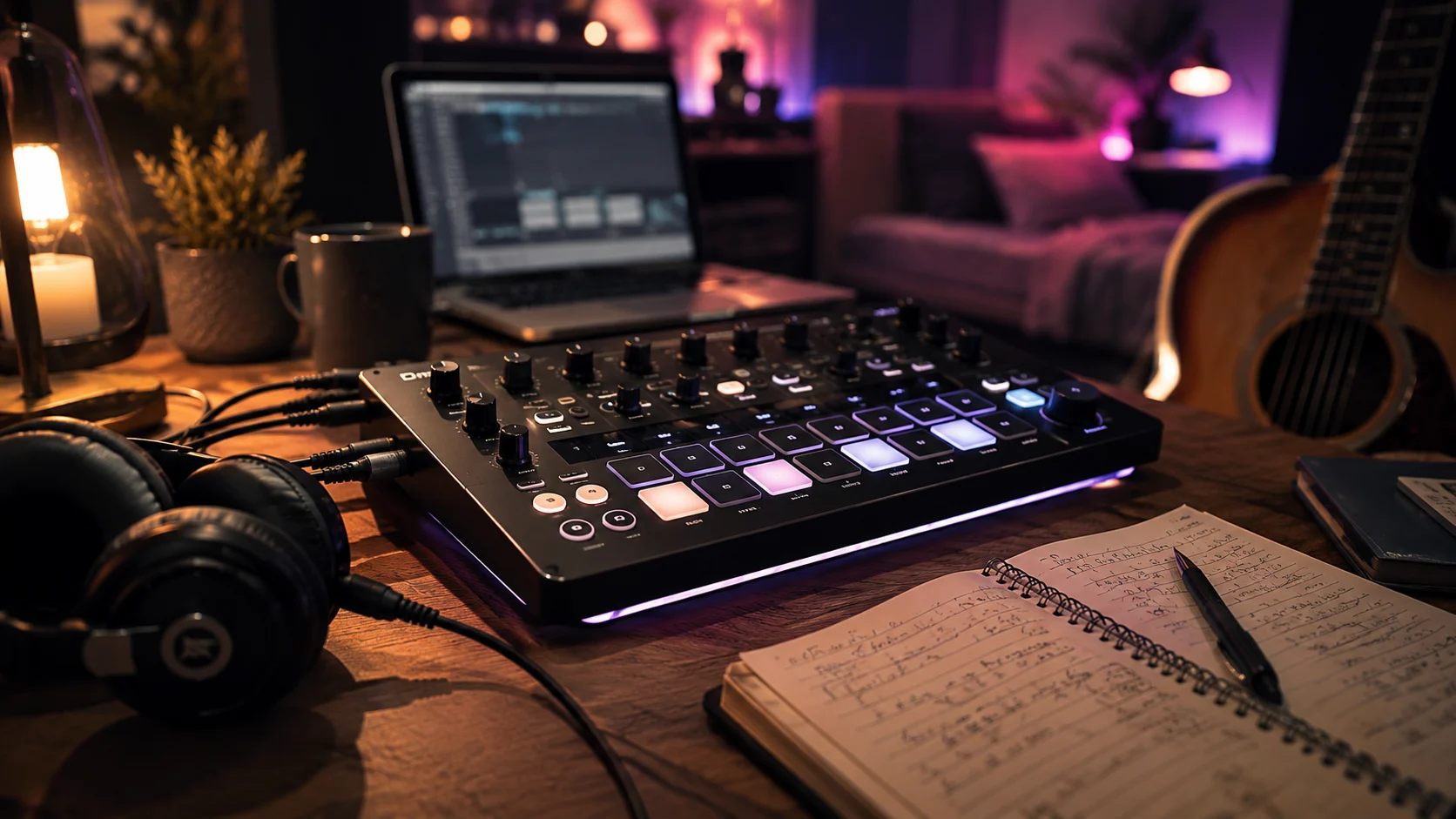
The most natural home for Orchid is probably not a perfectly treated studio with every cable labeled and every synth lined up like a museum piece. Its natural home is the messy creative zone where a laptop is open, a guitar is leaning against a chair, a voice memo is half-finished, and someone is trying to turn a feeling into a track before the energy disappears. In that environment, the Orchid synth can act as the harmonic center of the session. A songwriter can use it to test progressions, build a loop, sketch a verse bed, or find a bridge that does not sound like the obvious first choice. Once the idea exists, the DAW can take over and expand it into a full production.
For guitarists, Orchid may be especially useful because it breaks the muscle-memory loop that often controls songwriting. Guitar players tend to return to familiar shapes, favorite capo positions, and progressions that feel good under the fingers. That comfort can be beautiful, but it can also make new songs sound suspiciously close to old ones. A chord-focused synth creates a different physical relationship with harmony, which can push a guitarist toward voicings and movements they would not naturally grab on the fretboard. Even if the final track becomes guitar-driven, starting with Orchid can change the emotional DNA of the song.
For producers, the appeal is slightly different but just as clear. Many beatmakers begin with drums because rhythm is immediate, but a strong chord progression can make a beat feel less like a loop and more like a song. Orchid gives producers a quick way to establish mood without building harmony note by note in a piano roll. That can speed up the early stage of production, especially when the goal is to capture a vibe before polishing details. In a world where attention is constantly split, a tool that gets the first ninety seconds of a track moving can be more valuable than another endless sound pack.
From Voice Memo to Full Arrangement
One of the most underrated uses for a device like Orchid is supporting vocal writing. A lot of songwriters collect melodies as voice notes, but those fragments can remain trapped on a phone because they lack harmonic direction. By quickly testing chords underneath a vocal idea, a writer can discover whether the melody wants to feel dreamy, tense, romantic, strange, or urgent. That process can turn a throwaway hum into the start of a verse, especially when the chords suggest lyrical movement. In this way, Orchid is not only a synth for instrumentalists; it is also a bridge for topliners who need a fast emotional backdrop.
The arrangement stage can also benefit from the same chord-first mindset. Once a progression is working, the writer can explore how different textures change the meaning of the same harmonic movement. A soft pad may make the progression feel nostalgic, while a brighter pluck can push it toward pop immediacy, and a darker tone can pull it into cinematic territory. Those decisions may seem small, but they influence lyrics, drums, vocal delivery, and even the final mix. The best songwriting tools do not simply provide notes; they influence the attitude of the whole production.
Why Playfulness Matters in Serious Music
The Indonesian phrase in the topic, “mainan serius,” captures Orchid’s personality surprisingly well. It can feel like a toy because it invites play, removes barriers, and encourages the user to press things just to see what happens. At the same time, that toy-like quality is exactly what can make it serious for songwriting. Great songs often begin when the writer stops trying to look impressive and starts following curiosity. The Orchid synth understands that creativity needs permission to be a little unserious before it becomes meaningful.
In modern music culture, playfulness is not a weakness. It is survival. Artists are expected to be content creators, engineers, marketers, visual directors, and personal brands, all while producing music that still feels emotionally honest. That pressure can make the act of writing feel heavier than it should. Instruments that restore a sense of play help musicians reconnect with the reason they started making sound in the first place. Orchid’s charm is that it seems to make the first step feel less like a task and more like a small creative accident waiting to happen.
This is especially important for Gen Z and younger millennial creators who learned music through a mix of YouTube tutorials, cracked-open DAW sessions, TikTok snippets, Discord feedback, and bedroom experimentation. Their musical education is often nonlinear, practical, and deeply visual. They may understand vibe and arrangement better than traditional notation, but still want tools that help them sound harmonically rich. Orchid fits that learning style because it does not shame the user for not approaching music in a conservatory-approved way. Instead, it turns theory into something you can touch, hear, and bend into your own language.
The Limits That Make Orchid More Interesting
No piece of gear becomes culturally interesting by being perfect for everyone. In fact, Orchid’s limitations may be part of what gives it personality. A focused songwriting instrument will naturally frustrate users who want full traditional keyboard freedom, deep editing, or a completely open synth environment. Some musicians may find its concept too specific, especially if they already have strong theory skills and a custom workflow built around advanced MIDI tools. Yet for the right user, those same boundaries can become helpful because they keep the session from expanding into option fatigue.
This is an important distinction in any honest music gear review: limitation is not automatically failure. A guitar pedal with one great sound can be more useful than a plugin with five hundred forgettable options. A sampler with a quirky workflow can inspire stronger ideas than a flawless tool that feels emotionally blank. Orchid should be viewed through that lens, because its purpose is not to replace every harmonic tool in the studio. Its purpose is to make the early songwriting stage more inviting, more immediate, and more likely to result in a real idea.
That said, musicians should be realistic before romanticizing it. If someone expects Orchid to do everything a full production workstation does, disappointment is almost guaranteed. If someone wants a pure performance keyboard, they may find the chord-centered design too opinionated. But if a songwriter wants a compact idea machine that nudges them toward richer progressions and faster sketches, the conversation changes. The smartest way to understand Orchid is not as a universal answer, but as a very specific creative tool with a strong point of view.
Orchid Synth in the Age of AI and Infinite Plugins
The timing of Orchid also feels meaningful because music creation is currently surrounded by automation. AI tools can suggest melodies, generate stems, clean vocals, master tracks, and produce musical fragments at a speed that would have felt impossible a few years ago. That technology can be useful, but it also raises a quiet anxiety for musicians who want their work to feel personally made. The Orchid synth represents a different kind of future, one where technology helps the human make decisions rather than replacing the decision-making process entirely. It gives assistance without removing authorship, and that distinction matters more every year.
In a plugin-heavy workflow, the danger is not only that music becomes too easy. The danger is that the artist becomes detached from the moment of discovery. When a tool generates too much too quickly, the creator can end up curating instead of playing, selecting instead of responding. Orchid still requires the user to listen, react, and choose the emotional direction of the progression. That physical and musical involvement keeps the process grounded, even when the tool is doing part of the harmonic heavy lifting.
This is why the instrument feels connected to broader modern sound culture. The future of music gear may not belong only to the most complex systems or the most automated assistants. It may belong to tools that preserve human taste while reducing unnecessary friction. Songwriters do not always need machines that finish the song for them; often, they need machines that help them begin. Orchid’s rise in conversation suggests that many creators still want to feel surprised by their own hands.
Who Should Actually Care About Orchid?
The obvious audience for Orchid is the songwriter who loves harmony but does not want to get trapped in theory every time a new idea appears. That includes indie artists, synth-pop producers, guitarists looking for fresh chord movement, vocalists who need backing ideas, and beatmakers who want progressions that feel more alive. It may also appeal to musicians who enjoy portable hardware because they can write away from the main studio setup. The emotional benefit is simple: Orchid makes the starting point feel less intimidating. For people who struggle to move from idea to arrangement, that can be a real creative advantage.
It also makes sense for creators who feel bored by their usual tools. Every musician eventually builds habits, and those habits can become invisible walls. A producer might always start with the same drum kit, a guitarist might always reach for the same voicing, and a singer might always write over the same type of loop. Bringing in a tool with a different logic can interrupt that cycle in a healthy way. The Orchid synth does not guarantee better songs, but it can create different first decisions, and different first decisions often lead to different songs.
However, beginners should approach it with clear expectations. Orchid can make harmony easier to access, but it should not become a shortcut that prevents deeper learning forever. The best outcome is when a tool sparks curiosity, not dependency. A new songwriter might use Orchid to hear chord colors first, then slowly learn why those colors work. In that sense, the instrument can become both a creative sketchpad and a gateway into better musical understanding.
What Orchid Says About the Future of Songwriting Gear
Orchid’s most important contribution may not be any single sound or feature. Its bigger statement is that songwriting gear can be emotional, focused, and approachable without being shallow. For years, music technology often measured progress by how much control it could offer, but many creators now want tools that help them feel something faster. That does not mean depth is dead, and it does not mean advanced synths are losing relevance. It simply means there is room for instruments that treat inspiration as a core feature rather than a side effect.
This could influence how future hardware is designed. More brands may start building tools around specific creative moments instead of trying to cover every possible use case. There could be more devices for lyric sketching, harmonic exploration, vocal arrangement, live looping, or fast demo building. That kind of specialization makes sense in a world where full production power already exists inside most laptops. Hardware needs a reason to exist beyond specs, and Orchid’s reason is clear: it wants to make the beginning of a song feel good.
For ChordPunch readers, that is the most useful takeaway. The Orchid synth is not just a trendy object floating through gear culture; it is a sign of where songwriting tools are heading. The next wave of music gear may be less obsessed with proving technical dominance and more interested in shaping creative behavior. If an instrument helps a songwriter finish more ideas, escape stale habits, or find a chord they would never have chosen alone, then it has already done something meaningful. In a crowded world of plugins, presets, and automated shortcuts, that kind of human-centered design feels refreshingly serious.
Conclusion: A Small Box With a Big Creative Point
The story of Orchid is really a story about how musicians want to create now. They want speed, but not soulless automation. They want accessibility, but not cheap simplification. They want tools that feel fun, but still lead somewhere useful when the session gets serious. The Orchid synth captures that balance by turning chord exploration into something immediate, tactile, and emotionally inviting.
It may not replace a full keyboard, a favorite DAW, a trusted guitar, or a deep synth collection, and it does not need to. Its strength is narrower and more interesting than that. Orchid is built for the moment when a songwriter needs the first real spark, the first harmonic clue, or the first progression that makes a rough idea feel worth chasing. In that space, playfulness becomes practical, and simplicity becomes powerful. That is why this small chord-focused instrument feels like more than a gadget; it feels like a serious toy for the modern songwriter’s most important first move.