
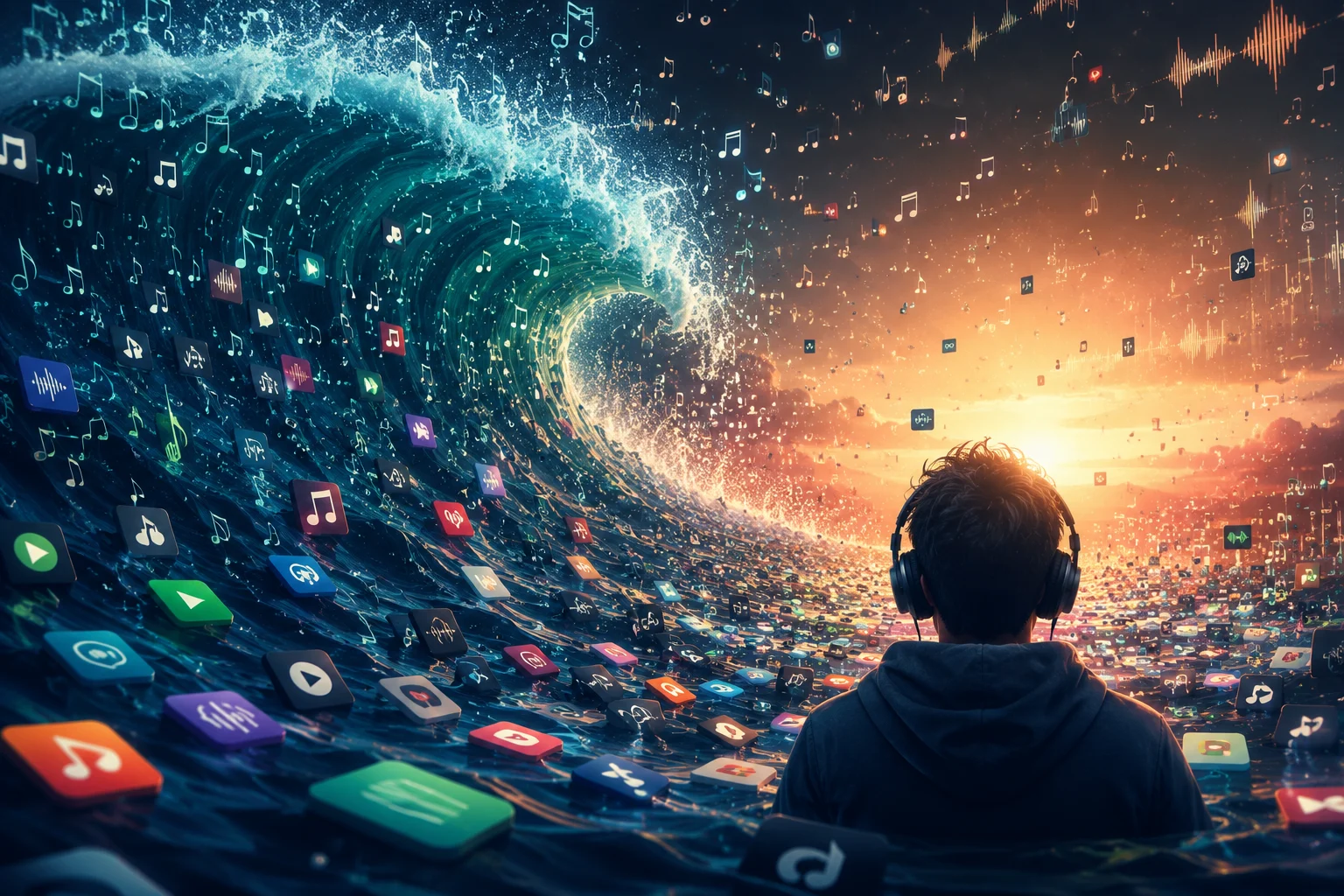
The streaming era was supposed to make music feel infinite, but the new wave of AI music streaming is making that infinity feel crowded, noisy, and weirdly weightless. Open any major platform today and the problem is not that there is too little music, but that there may be too much music arriving too fast for listeners, artists, and recommendation systems to process. Songs can now be generated, packaged, uploaded, renamed, and pushed into the same ecosystem where human artists spend years shaping a sound, building a scene, and earning trust one release at a time. That shift is not just a tech story, because it changes how people discover songs, how royalties move, and how culture decides what deserves attention. The result is a streaming landscape where the playlist never ends, but the meaning behind the music is suddenly harder to hear.
Why AI Music Suddenly Feels Everywhere
The rise of AI-generated music did not arrive like a traditional genre boom, where a new sound bubbles up from clubs, bedrooms, forums, and local scenes before breaking into the mainstream. It arrived more like a content machine, powered by tools that can turn a simple text prompt into a polished track within minutes. That speed changes the entire rhythm of music production, because the bottleneck is no longer studio time, session players, songwriting drafts, or vocal takes. Instead, the bottleneck becomes upload strategy, metadata, playlist targeting, and whether platforms can tell what is human-made, machine-made, or somewhere in between. For listeners, the change feels subtle at first, but over time it creates a strange sense that streaming catalogs are filling up with songs that sound finished while feeling emotionally unfinished.
Part of the tension comes from the fact that AI music is not automatically bad, lazy, or useless. A producer can use AI as a sketchpad, a songwriter can use it to test arrangements, and an indie artist can use it to move faster without hiring a whole studio team. The problem begins when the same tools are used at industrial scale, creating thousands of tracks that are designed less as art and more as streaming inventory. These songs often chase familiar moods, generic titles, soft-focus cover art, and algorithm-friendly vibes that fit neatly into background playlists. When that content floods the system, AI music streaming becomes less about creative experimentation and more about volume, visibility, and platform loopholes.
This is why the conversation feels different from past fears about drum machines, sampling, Auto-Tune, or laptop production. Those tools still needed a human point of view, even when critics complained that they made music too easy. AI music generation can imitate the surface of many styles without carrying the lived context that made those styles matter in the first place. A fake soul ballad can have warm keys, smoky vocals, and vinyl crackle, yet no singer who lived through the story. A synthetic indie track can sound like it came from a late-night apartment recording session, even if there was no apartment, no band, no scene, and no moment behind it.
The AI Music Streaming Flood Is a Discovery Problem
The biggest issue with the AI music streaming flood is not only how many synthetic songs exist, but how they compete for the same attention lanes as human artists. Streaming platforms rely heavily on recommendation engines, mood playlists, search behavior, and engagement signals. If a track gets skipped quickly, saved often, played while people sleep, or looped in the background, the system reads those signals and makes decisions. That means music discovery is no longer shaped only by taste, critics, radio, labels, or fan communities. It is shaped by data patterns, and AI tracks can be optimized for those patterns in ways that make the whole ecosystem feel less organic.
Imagine an unknown guitarist uploading a debut EP after years of writing, rehearsing, and saving money for recording sessions. That EP now enters a catalog where it may sit beside thousands of synthetic acoustic tracks with titles built for search, artwork built for mood playlists, and metadata tuned for recommendation systems. The guitarist is not just competing with other musicians anymore. They are competing with a production pipeline that does not get tired, does not need rent money, does not spend months searching for the right bridge, and does not care if one track fails because another hundred can appear tomorrow. That imbalance makes the discovery layer feel less like an open stage and more like a crowded marketplace where attention is constantly diluted.
For listeners, the discovery problem can feel even more confusing because AI songs are increasingly hard to identify by ear. Many tracks are not obviously robotic, especially when they are built around safe tempos, familiar chord progressions, soft vocal textures, and clean mastering. A listener might hear a song in a chill playlist, save it casually, and never know whether there was a real artist behind it. That uncertainty can slowly weaken the bond between listener and musician, because part of fandom is believing there is someone on the other side of the sound. When that belief becomes blurry, the emotional contract of music streaming starts to change.
The playlist economy makes the flood louder
Streaming did not create background listening, but it definitely turned it into a business model. Study playlists, sleep playlists, lo-fi loops, ambient focus mixes, coffee shop acoustics, gym edits, and mood-based discovery all thrive because listeners often want music that fits into life without demanding full attention. AI-generated tracks slide easily into that environment because they can be made to sound pleasant, frictionless, and endlessly replaceable. The more passive the listening moment, the easier it becomes for synthetic music to blend in unnoticed. This is why the flood feels loud even when the songs themselves are quiet, because the noise is not always sonic; it is structural.
The playlist economy rewards consistency, and AI is extremely good at consistency. It can generate a rainy-day piano track, a dreamy bedroom-pop instrumental, a soft jazz loop, or a cinematic synth bed without needing a personal reason to make any of them. That does not mean the result is worthless, but it does mean the system can be filled with music designed to occupy space rather than say something. Human artists also make background music, of course, and many do it beautifully. The difference is that human-made background music can still carry intention, taste, restraint, and subtle fingerprints that come from real creative choices.
What This Means for Artists Trying to Survive
For working musicians, the rise of AI music platforms lands at a brutal moment. Streaming payouts have already been a long-running frustration, touring costs have climbed, social media demands constant performance, and attention spans are split across every possible screen. Now artists are facing a new layer of competition from content that can be generated at almost no marginal cost. This does not just threaten superstar artists with fake vocal clones or impersonation drama. It also threatens session players, producers, composers, background vocalists, beatmakers, library musicians, and independent acts whose income depends on small but steady slices of the digital music economy.
The hardest part is that AI does not replace every artist in one dramatic moment. Instead, it chips away at the edges of opportunity. A brand that once hired a composer for a simple ad bed may try an AI tool first. A small creator who once licensed a track from an indie producer may generate something “close enough” instead. A playlist that once surfaced unknown ambient musicians may fill with anonymous synthetic tracks because they are cheaper, faster, and easier to scale. Over time, those small shifts can quietly remove the lower and middle rungs of the music career ladder.
That matters because culture needs more than celebrity artists at the top. It needs beginners, weirdos, specialists, local heroes, failed experiments, cult scenes, and musicians who are still figuring out their sound in public. When the ecosystem becomes flooded with machine-made content that mimics finished music, it can make real development harder to notice. Listeners may still love human artists, but they have to find them first. In a noisy catalog, being discoverable becomes its own privilege, and that privilege may increasingly belong to whoever understands platform mechanics rather than whoever has the strongest musical identity.
The human story is still the advantage
The good news is that AI music has a weakness that artists can still use: it struggles with lived narrative. It can imitate heartbreak, rebellion, confidence, nostalgia, or loneliness, but it cannot actually remember a basement show, a failed tour, a fight with a bandmate, or the first time a riff made a room explode. Modern fans do not only listen to tracks; they follow stories, aesthetics, process videos, studio breakdowns, gear choices, and personal worlds. That is why a strong artist identity may become even more valuable in the AI era. The more synthetic the catalog becomes, the more listeners may crave proof that a song came from an actual life.
This does not mean artists need to turn themselves into influencers every hour of the day. It means the human layer around the music becomes harder to ignore. Behind-the-scenes clips, live imperfections, handwritten lyrics, gear walkthroughs, production notes, local references, and honest explanations of how a song came together can help listeners connect the sound to a real person. For a site like chordpunch, that makes modern music guides more important, because listeners and creators need context to navigate what is changing. In a world of instant songs, the slow details suddenly matter more.
Why Platforms Are Starting to Draw Lines
Streaming services are now being pushed to decide what counts as acceptable AI music, what should be labeled, what should be removed, and what should earn money. That is a difficult line to draw because AI exists on a spectrum. A fully generated track with synthetic vocals and instrumental parts is different from a human song that used AI for mastering, stem separation, brainstorming, or sound design. A producer using AI as a tool is not the same as a spam network uploading endless tracks to farm royalties. Yet platforms need rules, because without rules the catalog becomes vulnerable to fraud, impersonation, and listener distrust.
One likely future is that platforms will treat transparency as a core feature instead of a side issue. Labels for fully AI-generated tracks, filters that let users avoid synthetic music, and policies around monetization could become normal parts of streaming design. That would not ban AI music completely, but it would separate disclosure from deception. Listeners deserve to know whether they are hearing a band, a solo producer, a virtual artist, or a track generated mostly by software. The more transparent the system becomes, the easier it is for people to choose what they actually want to support.
Monetization is the sharper debate because it decides whether the flood keeps growing. If fully AI-generated tracks can earn the same way human-made tracks do, then there is a financial incentive to keep uploading more of them. If those tracks are demonetized, downranked, labeled, or removed from algorithmic recommendations, the economics change fast. Platforms are not just fighting for artistic purity; they are protecting the credibility of their product. A streaming service that feels overrun by anonymous synthetic filler risks losing the trust that makes people pay for subscriptions in the first place.
The Gear World Is Also Part of This Story
At first glance, AI music streaming sounds like a software problem, but it also affects the gear world in a deep way. Music gear has always been tied to identity, because pedals, synths, interfaces, microphones, samplers, plug-ins, and amps shape how artists think. A fuzz pedal can push a guitarist into uglier riffs, a tape delay can turn a simple melody into a mood, and a cheap drum machine can define a whole underground scene. When AI tools generate finished songs from prompts, the role of gear becomes less obvious to casual listeners. That creates a new question for creators: what does musicianship look like when the final sound can be simulated without the messy process behind it?
The answer is not to reject technology, because music has never been pure in that way. Electric guitars were once disruptive, samplers were controversial, DAWs changed studio culture, and bedroom producers built entire genres with cracked software and budget headphones. The issue is whether tools extend human taste or replace the need for taste altogether. Gear matters because it forces decisions, limitations, accidents, and personal habits into the music. AI generation can be useful, but if it removes too many constraints, it can also remove the friction that often makes a track memorable.
This is where gear reviewers and music guides have a new responsibility. Reviews cannot only ask whether a device sounds good, because almost everything can be made to sound good now. They need to ask whether a tool encourages real creative movement, whether it helps musicians develop a signature, and whether it keeps the human hand visible in the process. A synth that invites experimentation, a pedal that reacts unpredictably, or a controller that changes how someone performs may become more valuable in the AI era. The future of gear culture may not be about chasing perfection, but about protecting personality.
Imperfect sound may become premium
As synthetic music gets cleaner, imperfections may become more meaningful. A cracked vocal, a rushed drum fill, a buzzing cable, a pick scrape, a room reflection, or a slightly late bass note can remind listeners that someone was physically present. In older production eras, engineers often tried to remove these details to make recordings sound polished. Now those details can function as proof of life. This does not mean every artist should fake lo-fi texture or intentionally make sloppy recordings, but it does suggest that sterile perfection may start to feel less impressive than it once did.
That shift could change how people talk about music quality. Instead of asking whether a song sounds expensive, listeners may ask whether it feels inhabited. Instead of chasing the smoothest mix, producers may leave room for performance artifacts that make the track breathe. Live sessions, raw demos, alternate takes, and studio diaries may become more culturally valuable because they reveal the human labor behind the finished song. In a catalog full of instant polish, process becomes part of the product.
Listeners Are Becoming Curators, Not Just Consumers
The AI flood also changes the listener’s role. In the early streaming era, convenience was the main selling point, because listeners could access almost any song instantly. Now convenience is not enough, because access without trust can feel overwhelming. People need better ways to decide what is worth their attention, what aligns with their values, and what kind of music economy they want to support. That turns listening into a form of curation, even for casual fans who never thought deeply about platform mechanics before.
Some listeners will not care whether a song is AI-generated, especially if it works as background sound. That is a valid position, because not every listening moment is sacred. However, many listeners do care when they feel misled, especially if a fake artist is presented like a real person or if synthetic tracks are quietly inserted into playlists that appear human-centered. The difference between choosing AI music and being tricked into it is huge. Transparency is what allows listeners to make that choice without feeling like the platform is hiding the ball.
This is why music discovery may start moving back toward trusted curators, niche writers, DJs, newsletters, record stores, small communities, and artist-led channels. Algorithms are useful, but when algorithms get flooded, human recommendation feels more valuable. A friend sending a track, a critic explaining why an album matters, or a producer breaking down a mix can cut through the noise in ways automated feeds cannot. The more crowded streaming becomes, the more culture may lean on people who can separate signal from filler.
The Legal and Ethical Mess Is Still Unfinished
The ethical side of AI music streaming is not only about whether a song was generated by a machine. It is also about what data trained the model, whether copyrighted material was used, whether vocal identities were imitated, and whether listeners are being misled. If an AI system learns from huge catalogs of human music, then generates songs that compete against the same artists whose work helped train it, the fairness question becomes impossible to ignore. Even when the output does not copy one song directly, it can still benefit from the collective labor of musicians who never agreed to participate. That is why the debate around AI music often feels personal, because it touches both income and identity.
Voice cloning makes the issue even more sensitive. A voice is not just a sound source; it is a signature, a body, a history, and sometimes a brand. When AI tools imitate a recognizable singer, the result can feel like a violation even when fans treat it as a novelty. The same concern applies to style imitation, where a prompt can ask for something that feels close to a living artist without naming them directly. The law is still catching up, but the cultural instinct is already clear: people know when a tool is being used to explore and when it is being used to exploit.
There is also a labor ethics issue around invisible musicians. The public often focuses on famous artists, but AI-generated music can also pressure composers who make sync music, producers who sell beats, vocalists who record hooks, and instrumentalists who contribute to commercial projects. These workers may not have massive fanbases, but they are part of the infrastructure that keeps music culture alive. If the market decides that “good enough” synthetic output is cheaper than hiring them, the impact spreads beyond streaming charts. It changes who gets to build a sustainable life around sound.
How Artists Can Cut Through the AI Noise
Artists cannot control the entire platform economy, but they can respond strategically. The first move is to make authorship visible. That can mean showing the writing process, documenting sessions, performing live, sharing stems, explaining gear choices, or building a visual world that makes the artist feel unmistakably human. None of this guarantees viral success, but it gives fans something synthetic tracks struggle to offer: continuity. A real artist grows, contradicts themselves, changes taste, reacts to life, and carries a history from one release to the next.
The second move is to build direct relationships outside algorithmic feeds. Email lists, Discord communities, Bandcamp pages, Patreon-style memberships, local shows, small venue circuits, and physical merch all matter more when streaming discovery becomes unstable. A listener who follows an artist directly is less likely to lose them in the flood. Direct fan relationships also create context around the music, which can turn a release into an event rather than just another file in the catalog. In the AI era, community is not a bonus feature; it is a defense mechanism.
The third move is to use AI carefully without letting it erase the artist’s voice. There is nothing wrong with experimenting with tools that generate ideas, assist with arrangement, clean audio, separate stems, or speed up boring tasks. The danger comes when the tool becomes the creative center and the artist becomes a curator of machine outputs. Strong musicians can use technology while still making choices that feel personal, risky, and specific. The goal is not to sound anti-tech, but to make sure the technology serves the song instead of replacing the reason for the song to exist.
How Streaming Could Feel Better Again
Fixing the streaming noise problem will require more than one policy. Platforms need AI labels that are easy to understand, not buried in vague metadata. They need stronger detection systems, clearer monetization rules, and better tools for listeners who want to filter synthetic tracks from recommendations. They also need to protect human artists from impersonation, fake collaborations, and mass-upload tactics designed to game the system. Most importantly, platforms need to stop pretending that infinite catalog growth automatically equals better user experience.
Streaming could become more intentional if discovery systems rewarded depth instead of only volume. That might mean giving more weight to real fan engagement, artist identity, editorial context, local scenes, live activity, and long-term listening behavior. It could also mean separating functional background audio from artist-driven music, so listeners know what kind of experience they are choosing. A sleep playlist filled with synthetic ambient tracks is not the same thing as a new album from a human composer, and platforms should not blur those categories just because both technically count as audio. Better design would make the difference visible.
There is also room for new badges, credits, and transparency layers that make music creation easier to trace. Listeners could see whether a track uses human vocals, AI vocals, session musicians, sampled material, AI-assisted production, or fully synthetic generation. Done well, this would not shame artists who use technology responsibly. It would simply give the audience more information. In a future where sound can be generated instantly, trust may become the most important format in music.
The Future of AI Music Streaming Is Not Just Noise
It would be too simple to say AI music will destroy everything, because music history is full of panic that later turned into innovation. Some artists will use AI in brilliant ways, especially those who treat it as an instrument rather than a shortcut. New genres may emerge from human-machine collaboration, and some listeners may genuinely enjoy virtual artists or synthetic sound worlds. The problem is not experimentation. The problem is scale without meaning, volume without accountability, and platforms that treat all uploads as equal until the catalog becomes too messy to trust.
The next phase of streaming will likely split music into clearer lanes. There will be human-made music, AI-assisted music, fully AI-generated music, functional sound content, virtual artist projects, and hybrid releases that do not fit old categories. That may sound complicated, but music culture has always adapted to new labels when the differences mattered. The key is honesty. Once listeners know what they are hearing, they can decide whether they want the synthetic chill loop, the human indie record, the AI-assisted pop experiment, or the live band recording with all its beautiful flaws.
For artists, this moment is stressful but not hopeless. Human creativity still has advantages that mass-generation cannot easily copy: memory, risk, community, humor, failure, taste, timing, and the ability to make a song matter beyond its waveform. For listeners, the challenge is learning to hear beyond convenience and ask what kind of music world their plays are supporting. For platforms, the pressure is to prove they can manage abundance without turning discovery into digital pollution. If they fail, streaming may remain infinite, but it will feel emptier.
Conclusion: The Signal Has to Beat the Flood
The rise of AI music streaming is not just a trend for tech blogs or music business insiders; it is a shift that touches every listener who opens a playlist and expects the songs to mean something. The flood of generated tracks makes streaming feel bigger, faster, and more chaotic, but bigger is not always better. Music needs discovery systems that respect human effort, AI policies that reward transparency, and fan cultures that value story as much as sound. Synthetic music will not disappear, and it does not need to disappear for human music to survive. But if the industry wants streaming to stay emotionally alive, it has to make sure the signal of real creativity does not get buried under an endless wave of automated noise.