
The phrase French synths used to sound like a niche corner of the gear world, the kind of phrase you would hear from a producer who spends way too much time comparing filter slopes and envelope curves at 2 a.m. Now it feels bigger than that, almost like a signal that electronic music is shifting its center of gravity again. From polished studio controllers to strange boutique boxes that look more like art objects than instruments, French makers have been pushing themselves into the middle of the global synth conversation. The timing feels right because producers are tired of tools that only chase nostalgia, and they are also tired of software that hides every creative decision behind menus, subscriptions, and endless presets. What makes the current French wave interesting is not just the gear itself, but the culture around it: playful, design-heavy, experimental, and still surprisingly practical for people who actually want to finish music.
Electronic music has always moved in waves, and those waves usually arrive through machines before they become scenes. A drum machine changes how people write grooves, a sampler changes how people think about memory, and a synth changes the emotional temperature of an entire decade. Right now, the conversation around French synths feels less like one product cycle and more like a full aesthetic shift. Instead of chasing only vintage American warmth, Japanese reliability, or German modular precision, younger producers are paying attention to French instruments because they often blend sound design, interface design, and cultural taste in one package. That blend matters because modern electronic music is no longer just about making a bassline; it is about building a world that can live on headphones, in clubs, on TikTok clips, and inside a live set without losing its identity.
Why French Synths Suddenly Feel So Relevant
The rise of French synths is not happening in a vacuum, and it is definitely not just about national pride or boutique hype. France has a long electronic music shadow, from synth-pop and library music to house, electro, film scoring, and the glossy futuristic sound associated with French touch. That background gives French gear makers a different kind of pressure because the products are not only expected to function well; they are expected to feel stylish, musical, and slightly cinematic. A synth made in this environment does not simply need oscillators, filters, and modulation lanes, because it also has to invite the user into a mood. That may sound abstract, but for producers, mood is often the difference between opening a session and actually making something worth keeping.
Another reason this wave feels fresh is that the broader music technology market is overloaded with extremes. On one side, there are massive workstation-style devices that can technically do everything but often feel more like operating systems than instruments. On the other side, there are ultra-minimal gadgets that look beautiful but sometimes struggle to justify their price once the novelty fades. French designers have been finding a lane between those two poles by creating gear that feels immediate without feeling shallow. That balance is powerful because today’s producer might be a beatmaker, live performer, sound designer, content creator, and mixing engineer all in the same week.
The cultural part is just as important as the hardware part, because synth communities are fueled by identity as much as specs. People buy instruments because they want a certain sound, but they also buy them because they want a certain relationship with music-making. A great synth makes you feel like you are discovering something rather than completing a technical assignment. The best French electronic music gear often leans into that feeling with interfaces that reward touch, motion, color, and surprise. In a world where so much music production happens on flat screens, that tactile philosophy gives French machines a strong emotional advantage.
The Design Language Behind French Electronic Gear
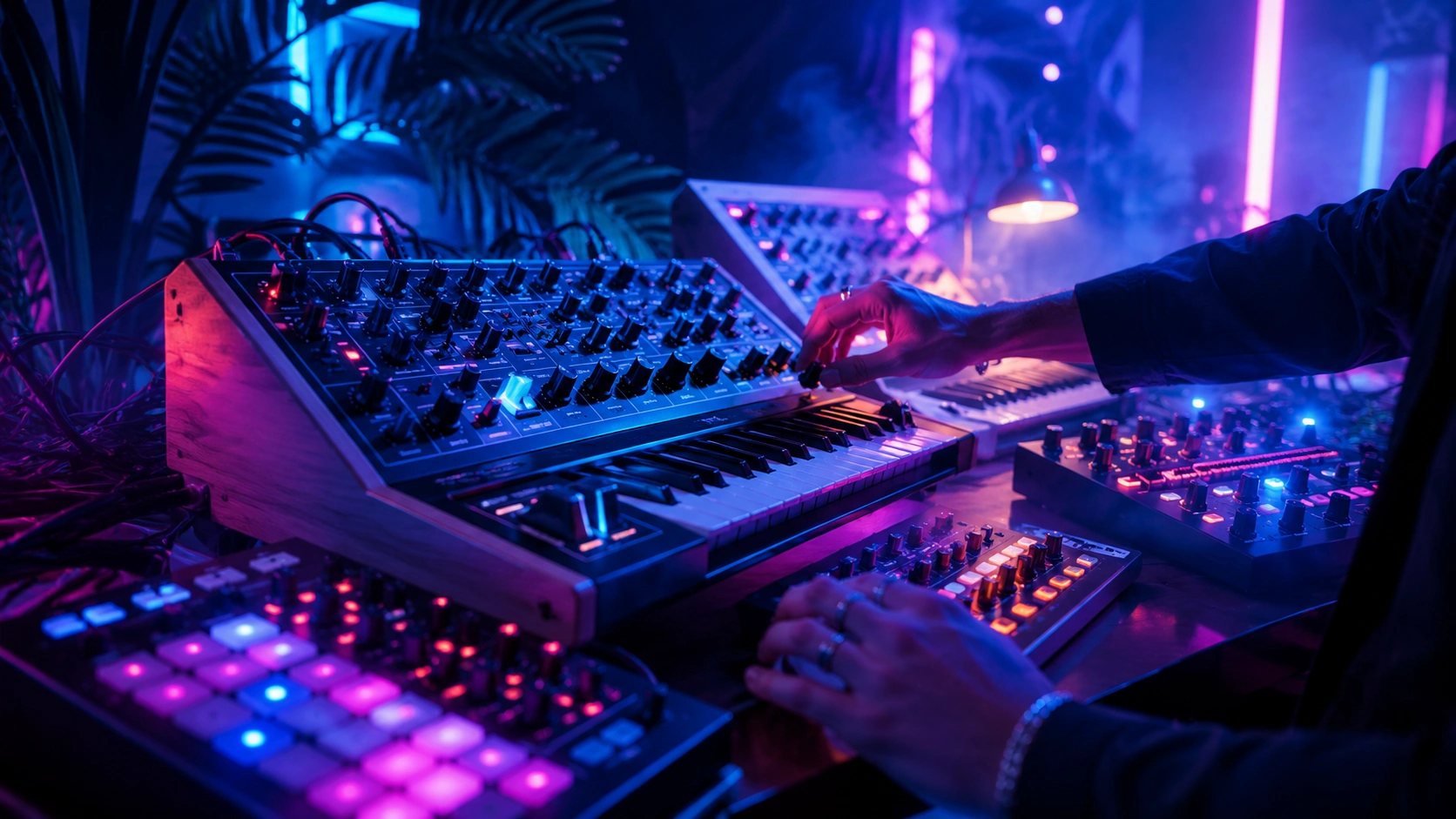
One thing that separates many French synths from the rest of the market is the way they treat design as part of the sound. This does not mean every French instrument looks expensive or minimalist, because some of the most exciting ones are weird, playful, and almost chaotic at first glance. The point is that the physical layout often pushes the musician toward a certain behavior. A controller with expressive pads encourages gestures, a one-knob performance concept forces trust in randomness, and a hybrid synth with carefully mapped controls can make complex sound design feel like shaping clay. These choices matter because interface design quietly tells the musician what kind of performance is possible.
French gear culture also seems comfortable with the idea that instruments can be both serious and fun. That sounds simple, but a lot of music tech still treats playfulness as a downgrade from professionalism. The French approach often flips that assumption by showing that playful tools can lead to deeper results precisely because they lower the fear of failure. When a producer is not trapped inside a technical maze, they are more likely to record accidents, resample textures, and follow strange ideas before judging them too early. That spirit has become especially valuable in electronic music, where over-polished workflows can sometimes erase the raw spark that made a track exciting in the first place.
This is why conversations around modern synth culture increasingly connect gear design with creative psychology. A synth is not only a box of circuits or code; it is a behavioral environment. Some instruments reward discipline, others reward chaos, and the most memorable ones do both depending on how they are played. The current French wave feels interesting because it often treats limitation as a creative feature rather than a missing spec. That idea connects deeply with modern producers who already have unlimited plugins but still crave a tool that tells them, in a useful way, where to start.
French Synths and the New Hardware Mindset
The hardware synth market has changed because producers no longer buy physical instruments only to escape computers. Many artists now use hardware and software together, building hybrid setups that combine DAW editing, plugin chains, physical sequencing, and hands-on sound manipulation. In that environment, French synths succeed when they offer something a laptop cannot easily replace. That might be expressive control, unpredictable modulation, beautifully designed presets, or simply the feeling of performing sound instead of dragging blocks on a timeline. The best devices do not compete with the computer; they give the computer a more human front door.
This shift is important for readers of modern gear reviews because value in 2026 is not only measured by feature count. A synth can have fewer voices than a competitor and still feel more useful if it gets the user to a strong idea faster. A controller can be worth attention even without generating sound if it makes software instruments feel alive under the fingers. A boutique box can matter even if it is not designed for everyone, because it may introduce a workflow that larger companies eventually borrow. This is the kind of conversation French synth culture has been pushing into the mainstream: not “what does it have,” but “what does it make you do?”
The popularity of smaller, expressive, and performance-ready gear also reflects how music is being shared now. Producers are not only making albums in hidden studios; they are filming jams, streaming process clips, performing hybrid sets, and turning sound design into short-form content. A visually distinctive synth can become part of an artist’s identity before the track is even finished. This does not mean design matters more than sound, but it does mean sound and presentation now travel together. French makers seem unusually aware of that reality, which may explain why their tools often feel ready for both the studio desk and the camera frame.
The Return of Touch in a Screen-Heavy Era
One of the strongest reasons French synths have gained attention is the return of touch as a serious creative value. For years, producers were told that the future was fully in the box, and in many ways that future arrived because software is powerful, flexible, and affordable. Still, something got lost when every instrument became another window on the same screen. The muscle memory of twisting a filter, pressing an expressive surface, or pushing a sequencer into unstable territory creates a different kind of musical decision. French electronic gear often leans into that tactile gap, offering controls that feel less like office work and more like performance.
This matters even more for younger producers who grew up with infinite software options. When every plugin promises thousands of presets, the hard part is no longer access to sound; the hard part is choosing a direction. A physical instrument can reduce that pressure by giving the session a center of gravity. Instead of auditioning endless options, the producer responds to the machine in front of them. That direct feedback loop is why many modern musicians talk about hardware not as a luxury, but as a way to protect attention.
How French Synth Culture Connects Past and Future
The best part of the current French synth moment is that it does not feel trapped in retro cosplay. Of course, electronic music still loves vintage tones, and there will always be room for warm pads, acid basslines, dusty drum machines, and dreamy analog drift. But the most exciting French synths are not simply trying to recreate a golden age. They are pulling from the past while asking what a modern instrument should feel like when artists are moving between club systems, bedroom studios, social platforms, and experimental performance spaces. That question gives the movement a sense of direction rather than just aesthetic nostalgia.
France also has a deep relationship with electronic music as both pop culture and art culture. The country’s music history includes glossy dance records, experimental sound design, cinematic scoring, and underground club movements that never fully separated style from concept. This background gives French synth builders a broad palette to pull from. A device can be melodic and strange, elegant and disruptive, clean enough for pop production but flexible enough for ambient, techno, electro, or noise. That range is one reason the conversation does not feel limited to one genre tribe.
Modern sound culture is hungry for tools that can cross those boundaries. A producer might start the day designing a bass patch for a dance track, then use the same machine to create transition textures for a video score, then sample it into a beat later that night. Gear that supports that kind of fluid movement has a real advantage. French makers often seem to understand that the modern musician does not live in one lane anymore. The result is a generation of instruments that feel less like genre machines and more like creative companions.
The Boutique Energy Driving the Conversation
Boutique synth culture has always had a special kind of gravity because it lets smaller teams take risks that giant brands might avoid. In France, that energy has produced instruments and controllers that do not always look like safe corporate bets. Some ideas feel almost rebellious, especially when they reduce control, reshape performance, or ask the user to trust a strange interface. That is exactly why the scene is attracting attention. When the gear world gets crowded with lookalike analog polysynths and familiar plugin bundles, a weird French device can cut through the feed just by having a point of view.
The boutique factor also changes how musicians talk about instruments online. A mass-market synth is often judged through specs, price, and comparison charts, while a boutique instrument is judged through personality. People ask whether it inspires accidents, whether it makes them play differently, and whether it creates sounds they would not have found in a standard plugin folder. This kind of discussion is perfect for modern music culture because it turns gear into storytelling. A synth becomes not only a purchase decision, but a creative identity marker.
That does not mean every boutique release is automatically meaningful. Some products lean too hard on scarcity, mystery, or visual branding without offering enough musical depth. However, the strongest French entries usually succeed because the concept and the workflow are connected. The design is not just there to look interesting on a desk; it pushes a clear way of making sound. For producers, that distinction is everything because a beautiful object becomes a real instrument only when it keeps inviting new music after the first week of excitement fades.
Why Weird Interfaces Are Winning Again
Weird interfaces are having a moment because normal workflows have become almost too efficient. A DAW can correct timing, tune vocals, generate ideas, organize samples, and automate mixes, but that convenience can also make the creative process feel predictable. A strange synth interrupts that pattern by forcing the musician to react. When a control does not behave exactly like expected, the user has to listen harder and make more instinctive choices. That is where many memorable electronic textures begin, because the machine becomes a collaborator rather than a silent servant.
This is especially important in a time when AI-generated music and preset-heavy production can make tracks feel interchangeable. Artists are looking for fingerprints again, and fingerprints often come from friction. A slightly odd sequencer, a unique modulation path, or an expressive control surface can produce human decisions that are difficult to fake. French synth design often embraces this kind of productive friction without turning the process into pure confusion. That balance makes the gear feel experimental but still usable, which is exactly where many modern electronic musicians want to live.
French Synths in the Age of AI Music
The conversation around French synths becomes even more interesting when placed next to the rise of AI music. As generative tools become more common, the value of a musical instrument may shift from pure output to process, taste, and performance. If a machine can generate a passable loop instantly, then the human artist needs tools that help build a more personal sonic language. Hardware synths, especially those with expressive and unusual interfaces, give musicians a way to create sounds that feel touched, shaped, and discovered. That is one reason the current French wave feels culturally relevant rather than just technically cool.
AI tools are not automatically enemies of electronic music, because electronic musicians have always used technology to stretch what composition can be. The problem begins when speed becomes the only value and the track loses any sense of intention. A good synth slows the process down in a productive way. It asks the producer to make micro-decisions about movement, texture, pressure, timing, and space. In that sense, French electronic instruments can act as a counterweight to the frictionless content machine by reminding artists that sound design is not just output, but touch and judgment.
This is also why the modern synth conversation is no longer only about analog versus digital. That debate still exists, but it feels less central than it did a decade ago. Producers now care more about whether a tool helps them create a strong emotional result. A digital engine can feel alive if the interface is expressive, and an analog circuit can feel boring if the workflow is uninspired. The French scene has benefited from this wider mindset because many of its most talked-about tools refuse to sit neatly in old categories.
What Producers Can Learn From the French Wave
The biggest lesson from the rise of French synths is not that every producer needs to buy French gear. The real lesson is that instruments should shape behavior, not just expand options. A producer building a setup in 2026 should ask what kind of music a tool encourages, what kind of attention it demands, and whether it creates a workflow that feels alive after the honeymoon phase. That mindset is more useful than chasing whatever device is currently trending. Gear should earn its place by changing the way the artist hears, moves, and finishes ideas.
For beginners, this trend is a reminder that the best first synth is not always the one with the longest spec sheet. A straightforward machine with a great interface can teach more about synthesis than a complex device that hides everything behind menus. For intermediate producers, French gear culture offers a push toward more intentional limitations. Instead of adding another plugin to an already crowded folder, it might be more useful to choose one instrument and explore it deeply. That kind of focus often produces a stronger sound identity than constantly restarting with new presets.
For advanced musicians, the French wave points toward performance as the next frontier of sound design. It is no longer enough to build impressive patches in isolation. Producers want instruments that let them shape sound in real time, respond to a room, and turn studio ideas into physical gestures. This is where controllers, hybrid synths, and boutique performance boxes become especially important. They help electronic musicians move beyond programming and into something closer to playing, even when the music remains deeply synthetic.
A Practical Buying Mindset for Modern Synth Gear
Anyone tempted by the hype around French synths should start with the same honest question: what problem is this instrument solving in my setup? If the answer is only “it looks cool,” that may not be enough, even though visual identity is part of modern music culture. A stronger answer might be that the instrument improves performance, opens a new texture palette, simplifies a complex workflow, or makes sound design feel more physical. Producers should also think about how the synth connects with the rest of their system, because even the most inspiring box can become frustrating if it does not fit the studio’s routing, MIDI flow, or recording habits. The smartest gear choices are rarely the loudest ones; they are the ones that keep showing up in finished tracks.
It also helps to separate inspiration from productivity. Some instruments are amazing idea generators but not ideal for polished arrangements. Others are less flashy but become reliable anchors in a studio because they always deliver usable tones. The best setup usually includes both types of tools, and French gear often sits somewhere between them. That middle position is useful because it lets a musician chase surprise without losing the ability to finish songs. In a creative world full of abandoned loops, that finishing power should not be underestimated.
The Sound of French Synths Is Also a Cultural Signal
When people talk about the sound of French synths, they are often talking about more than waveform character. They are talking about a broader vibe that includes elegance, contrast, motion, and a certain willingness to blur the line between club utility and art-school weirdness. That combination fits the present moment because electronic music itself is becoming more hybrid. Club tracks borrow from ambient design, pop productions borrow from modular textures, and experimental artists use tools that were once considered purely commercial. French synth culture sits comfortably in that in-between zone, which makes it feel unusually current.
The “French” label can be risky if it becomes too broad, because no country has one single sound. Still, there are visible patterns in the way French music technology is being discussed. The focus often lands on emotional interface design, stylish hardware, expressive control, and a willingness to challenge standard workflows. These traits align with a generation of musicians who want their tools to feel personal and visually distinct. In that sense, the French synth conversation is partly about geography, but it is also about a design philosophy that many producers are craving.
This cultural signal extends beyond professionals and into the wider community of bedroom producers, gear YouTubers, live performers, and synth-curious listeners. People now discover instruments through short jams, desk setup videos, and breakdowns that show the creative process as much as the final track. A synth with character can travel quickly through that ecosystem because it gives people something to look at, hear, and imagine using. That does not replace deep musicianship, but it does change how instruments enter the public imagination. French makers seem well positioned for this era because they understand that modern gear must communicate before a buyer even touches it.
How This Trend Could Shape Electronic Music Next
The growing attention around French synths could influence electronic music in several ways over the next few years. First, it may push bigger brands to rethink interface design and take more risks with physical interaction. If smaller French companies can make producers excited through unique workflows, larger manufacturers may have to move beyond safe layouts and predictable product refreshes. Second, it could strengthen the market for hybrid tools that combine digital power with hands-on control. Third, it may encourage more musicians to value instruments that create a distinct relationship with sound rather than simply offering more presets.
There is also a chance that the trend will affect how artists perform live. Electronic performance has always struggled with the gap between what is happening on stage and what the audience can understand visually. A laptop set can be musically brilliant but still look static from the floor. Instruments with expressive controls, visible gestures, and unpredictable interactions help close that gap. French synth design, with its focus on touch and personality, could help make electronic performance feel more physical and readable without reducing it to spectacle.
At the same time, hype can burn fast if the gear does not keep proving itself in real music. The synth world is full of devices that looked exciting for one trade-show cycle and then disappeared into the used market. The French wave will only matter long-term if artists continue making memorable tracks, live sets, and sound libraries with these tools. That is the real test for any music technology movement. A machine becomes culture only when musicians turn it into records, performances, and habits that outlast the launch video.
Why French Synths Own the Conversation Now
The reason French synths are dominating the electronic music conversation is not because they are the only good instruments on the market. It is because they represent a bigger desire for tools that feel intentional, physical, and creatively opinionated. In a crowded gear landscape, that point of view matters. Producers already have access to endless sounds, so the new question is how those sounds are reached, shaped, performed, and remembered. French gear makers have tapped into that question with unusual confidence, and that is why the scene feels louder than its size might suggest.
This moment also shows how electronic music culture keeps refreshing itself through instruments. Every few years, a new machine or design philosophy reminds artists that there are still other ways to make noise, build rhythm, and create emotion from voltage or code. The current French wave feels like one of those reminders. It is stylish without being empty, experimental without being completely inaccessible, and modern without rejecting the past. That combination gives musicians something rare: a sense that the future of sound can still be touched by hand.
For Chordpunch readers, the takeaway is clear: the story of French synths is not just a gear trend, it is a window into where modern sound culture is heading. The best instruments now are not judged only by technical depth, but by the creative behavior they unlock. As AI music, hybrid studios, short-form performance, and boutique design keep reshaping the scene, producers will keep looking for tools that feel personal rather than generic. French synth makers have stepped directly into that hunger with machines that invite curiosity, friction, and play. In a world overflowing with sound, that may be the most valuable feature of all.